Natale Francesco, Capasso Raffaele, Casalino Alfonso, Crescenzi Clotilde, Sangiuolo Paolo, Golino Paolo, Loffredo Francesco S, Cimmino Giovanni
Vanvitelli Cardiology and Intensive Care Unit, Monaldi Hospital, 80131 Naples, Italy.
Department of Translational Medical Sciences, Section of Cardiology, University of Campania "Luigi Vanvitelli", 80131 Naples, Italy.
Medicina (Kaunas). 2021 Jun 29;57(7):672. doi: 10.3390/medicina57070672.
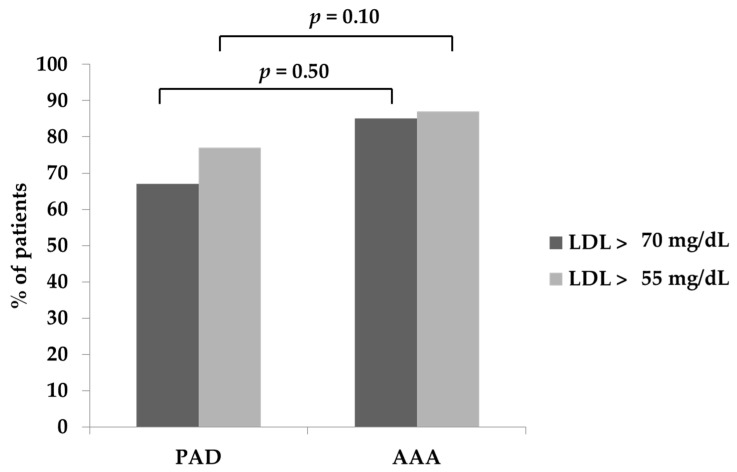
: It is well established that patients with peripheral artery disease (PAD) as well abdominal aortic aneurysm (AAA) have an increased cardiovascular (CV) mortality. Despite this higher risk, PAD and AAA patients are often suboptimality treated. This study assessed the CV profile of PAD and AAA patients, quantifying the survival benefits of target-based risk-factors modification even in light of the COVID-19 pandemic. : PAD and AAA patients admitted for any reason to the Vascular Unit from January 2019 to February 2020 were retrospectively analyzed. Biochemical and CV profiles as well as ongoing medical therapies were recorded. Benefits of CV risk-factors control were estimated using the SMART-REACH model. A follow-up visit during the year 2020 was scheduled. : A total of 669 patients were included. Of these, 190 showed AAA and 479 PAD at any stage. Only 54% of PAD and 41% of AAA patients were on lipid-lowering drugs with non-optimal low-density lipoprotein (LDL) levels for most of them. A better control of all modifiable CV risk-factors based on the current guidelines would offer an absolute risk reduction of the mean 10-year CV risk by 9% in PAD and 14% in AAA. Unfortunately, the follow-up visit was lost because of COVID-19 limitations. : Lipid profiles of PAD and AAA patients were far from guideline-based targets, and medical management was suboptimal. In our center, the COVID-19 pandemic impacted on the strict surveillance required in these very high-risk patients. The achievement of guideline-based therapeutic targets would definitively confer additional significant benefits in reducing the CV risk in these patients.
外周动脉疾病(PAD)患者以及腹主动脉瘤(AAA)患者的心血管(CV)死亡率升高,这一点已得到充分证实。尽管存在这种较高风险,但PAD和AAA患者的治疗往往并不理想。本研究评估了PAD和AAA患者的心血管状况,量化了基于靶点的风险因素调整所带来的生存益处,即使是在新冠疫情期间。
对2019年1月至2020年2月因任何原因入住血管科的PAD和AAA患者进行回顾性分析。记录生化和心血管状况以及正在进行的药物治疗。使用SMART-REACH模型评估心血管风险因素控制的益处。计划在2020年进行一次随访。
共纳入669例患者。其中,190例在任何阶段表现为AAA,479例表现为PAD。只有54%的PAD患者和41%的AAA患者服用降脂药物,且大多数患者的低密度脂蛋白(LDL)水平未达到理想状态。根据当前指南更好地控制所有可改变的心血管风险因素,将使PAD患者的平均10年心血管风险绝对降低9%,AAA患者降低14%。不幸的是,由于新冠疫情限制,随访未能进行。
PAD和AAA患者的血脂水平远未达到基于指南的目标,医疗管理也不理想。在我们中心,新冠疫情影响了对这些高危患者所需的严格监测。实现基于指南的治疗目标肯定会在降低这些患者的心血管风险方面带来额外的显著益处。