Institute of Computing, Fluminense Federal University, Niterói, Rio de Janeiro 24220-900, Brazil.
Department of Internal Medicine, Fluminense Federal University, Niterói, Rio de Janeiro 24033-900, Brazil.
Sensors (Basel). 2021 Jun 29;21(13):4459. doi: 10.3390/s21134459.
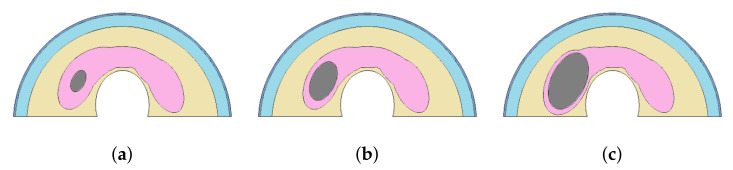
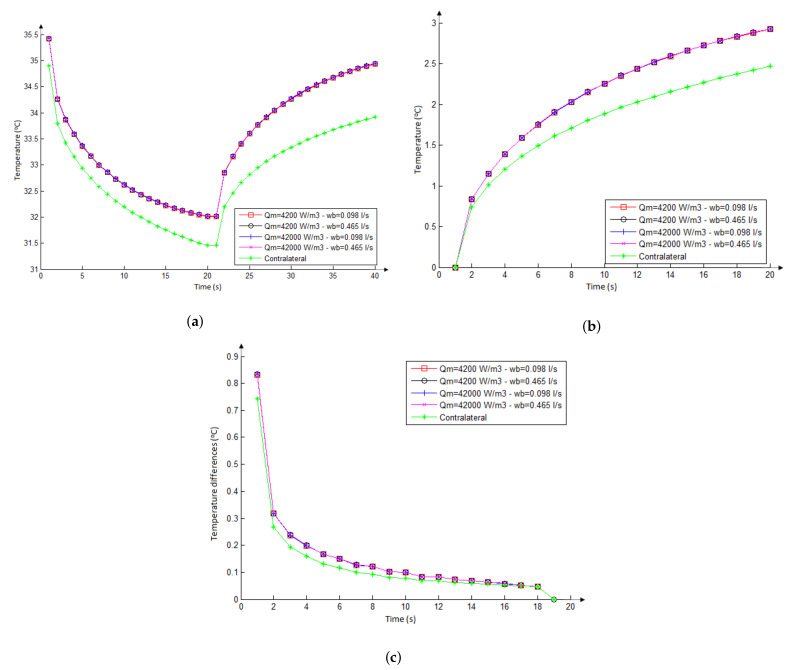
According to experts and medical literature, healthy thyroids and thyroids containing benign nodules tend to be less inflamed and less active than those with malignant nodules. It seems to be a consensus that malignant nodules have more blood veins and more blood circulation. This may be related to the maintenance of the nodule's heat at a higher level compared with neighboring tissues. If the internal heat modifies the skin radiation, then it could be detected by infrared sensors. The goal of this work is the investigation of the factors that allow this detection, and the possible relation with any pattern referent to nodule malignancy. We aim to consider a wide range of factors, so a great number of numerical simulations of the heat transfer in the region under analysis, based on the Finite Element method, are performed to study the influence of each nodule and patient characteristics on the infrared sensor acquisition. To do so, the protocol for infrared thyroid examination used in our university's hospital is simulated in the numerical study. This protocol presents two phases. In the first one, the body under observation is in steady state. In the second one, it is submitted to thermal stress (transient state). Both are simulated in order to verify if it is possible (by infrared sensors) to identify different behavior referent to malignant nodules. Moreover, when the simulation indicates possible important aspects, patients with and without similar characteristics are examined to confirm such influences. The results show that the tissues between skin and thyroid, as well as the nodule size, have an influence on superficial temperatures. Other thermal parameters of thyroid nodules show little influence on surface infrared emissions, for instance, those related to the vascularization of the nodule. All details of the physical parameters used in the simulations, characteristics of the real nodules and thermal examinations are publicly available, allowing these simulations to be compared with other types of heat transfer solutions and infrared examination protocols. Among the main contributions of this work, we highlight the simulation of the possible range of parameters, and definition of the simulation approach for mapping the used infrared protocol, promoting the investigation of a possible relation between the heat transfer process and the data obtained by infrared acquisitions.
根据专家和医学文献,健康的甲状腺和含有良性结节的甲状腺往往比恶性结节的炎症和活动程度低。似乎大家都认为恶性结节有更多的血管和更多的血液循环。这可能与结节的热量保持在比周围组织更高的水平有关。如果内部热量改变了皮肤辐射,那么它可能会被红外传感器检测到。这项工作的目的是研究允许这种检测的因素,以及与结节恶性相关的任何模式的可能关系。我们旨在考虑广泛的因素,因此,基于有限元方法,对该区域的传热进行了大量的数值模拟,以研究每个结节和患者特征对红外传感器采集的影响。为此,在数值研究中模拟了我们大学医院使用的甲状腺红外检查协议。该协议有两个阶段。在第一阶段,观察到的身体处于稳态。在第二阶段,它受到热应力(瞬态)的影响。这两个阶段都进行了模拟,以验证是否可以(通过红外传感器)识别出与恶性结节相关的不同行为。此外,当模拟表明存在可能的重要方面时,会检查具有类似特征的患者和不具有类似特征的患者,以确认这些影响。结果表明,皮肤和甲状腺之间的组织以及结节的大小对表面温度有影响。甲状腺结节的其他热参数对表面红外发射的影响很小,例如与结节血管化相关的参数。模拟中使用的物理参数的所有细节、实际结节的特征和热检查都是公开的,允许将这些模拟与其他类型的传热解决方案和红外检查协议进行比较。这项工作的主要贡献之一是模拟了可能的参数范围,并定义了模拟方法来映射所使用的红外协议,从而促进了传热过程与通过红外采集获得的数据之间的关系的研究。