
血管支架的结构设计:综述
Structural Design of Vascular Stents: A Review.
作者信息
Pan Chen, Han Yafeng, Lu Jiping
机构信息
School of Mechanical Engineering, Beijing Institute of Technology, Zhongguancun South Street No. 5, Haidian District, Beijing 100081, China.
Institute of Engineering Medicine, Beijing Institute of Technology, Zhongguancun South Street No. 5, Haidian District, Beijing 100081, China.
出版信息
Micromachines (Basel). 2021 Jun 29;12(7):770. doi: 10.3390/mi12070770.
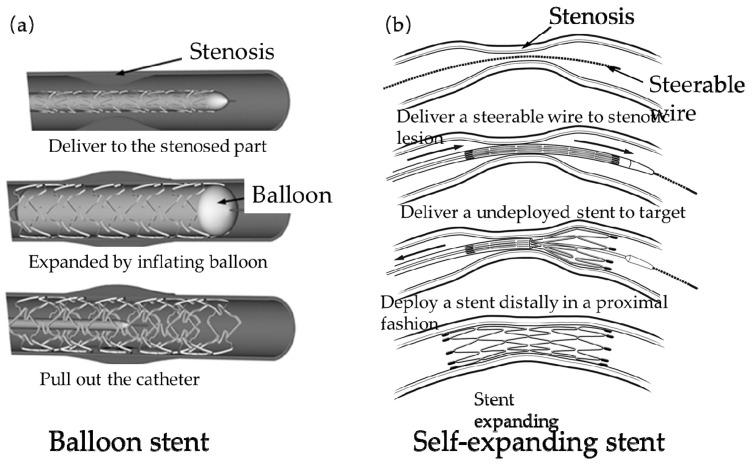
Percutaneous Coronary Intervention (PCI) is currently the most conventional and effective method for clinically treating cardiovascular diseases such as atherosclerosis. Stent implantation, as one of the ways of PCI in the treatment of coronary artery diseases, has become a hot spot in scientific research with more and more patients suffering from cardiovascular diseases. However, vascular stent implanted into vessels of patients often causes complications such as In-Stent Restenosis (ISR). The vascular stent is one of the sophisticated medical devices, a reasonable structure of stent can effectively reduce the complications. In this paper, we introduce the evolution, performance evaluation standards, delivery and deployment, and manufacturing methods of vascular stents. Based on a large number of literature pieces, this paper focuses on designing structures of vascular stents in terms of "bridge (or link)" type, representative volume unit (RVE)/representative unit cell (RUC), and patient-specific stent. Finally, this paper gives an outlook on the future development of designing vascular stents.
经皮冠状动脉介入治疗(PCI)是目前临床上治疗动脉粥样硬化等心血管疾病最常用且有效的方法。支架植入作为PCI治疗冠状动脉疾病的方式之一,随着越来越多的患者患有心血管疾病,已成为科研热点。然而,植入患者血管的血管支架常常会引发诸如支架内再狭窄(ISR)等并发症。血管支架是复杂的医疗器械之一,合理的支架结构可有效减少并发症。本文介绍了血管支架的发展历程、性能评估标准、输送与展开以及制造方法。基于大量文献,本文重点从“桥(或连接)”型、代表性体积单元(RVE)/代表性单元胞(RUC)以及个性化支架等方面对血管支架结构进行设计。最后,本文对血管支架设计的未来发展进行了展望。




 Zotero 插件