Wang Wei, Guo Hong, Wu Chongning, Yu Hui, Li Xiaokang, Chen Guangfeng, Tian Jichun, Deng Zhiying
State Key Laboratory of Crop Biology, Key Laboratory of Crop Biology of Shandong Province, Group of Wheat Quality and Molecular Breeding, College of Agronomy, Shandong Agricultural University, Tai'an, Shandong, 271000, P.R. China.
Handan Academy of Agricultural Sciences, Handan, Hebei, 056000, P.R. China.
BMC Plant Biol. 2021 Jul 1;21(1):311. doi: 10.1186/s12870-021-03105-3.
Mineral elements are important for maintaining good human health besides heavy metals. Mining genes that control mineral elements are paramount for improving their accumulation in the wheat grain. Although previous studies have reported some loci for beneficial trace elements, they have mainly focused on Zn and Fe content. However, little information is available regarding the genetic loci differences in dissecting synchronous accumulation of multiple mineral elements in wheat grains, including beneficial and heavy elements. Therefore, a genome-wide association study (GWAS) was conducted on 205 wheat accessions with 24,355 single nucleotide polymorphisms (SNPs) to identify important loci and candidate genes for controlling Ca, Fe, Zn, Se, Cu, Mn, Cd, As, and Pb accumulation in wheat grains.
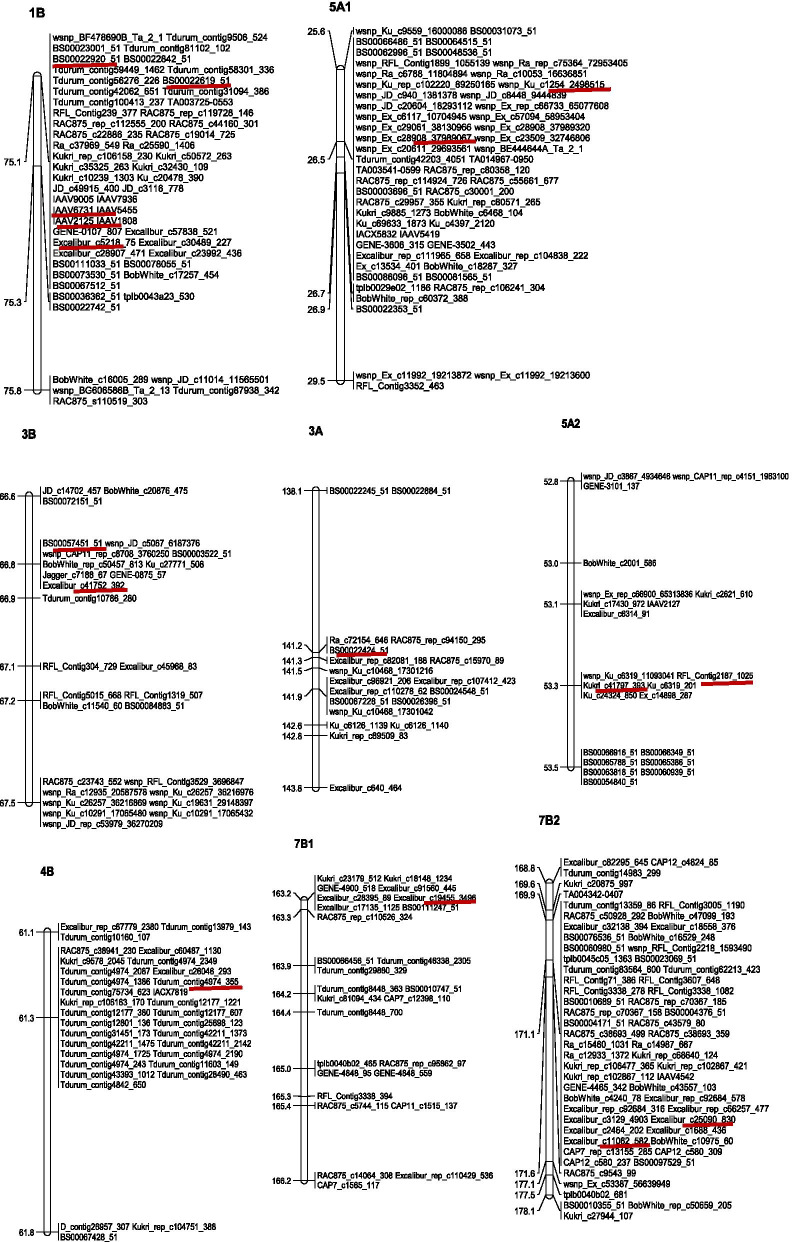
A total of 101 marker-trait associations (MTAs) (P < 10) loci affecting the content of nine mineral elements was identified on chromosomes 1B, 1D, 2A, 2B, 3A, 3B, 3D, 4A, 4B, 5A, 5B, 5D, 6B, 7A, 7B, and 7D. Among these, 17 major MTAs loci for the nine mineral elements were located, and four MTAs loci (P < 10) were found on chromosomes 1B, 6B, 7B, and 7D. Eight multi-effect MTAs loci were detected that are responsible for the control of more than one trait, mainly distributed on chromosomes 3B, 7B, and 5A. Furthermore, sixteen candidate genes controlling Ca, Fe, Zn, Se, Cd, and Pb were predicted, whose functions were primarily related to ion binding, including metals, Fe, Ca, Cu, Mg, and Zn, ATP binding, ATPase activity, DNA binding, RNA binding, and protein kinase activity.
Our study indicated the existence of gene interactions among mineral elements based on multi-effect MTAs loci and candidate genes. Meanwhile this study provided new insights into the genetic control of mineral element concentrations, and the important loci and genes identified may contribute to the rapid development of beneficial mineral elements and a reduced content of harmful heavy metals in wheat grain.
除重金属外,矿物质元素对维持人体健康也很重要。挖掘控制矿物质元素的基因对于提高其在小麦籽粒中的积累量至关重要。尽管先前的研究已经报道了一些有益微量元素的位点,但主要集中在锌和铁的含量上。然而,关于剖析小麦籽粒中多种矿物质元素(包括有益元素和重金属元素)同步积累的遗传位点差异的信息却很少。因此,对205份小麦种质进行了全基因组关联研究(GWAS),利用24355个单核苷酸多态性(SNP)来鉴定控制小麦籽粒中钙、铁、锌、硒、铜、锰、镉、砷和铅积累的重要位点和候选基因。
在1B、1D、2A、2B、3A、3B、3D、4A、4B、5A、5B、5D、6B、7A、7B和7D染色体上共鉴定出101个影响9种矿物质元素含量的标记-性状关联(MTA)(P < 10)位点。其中,定位了9种矿物质元素的17个主要MTA位点,在1B、6B、7B和7D染色体上发现了4个MTA位点(P < 10)。检测到8个多效MTA位点,负责控制多个性状,主要分布在3B、7B和5A染色体上。此外,预测了16个控制钙、铁、锌、硒、镉和铅的候选基因,其功能主要与离子结合有关,包括金属、铁、钙、铜、镁和锌,ATP结合、ATP酶活性、DNA结合、RNA结合和蛋白激酶活性。
我们的研究表明基于多效MTA位点和候选基因存在矿物质元素之间的基因相互作用。同时,本研究为矿物质元素浓度的遗传控制提供了新的见解,所鉴定的重要位点和基因可能有助于小麦籽粒中有益矿物质元素的快速发育和有害重金属含量的降低。