Department of Forensic and Neurodevelopmental Sciences, Institute of Psychiatry, Psychology and Neuroscience, King's College London, 16 De Crespigny Park, London, SE5 8AF, UK.
Department of Cognitive Neuroscience, Donders Institute for Brain, Cognition and Behaviour, Radboud University Nijmegen Medical Centre, Nijmegen, The Netherlands.
Mol Autism. 2021 Jul 1;12(1):49. doi: 10.1186/s13229-021-00454-6.
Autism spectrum disorder (ASD) has a high cost to affected individuals and society, but treatments for core symptoms are lacking. To expand intervention options, it is crucial to gain a better understanding of potential treatment targets, and their engagement, in the brain. For instance, the striatum (caudate, putamen, and nucleus accumbens) plays a central role during development and its (atypical) functional connectivity (FC) may contribute to multiple ASD symptoms. We have previously shown, in the adult autistic and neurotypical brain, the non-intoxicating cannabinoid cannabidivarin (CBDV) alters the balance of striatal 'excitatory-inhibitory' metabolites, which help regulate FC, but the effects of CBDV on (atypical) striatal FC are unknown.
To examine this in a small pilot study, we acquired resting state functional magnetic resonance imaging data from 28 men (15 neurotypicals, 13 ASD) on two occasions in a repeated-measures, double-blind, placebo-controlled study. We then used a seed-based approach to (1) compare striatal FC between groups and (2) examine the effect of pharmacological probing (600 mg CBDV/matched placebo) on atypical striatal FC in ASD. Visits were separated by at least 13 days to allow for drug washout.
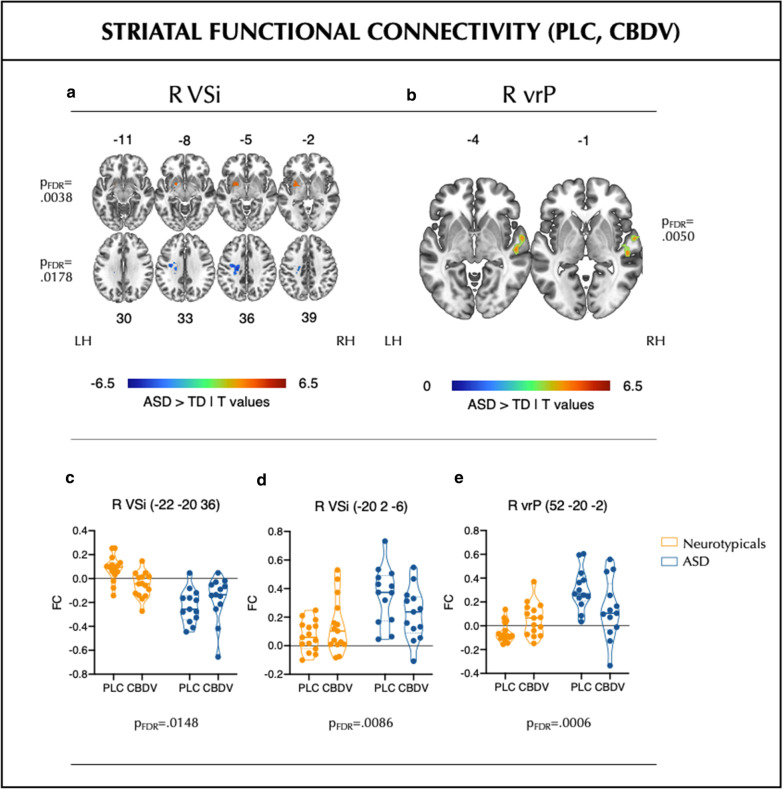
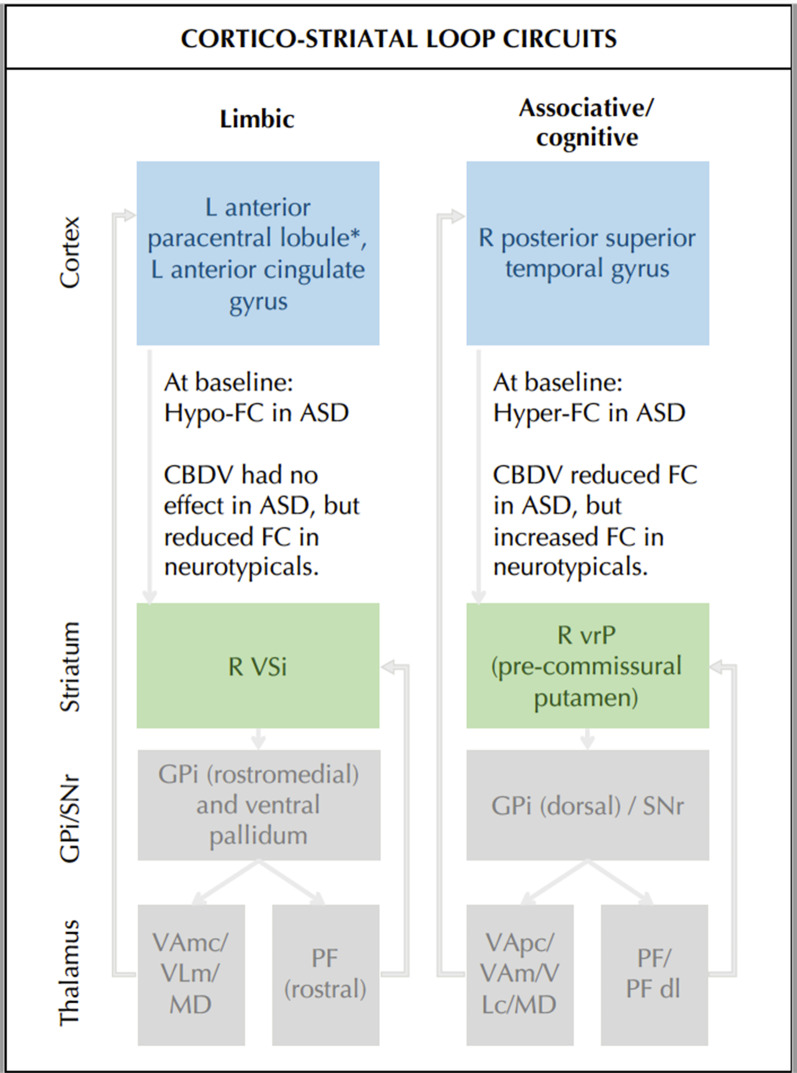
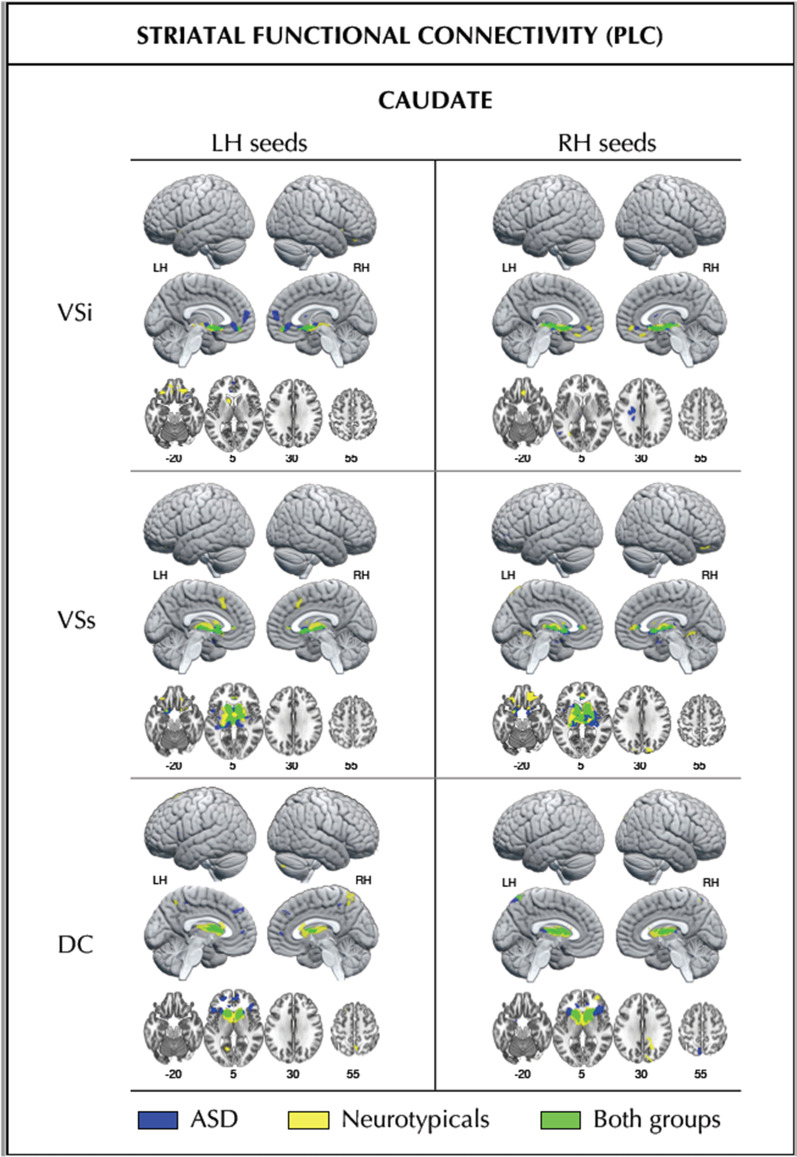
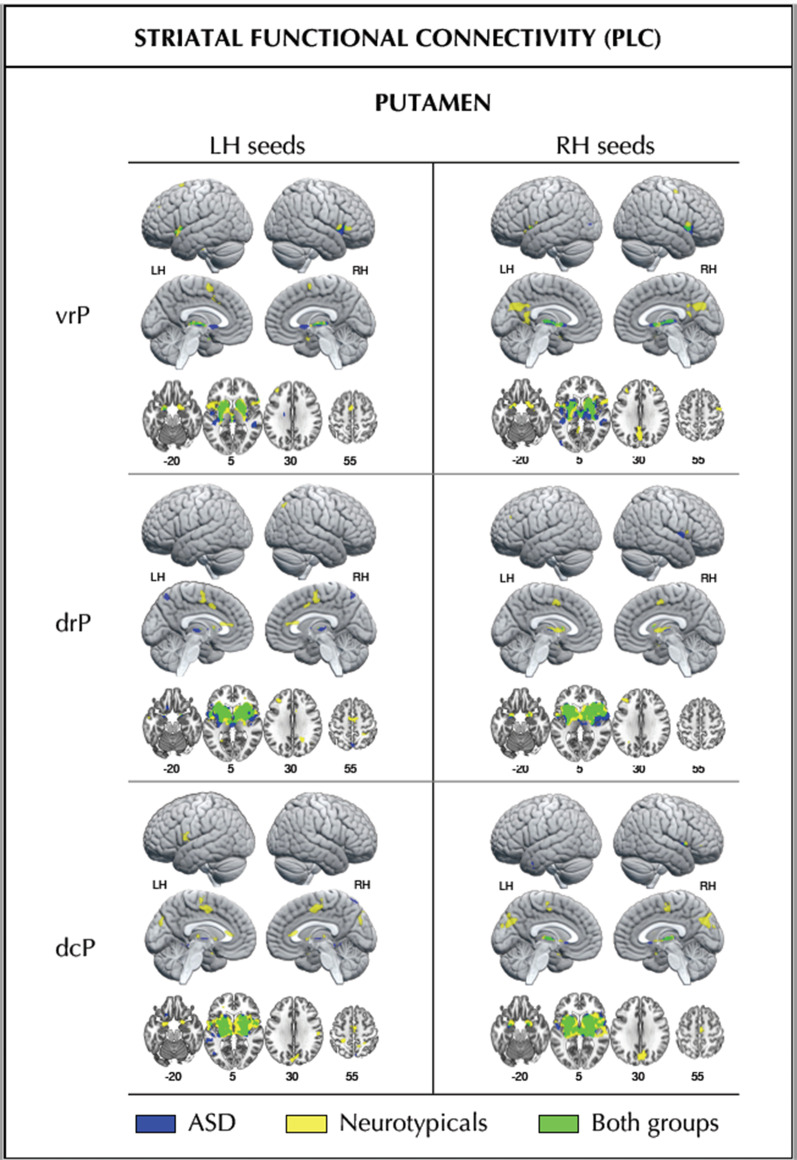
Compared to the neurotypicals, ASD individuals had lower FC between the ventral striatum and frontal and pericentral regions (which have been associated with emotion, motor, and vision processing). Further, they had higher intra-striatal FC and higher putamenal FC with temporal regions involved in speech and language. In ASD, CBDV reduced hyperconnectivity to the neurotypical level.
Our findings should be considered in light of several methodological aspects, in particular our participant group (restricted to male adults), which limits the generalizability of our findings to the wider and heterogeneous ASD population.
In conclusion, here we show atypical striatal FC with regions commonly associated with ASD symptoms. We further provide preliminary proof of concept that, in the adult autistic brain, acute CBDV administration can modulate atypical striatal circuitry towards neurotypical function. Future studies are required to determine whether modulation of striatal FC is associated with a change in ASD symptoms.
clinicaltrials.gov, Identifier: NCT03537950. Registered May 25th, 2018-Retrospectively registered, https://clinicaltrials.gov/ct2/show/NCT03537950?term=NCT03537950&draw=2&rank=1 .
自闭症谱系障碍(ASD)给患者和社会带来了高昂的成本,但核心症状的治疗方法却很缺乏。为了扩大干预选择,了解大脑中潜在的治疗靶点及其参与情况至关重要。例如,纹状体(尾状核、壳核和伏隔核)在发育过程中起着核心作用,其(非典型)功能连接(FC)可能导致多种 ASD 症状。我们之前在成年自闭症和神经典型大脑中发现,非成瘾性大麻素大麻二酚(CBDV)改变了纹状体“兴奋-抑制”代谢物的平衡,这有助于调节 FC,但 CBDV 对(非典型)纹状体 FC 的影响尚不清楚。
为了在一项小型试点研究中对此进行研究,我们在一项重复测量、双盲、安慰剂对照的研究中,在两次就诊时从 28 名男性(15 名神经典型,13 名 ASD)中获取静息态功能磁共振成像数据。然后,我们使用基于种子的方法(1)比较组间纹状体 FC,(2)检查药物探查(600mg CBDV/匹配安慰剂)对 ASD 中异常纹状体 FC 的影响。两次就诊之间至少间隔 13 天,以允许药物清除。
与神经典型组相比,ASD 个体的腹侧纹状体与额叶和中央旁区域之间的 FC 较低(这些区域与情绪、运动和视觉处理有关)。此外,他们的纹状体内部 FC 较高,与涉及言语和语言的颞叶区域的壳核 FC 较高。在 ASD 中,CBDV 可使过度连接降低至神经典型水平。
应根据几个方法学方面来考虑我们的研究结果,特别是我们的参与者群体(仅限于成年男性),这限制了我们的研究结果在更广泛和异质的 ASD 人群中的普遍性。
总之,在这里我们显示了与 ASD 症状通常相关的异常纹状体 FC。我们进一步提供了初步的概念证明,即急性 CBDV 给药可调节成人自闭症大脑中异常纹状体回路,使其向神经典型功能转变。需要进一步的研究来确定纹状体 FC 的调节是否与 ASD 症状的变化相关。
clinicaltrials.gov,标识符:NCT03537950。2018 年 5 月 25 日注册-回顾性注册,https://clinicaltrials.gov/ct2/show/NCT03537950?term=NCT03537950&draw=2&rank=1。