Center on Alcohol, Substance use, and Addictions, 2650 Yale Blvd SE, Albuquerque, NM 87106, United States of America.
Department of Psychology, East Tennessee State University, 420 Rogers Stout Hall, P.O. Box 70649, Johnson City, TN 37614, United States of America.
J Subst Abuse Treat. 2022 Feb;133:108556. doi: 10.1016/j.jsat.2021.108556. Epub 2021 Jun 24.
Treatment providers have applied contingency management (CM) treatment, an intervention that often rewards individuals for drug abstinence (i.e., ABS CM), to treatment engagement as well. However, we know little about the magnitude of treatment effects when providers target attendance behaviors (i.e., ATT CM).
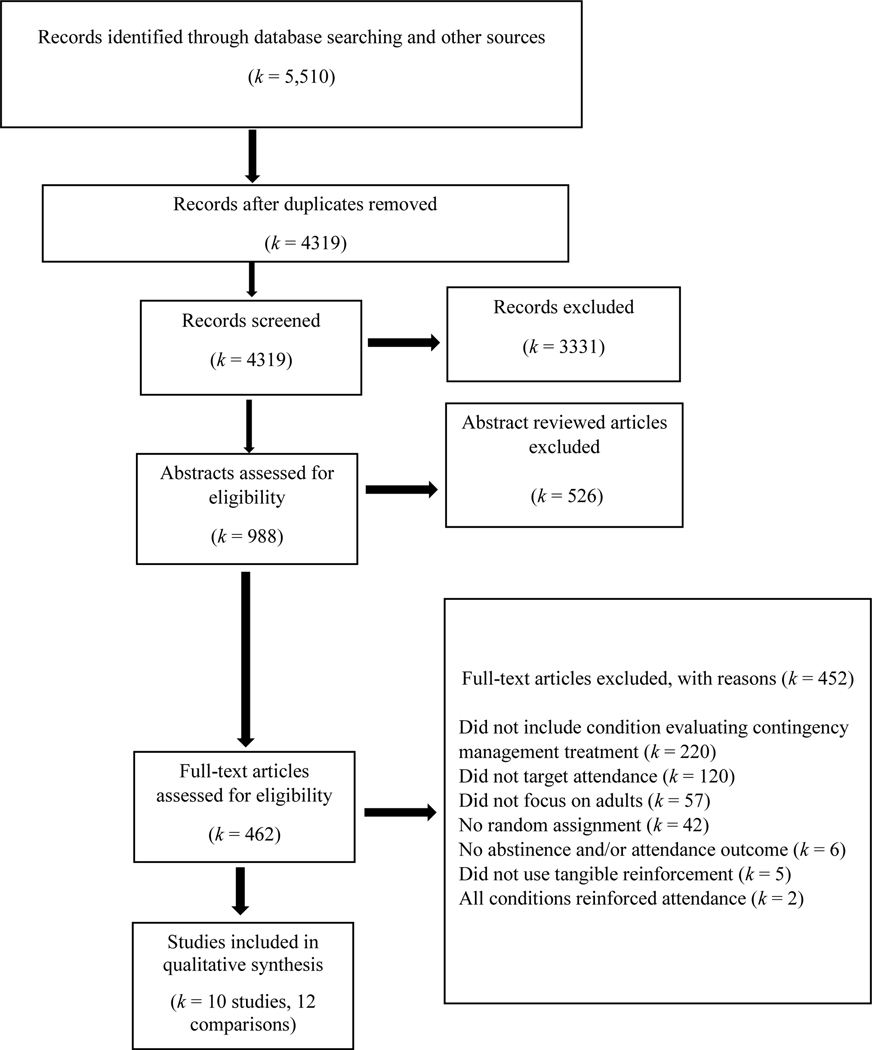
This study conducted a systematic search to identify studies that included ATT CM, either in isolation or in combination with ABS CM. The study used meta-analysis to estimate the effect size of ATT CM and ABS CM + ATT CM on treatment attendance and drug abstinence. We identified a total of 10 studies including 12 CM treatments (6 ATT CM and 6 ABS CM + ATT CM) with 1841 participants.
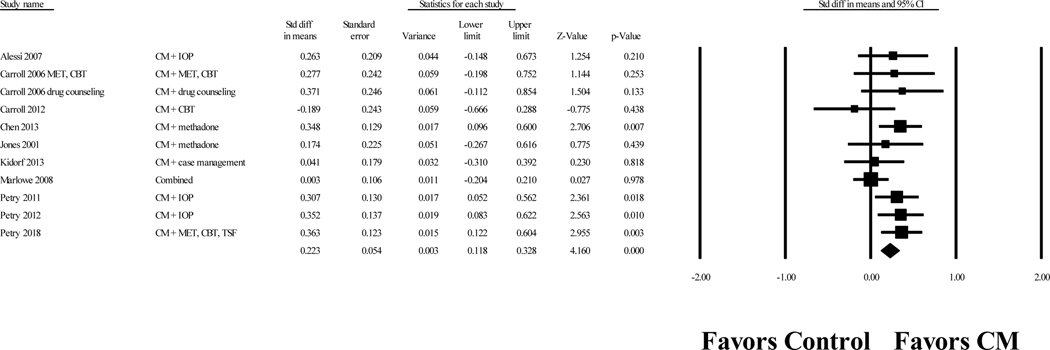
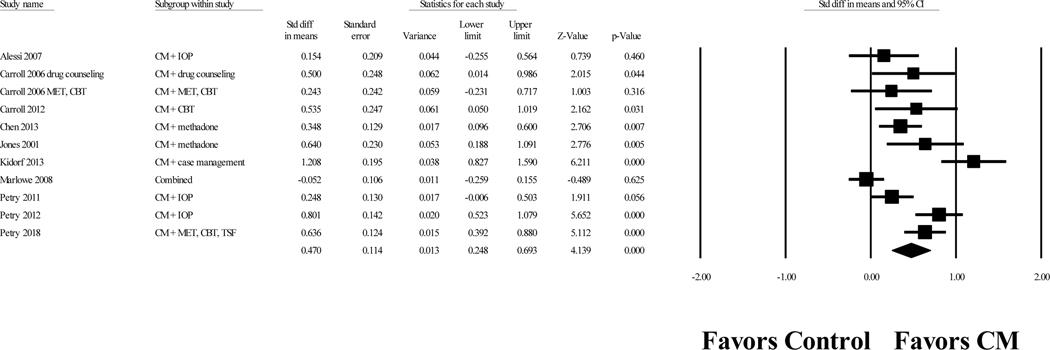
Results indicated a moderate effect (d = 0.47, 95% confidence interval (CI) [0.25, 0.69]) of ATT CM on attendance relative to non-reward active comparison conditions. Frequency of rewards was significantly associated with larger effect sizes. Results also indicated a small effect (d = 0.22, 95% CI [0.12, 0.33]) of ATT CM on abstinence outcomes relative to nonreward comparisons, p < 0.001. The study found no significant differences in attendance or abstinence between ATT CM and ABS CM + ATT CM (p's > 0.05).
Overall, the results supported ATT CM for increasing treatment engagement, with smaller effects on abstinence. Effects on abstinence were smaller than those observed in prior meta-analyses focused on ABS CM. No significant differences existed in attendance or abstinence outcomes between ATT CM and ABS + ATT CM. However, future studies are needed to experimentally compare ABS CM + ATT CM to ABS CM, and ATT CM to determine additive effects. Clinics implementing CM should consider the differential effects between ATT CM and ABS CM when selecting target behavior(s).
治疗提供者已经将条件性管理(CM)治疗应用于治疗中,这种干预措施通常会奖励个人的戒毒(即 ABS CM),也适用于治疗参与。然而,当提供者针对出勤率行为(即 ATT CM)时,我们对治疗效果的程度知之甚少。
本研究进行了系统搜索,以确定包括 ATT CM 的研究,无论是单独使用还是与 ABS CM 联合使用。该研究使用荟萃分析来估计 ATT CM 和 ABS CM + ATT CM 对治疗出勤率和药物戒除的效果大小。我们共确定了 10 项研究,包括 12 项 CM 治疗(6 项 ATT CM 和 6 项 ABS CM + ATT CM),共 1841 名参与者。
结果表明,与非奖励主动比较条件相比,ATT CM 对出勤率的影响具有中等效应(d=0.47,95%置信区间(CI)[0.25,0.69])。奖励频率与更大的效果大小显著相关。结果还表明,与非奖励比较相比,ATT CM 对戒断结果的影响较小(d=0.22,95%CI[0.12,0.33]),p<0.001。研究发现 ATT CM 与 ABS CM + ATT CM 之间在出勤率或戒断方面没有显著差异(p>0.05)。
总体而言,结果支持 ATT CM 提高治疗参与度,对戒断的影响较小。与专注于 ABS CM 的先前荟萃分析相比,戒断效果较小。ATT CM 与 ABS + ATT CM 之间在出勤率或戒断结果方面没有显著差异。然而,需要进一步的研究来在 ABS CM + ATT CM 与 ABS CM 之间以及 ATT CM 与 ABS CM 之间进行实验比较,以确定附加效果。实施 CM 的诊所应在选择目标行为时考虑 ATT CM 和 ABS CM 之间的差异影响。