Air Quality Processes Research Section, Environment and Climate Change Canada, Toronto, Ontario M3H 5T4. Canada.
Queensland Alliance for Environmental Health Sciences (QAEHS), The University of Queensland, Woolloongabba, Queensland 4102, Australia.
Environ Sci Technol. 2021 Jul 20;55(14):9479-9488. doi: 10.1021/acs.est.1c01705. Epub 2021 Jul 2.
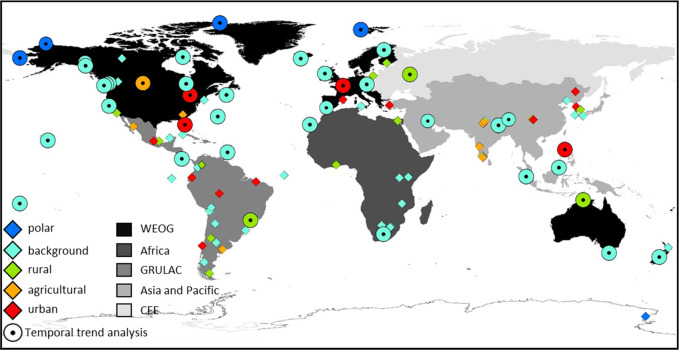
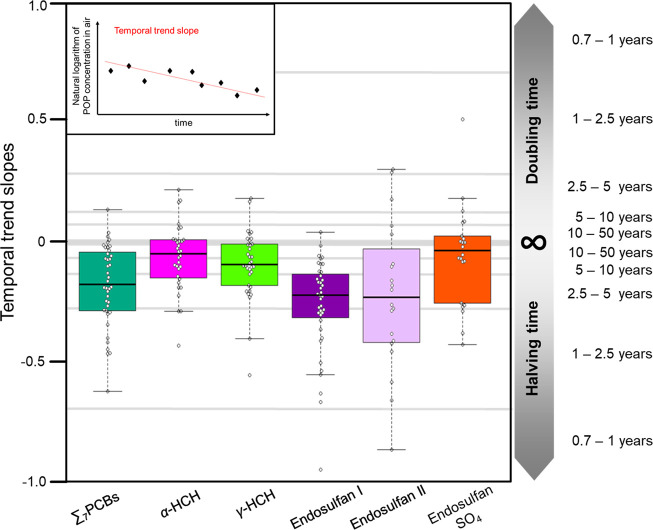
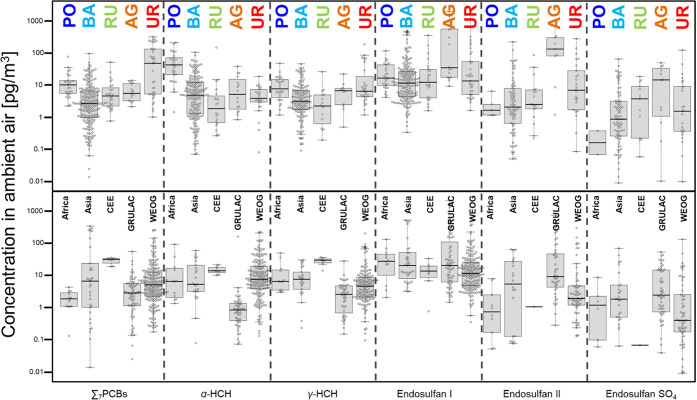
The Global Atmospheric Passive Sampling (GAPS) network, initiated in 2005 across 55 global sites, supports the global monitoring plan (GMP) of the Stockholm Convention on Persistent Organic Pollutants (POPs) by providing information on POP concentrations in air on a global scale. These data inform assessments of the long-range transport potential of POPs and the effectiveness evaluation of chemical regulation efforts, by observing changes in concentrations over time. Currently, measurements spanning 5-10 sampling years are available for 40 sites from the GAPS Network. This study was the first time that POP concentrations in air were reported on a global scale for an extended time period and the first to evaluate worldwide trends with an internally consistent sample set. For consistency between sampling years, site- and sample specific sampling rates were calculated with a new, public online model, which accounts for the effects of wind speed variability. Concentrations for legacy POPs in air between 2005 and 2014 show different trends for different organochlorine pesticides (OCPs) and polychlorinated biphenyls (PCBs). The POPs discussed in this study were chosen due to being the most frequently detected, with detection at the majority of sites. PCB, endosulfan, and hexachlorocyclohexane (HCH) concentrations in air are decreasing at most sites. The global trends reflect global sources and recycling of HCH, ongoing emissions from old stockpiles for PCBs, and recent use restrictions for endosulfan. These chlorinated OCPs continue to present exposure threat to humans and ecosystems worldwide. Concentrations of other OCPs, such as chlordanes, heptachlor and dieldrin, are steady and/or declining slowly at the majority of sites, reflecting a transition from primary to secondary sources (i.e., re-emission from reservoirs where these POPs have accumulated historically) which now control ambient air burdens.
全球大气被动采样(GAPS)网络于 2005 年在全球 55 个地点启动,通过提供大气中持久性有机污染物(POPs)浓度的全球范围信息,为斯德哥尔摩持久性有机污染物公约(POPs)的全球监测计划(GMP)提供支持。这些数据通过观察浓度随时间的变化,为 POPs 的长距离迁移潜力评估和化学品监管努力的效果评估提供信息。目前,GAPS 网络的 40 个站点提供了 5-10 年采样的测量数据。本研究首次在全球范围内长时间报道了大气中 POPs 的浓度,也是首次利用一致的样本集评估全球趋势。为了使各采样年份之间具有一致性,使用一个新的、公开的在线模型计算了站点和样本特定的采样率,该模型考虑了风速变化的影响。2005 年至 2014 年大气中持久性有机污染物的浓度显示,不同的有机氯农药(OCPs)和多氯联苯(PCBs)表现出不同的趋势。本研究中讨论的 POPs 是因为它们是最常被检测到的,在大多数站点都有检测到。大多数站点的空气 PCBs、硫丹和六氯环己烷(HCH)浓度正在下降。全球趋势反映了 HCH 的全球来源和再循环、旧库存 PCBs 的持续排放以及硫丹的最近使用限制。这些氯化 OCPs 继续对全球人类和生态系统构成暴露威胁。其他 OCPs,如氯丹、七氯和狄氏剂的浓度在大多数站点保持稳定或缓慢下降,反映了从主要来源向次要来源的转变(即,从这些 POPs 历史上积累的储存库中重新排放),这些来源现在控制着环境空气负担。