Institute for Sport and Health, University College Dublin, Dublin, Ireland.
Genuity Science, Dublin, Ireland.
Geroscience. 2021 Oct;43(5):2533-2546. doi: 10.1007/s11357-021-00410-5. Epub 2021 Jul 2.
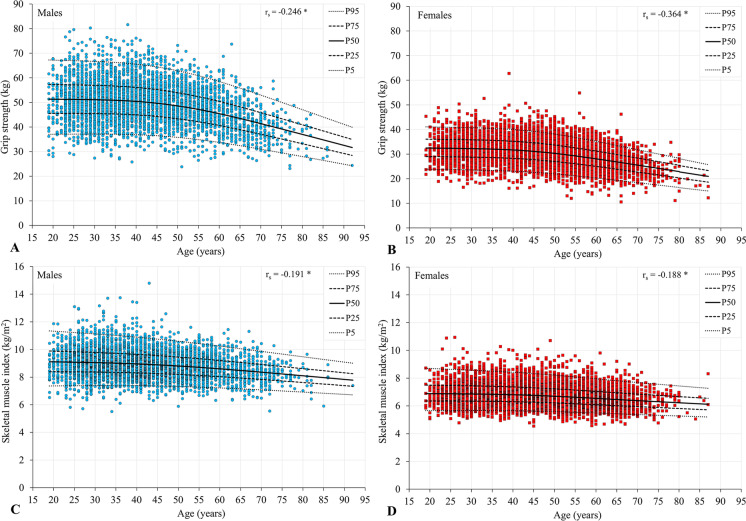
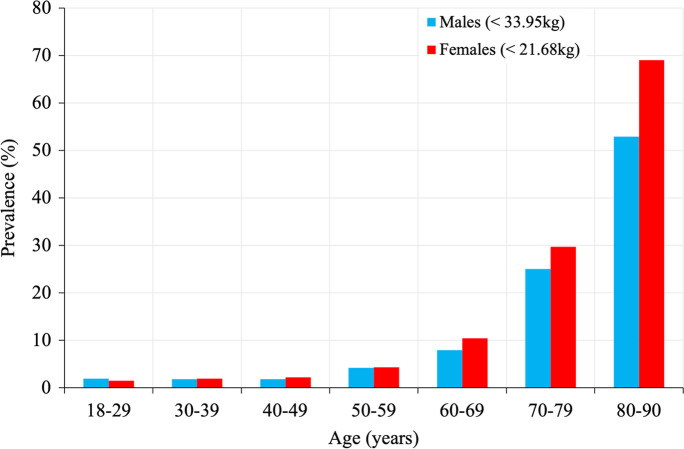
Weak grip strength is a strong predictor of multiple adverse health outcomes and an integral diagnostic component of sarcopenia. However, the limited availability of normative data for certain populations impedes the interpretation of grip performance across adulthood. This study aimed to establish normative data and low grip strength thresholds in a large adult population, and to examine associations between grip strength and clinically relevant health variables. A total of 9431 adults aged between 18 and 92 years participated in this study (mean age: 44.8 ± 13.4 years; 57% females). Grip strength, body composition, and cardiorespiratory (CR) fitness were assessed using hand dynamometry, dual-energy x-ray absorptiometry and physical work capacity tests, respectively. Low grip strength was established according to criteria of the European Working Group on Sarcopenia in Older People. Normative data and t-scores, stratified by sex and age groups, are presented. Grip performance was associated with lean mass, skeletal muscle index (SMI), fat mass, CR fitness, bone mineral density (BMD), android/gynoid ratio, disease prevalence and physical activity levels (all p < 0.001) after controlling for multiple potential confounders. Individuals with weak grip strength had lower lean mass, SMI, CR fitness (all p < 0.001) and BMD (p = 0.001), and higher disease prevalence (p < 0.001), compared to healthy controls, although sex-specific differences were observed. Grip strength has practical screening utility across a range of health domains. The normative data and grip strength thresholds established in this study can guide the clinical interpretation of grip performance and facilitate timely therapeutic strategies targeting sarcopenia.
握力弱是多种健康不良后果的强有力预测指标,也是肌少症诊断的一个重要组成部分。然而,某些人群的握力正常值数据有限,这妨碍了对成年期整个阶段的握力表现进行解读。本研究旨在为大量成年人群建立握力正常值数据和低握力阈值,并探讨握力与临床相关健康变量之间的关联。共有 9431 名年龄在 18 至 92 岁之间的成年人(平均年龄:44.8±13.4 岁;57%为女性)参与了这项研究。使用手持测力计评估握力,使用双能 X 射线吸收法和物理工作能力测试分别评估身体成分和心肺(CR)功能。根据欧洲老年人肌少症工作组的标准确定低握力。按性别和年龄组列出了正常值数据和 t 分数。在控制了多个潜在混杂因素后,握力表现与瘦体重、骨骼肌指数(SMI)、体脂量、CR 功能、骨密度(BMD)、安卓/臀围比、疾病患病率和身体活动水平相关(所有 p<0.001)。与健康对照组相比,握力弱的个体瘦体重、SMI、CR 功能(均 p<0.001)和 BMD(p=0.001)较低,而疾病患病率较高(p<0.001),尽管存在性别差异。握力在一系列健康领域具有实用的筛查效用。本研究中建立的正常值数据和握力阈值可以指导握力表现的临床解读,并有助于针对肌少症及时制定治疗策略。