Faculty of Health Sciences, University of Castilla-La Mancha, 45600, Talavera de la Reina, Toledo, Spain.
Economic Analysis and Finance Department, Faculty of Social Sciences, University of Castilla-La Mancha, Avda. Real Fábrica de Seda S/N, 45600, Talavera de la Reina, Toledo, Spain.
Orphanet J Rare Dis. 2021 Jul 2;16(1):294. doi: 10.1186/s13023-021-01883-5.
Tenosynovial Giant-Cell Tumour (TGCT) is a benign clonal neoplastic proliferation arising from the synovium, causing a variety of symptoms and often requiring repetitive surgery. This study aims to define the economic burden-from a societal perspective-associated with TGCT patients and their health-related quality of life (HRQOL) in six European countries.
This article analyses data from a multinational, multicentre, prospective observational registry, the TGCT Observational Platform Project (TOPP), involving hospitals and tertiary sarcoma centres from six European countries (Austria, France, Germany, Italy, the Netherlands, and Spain). It includes information on TGCT patients' health-related quality of life and healthcare and non-healthcare resources used at baseline (the 12-month period prior to the patients entering the registry) and after 12 months of follow-up.
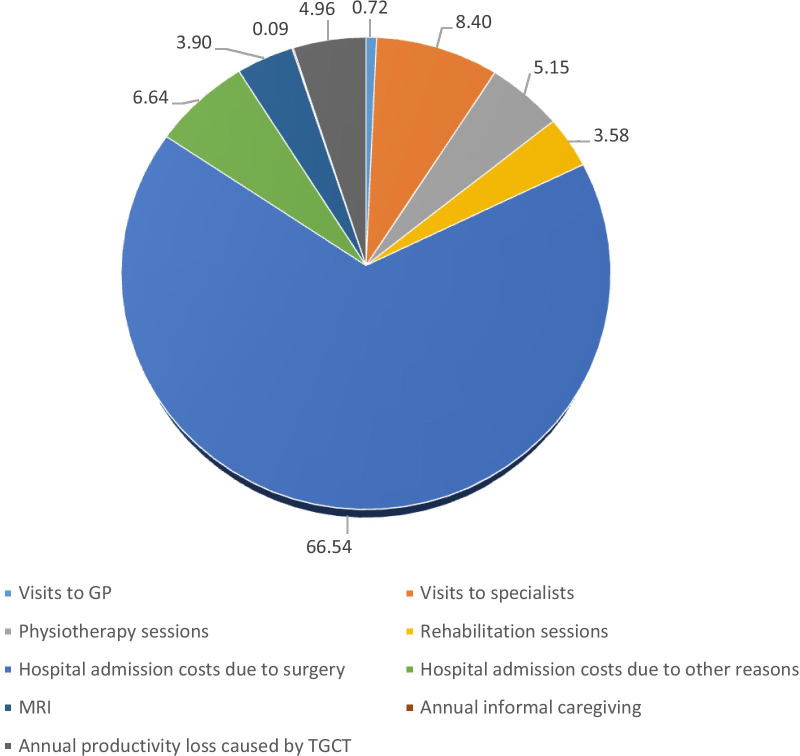
146 TGCT patients enrolled for the study, of which 137 fulfilled the inclusion criteria. Their mean age was 44.5 years, and 62% were female. The annual average total costs associated with TGCT were €4866 at baseline and €5160 at the 12-month follow-up visit. The annual average healthcare costs associated with TGCT were €4620 at baseline, of which 67% and 18% corresponded to surgery and medical visits, respectively. At the 12-month follow-up, the mean healthcare costs amounted to €5094, with surgery representing 70% of total costs. Loss of productivity represented, on average, 5% of the total cost at baseline and 1.3% at follow-up. The most-affected HRQOL dimensions, measured with the EQ-5D-5L instrument, were pain or discomfort, mobility, and the performance of usual activities, both at baseline and at the follow-up visit. Regarding HRQOL, patients declared a mean index score of 0.75 at baseline and 0.76 at the 12-month follow-up.
The results suggest that TGCT places a heavy burden on its sufferers, which increases after one year of follow-up, mainly due to the healthcare resources required-in particular, surgical procedures. As a result, this condition has a high economic impact on healthcare budgets, while the HRQOL of TGCT patients substantially deteriorates over time.
腱鞘巨细胞瘤(TGCT)是一种源于滑膜的良性克隆性肿瘤增生,引起多种症状,常需要重复手术。本研究旨在从社会角度定义 TGCT 患者的经济负担及其在六个欧洲国家的健康相关生活质量(HRQOL)。
本文分析了来自一个多国家、多中心、前瞻性观察性登记处——TGCT 观察平台项目(TOPP)的数据,该登记处涉及六个欧洲国家(奥地利、法国、德国、意大利、荷兰和西班牙)的医院和三级肉瘤中心。它包含了 TGCT 患者的健康相关生活质量以及基线时(患者进入登记处前的 12 个月)和 12 个月随访后使用的医疗保健和非医疗保健资源的信息。
146 名 TGCT 患者参与了该研究,其中 137 名符合纳入标准。他们的平均年龄为 44.5 岁,62%为女性。与 TGCT 相关的年平均总费用在基线时为 4866 欧元,在 12 个月随访时为 5160 欧元。与 TGCT 相关的年平均医疗保健费用在基线时为 4620 欧元,其中 67%和 18%分别对应于手术和医疗就诊。在 12 个月的随访中,平均医疗保健费用为 5094 欧元,手术占总费用的 70%。生产力损失平均占基线时总费用的 5%,随访时占 1.3%。受影响最严重的 HRQOL 维度,用 EQ-5D-5L 工具测量,在基线和随访时均为疼痛或不适、移动性和日常活动能力。关于 HRQOL,患者在基线时报告平均指数评分为 0.75,在 12 个月随访时为 0.76。
结果表明,TGCT 给患者带来了沉重的负担,在随访一年后增加,主要是由于医疗保健资源的需求,特别是手术程序。因此,这种情况对医疗保健预算有很大的经济影响,而随着时间的推移,TGCT 患者的 HRQOL 会大幅下降。