Paediatric Critical Care Research Group, Child Health Research Centre, The University of Queensland, 62 Graham Street, South Brisbane, QLD, 4101, Australia.
Paediatric Intensive Care Unit, Queensland Children's Hospital, South Brisbane, Australia.
Trials. 2021 Jul 3;22(1):427. doi: 10.1186/s13063-021-05376-5.
Intravenous fluid therapy represents the most common intervention critically ill patients are exposed to. Hyperchloremia and metabolic acidosis associated with 0.9% sodium chloride have been observed to lead to worse outcomes, including mortality. Balanced solutions, such as Plasma-Lyte 148 and Compound Sodium Lactate, represent potential alternatives but the evidence on optimal fluid choices in critically ill children remains scarce. This study aims to demonstrate whether balanced solutions, when used as intravenous fluid therapy, are able to reduce the incidence of a rise in serum chloride level compared to 0.9% sodium chloride in critically ill children.
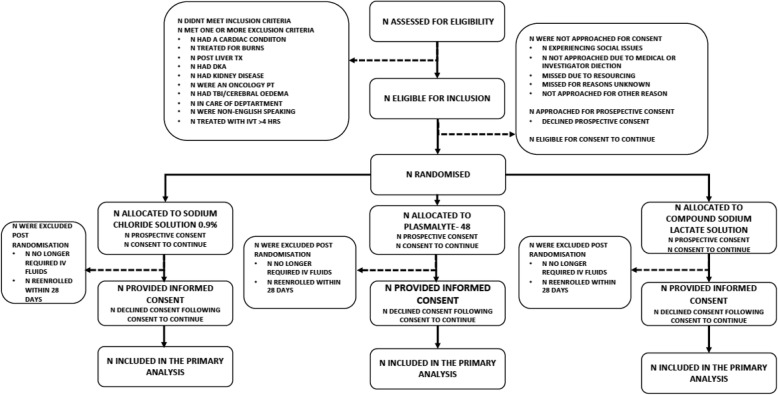
This is a single-centre, open-label randomized controlled trial with parallel 1:1:1 assignment into three groups: 0.9% sodium chloride, Plasma-Lyte 148, and Compound Sodium Lactate solutions for intravenous fluid therapy. The intervention includes both maintenance and bolus fluid therapy. Children aged < 16 years admitted to intensive care and receiving intravenous fluid therapy during the first 4 h of admission are eligible. The primary outcome measure is a ≥ 5mmol/L increase in serum chloride level within 48 h post-randomization. The enrolment target is 480 patients. The main analyses will be intention-to-treat.
This study tests three types of intravenous fluid therapy in order to compare the risk of hyperchloremia associated with normal saline versus balanced solutions. This pragmatic study is thereby assessing the most common intervention in paediatric critical care. This is a single-centre open-label study with no blinding at the level of delivery of the intervention. Certain paediatric intensive care unit (PICU) patient groups such as those admitted with a cardiac condition or following a traumatic brain injury are excluded from this study.
The study has received ethical approval (HREC/19/QCHQ/53177: 06/06/2019). It is registered in the Australian New Zealand Clinical Trials Registry ( ACTRN12619001244190 ) from 9th September 2019. Recruitment commenced on 12th November 2019. The primary results manuscript will be published in a peer-reviewed journal.
静脉输液治疗是危重症患者最常见的干预措施。已观察到 0.9%氯化钠相关的高氯血症和代谢性酸中毒会导致更差的结局,包括死亡率。平衡溶液,如 Plasma-Lyte 148 和复方乳酸钠,代表潜在的替代方案,但在危重症儿童中最佳液体选择的证据仍然很少。本研究旨在证明在危重症儿童中,与 0.9%氯化钠相比,使用平衡溶液作为静脉输液治疗是否能够降低血清氯水平升高的发生率。
这是一项单中心、开放标签、平行 1:1:1 随机对照试验,分为三组:0.9%氯化钠、Plasma-Lyte 148 和复方乳酸钠溶液用于静脉输液治疗。干预措施包括维持和冲击输液治疗。年龄<16 岁、入 ICU 后 4 小时内接受静脉输液治疗的患儿符合入组条件。主要结局指标是随机分组后 48 小时内血清氯水平升高≥5mmol/L。目标入组人数为 480 例。主要分析将采用意向治疗。
本研究比较了三种静脉输液治疗方法,以比较正常生理盐水与平衡溶液相关的高氯血症风险。这项实用研究评估了儿科重症监护中最常见的干预措施。这是一项单中心开放标签研究,在干预措施的实施层面没有设盲。某些儿科重症监护病房(PICU)患者群体,如患有心脏疾病或创伤性脑损伤后入院的患者,被排除在本研究之外。
该研究已获得伦理批准(HREC/19/QCHQ/53177: 06/06/2019)。它于 2019 年 9 月 9 日在澳大利亚和新西兰临床试验注册中心(ACTRN12619001244190)注册。招募于 2019 年 11 月 12 日开始。主要结果论文将发表在同行评议的期刊上。