Division of Cancer Epidemiology and Genetics, National Cancer Institute, Bethesda, MD, USA.
Division of Cancer Epidemiology and Genetics, National Cancer Institute, Bethesda, MD, USA.
Prev Med. 2021 Oct;151:106596. doi: 10.1016/j.ypmed.2021.106596. Epub 2021 Jun 30.
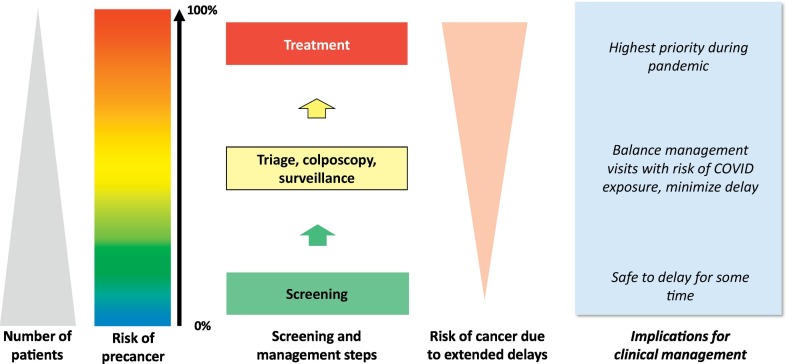
The COVID-19 pandemic has a major impact on a wide range of health outcomes. Disruptions of elective health services related to cervical screening, management of abnormal screening test results, and treatment of precancers, may lead to increases in cervical cancer incidence and exacerbate existing health disparities. Modeling studies suggest that a short delay of cervical screening in subjects with previously negative HPV results has minor effects on cancer outcomes, while delay of management and treatment can lead to larger increases in cervical cancer. Several approaches can mitigate the effects of disruption of cervical screening and management. HPV-based screening has higher accuracy compared to cytology, and a negative HPV result provides longer reassurance against cervical cancer; further, HPV testing can be conducted from self-collected specimens. Self-collection expands the reach of screening to underserved populations who currently do not participate in screening. Self-collection and can also provide alternative screening approaches during the pandemic because testing can be supported by telehealth and specimens collected in the home, substantially reducing patient-provider contact and risk of COVID-19 exposure, and also expanding the reach of catch-up services to address backlogs of screening tests that accumulated during the pandemic. Risk-based management allows prioritizing management of patients at highest risk of cervical cancer while extending screening intervals for those at lowest risk. The pandemic provides important lessons for how to make cervical screening more resilient to disruptions and how to reduce cervical cancer disparities that may be exacerbated due to disruptions of health services.
COVID-19 大流行对广泛的健康结果产生重大影响。与宫颈筛查相关的选择性医疗服务中断、异常筛查结果的管理以及癌前病变的治疗,可能导致宫颈癌发病率上升,并加剧现有的健康不平等。建模研究表明,对于 HPV 结果先前为阴性的受试者,宫颈筛查的短暂延迟对癌症结果的影响较小,而管理和治疗的延迟可能会导致宫颈癌的更大增加。几种方法可以减轻宫颈筛查和管理中断的影响。与细胞学相比,基于 HPV 的筛查具有更高的准确性,HPV 结果阴性可提供更长时间的宫颈癌保护;此外,HPV 检测可从自我采集的标本中进行。自我采集将筛查范围扩大到目前未参与筛查的服务不足人群。自我采集也可以在大流行期间提供替代筛查方法,因为测试可以通过远程医疗和在家中采集的标本来支持,这大大减少了患者与提供者的接触和 COVID-19 暴露的风险,并且还扩大了追赶服务的范围,以解决大流行期间积累的筛查测试积压问题。基于风险的管理允许优先管理宫颈癌风险最高的患者,同时延长风险最低患者的筛查间隔。大流行提供了重要的经验教训,说明如何使宫颈筛查更能抵御干扰,以及如何减少因医疗服务中断而加剧的宫颈癌差异。