Office of Cancer Research and Implementation, American Cancer Society, Atlanta, GA, USA.
Office of Cancer Research and Implementation, American Cancer Society, Atlanta, GA, USA.
Prev Med. 2021 Oct;151:106681. doi: 10.1016/j.ypmed.2021.106681. Epub 2021 Jun 30.
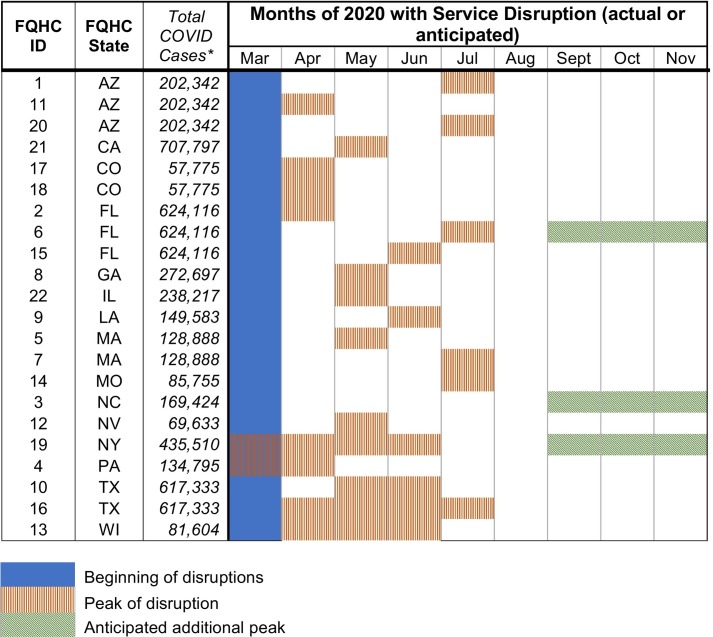
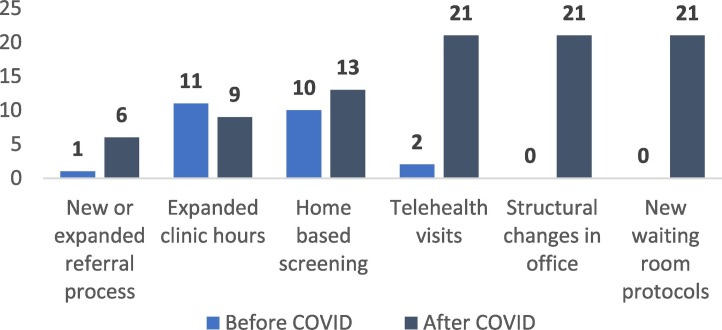
The COVID-19 pandemic has contributed to decreases in breast, colorectal, and cervical cancer screenings between 86 and 94% compared to three-year averages. These postponed screenings have created backlogs that systems will need to address as healthcare facilities re-open for preventive care. The American Cancer Society is leading a 17-month intervention with 22 federally qualified health centers (FQHCs) across the United States aimed at reducing cancer incidence and mortality disparities and alleviating additional strain caused by COVID-19. This study describes COVID-related cancer screening service disruptions reported by participating FQHCs. Selected FQHCs experienced service disruptions and/or preventive care cancellations due to COVID-19 that varied in severity and duration. Fifty-nine percent stopped cancer screenings completely. Centers transitioned to telehealth visits or rescheduled for the future, but the impact of these strategies may be limited by continued pandemic-related disruptions and the inability to do most screenings at home; colon cancer screening being the exception. Most centers have resumed in-person screening, but limited in person appointments and high levels of community transmission may reduce FQHC abilities to provide catch-up services. FQHCs provide critical cancer prevention services to vulnerable populations. The delivery of culturally competent, high-quality healthcare can mitigate and potentially reverse racial and ethnic disparities in cancer prevention testing and treatment. Ensuring and expanding access to care as we move out of the pandemic will be critical to preventing excess cancer incidence and mortality in vulnerable populations.
与三年平均水平相比,COVID-19 大流行导致乳腺癌、结直肠癌和宫颈癌筛查减少了 86%至 94%。这些推迟的筛查造成了积压,随着医疗保健设施重新开放进行预防保健,系统将需要解决这些积压问题。美国癌症协会正在领导一项为期 17 个月的干预措施,涉及美国 22 个联邦合格的健康中心 (FQHC),旨在减少癌症发病率和死亡率的差异,并缓解 COVID-19 造成的额外压力。本研究描述了参与的 FQHC 报告的与 COVID 相关的癌症筛查服务中断情况。选定的 FQHC 因 COVID-19 而经历了服务中断和/或预防性护理取消,其严重程度和持续时间各不相同。59%的中心完全停止了癌症筛查。中心过渡到远程医疗访问或重新安排未来的预约,但这些策略的影响可能受到持续的大流行相关干扰以及在家中进行大多数筛查的能力的限制;结肠癌筛查是例外。大多数中心已恢复现场筛查,但现场预约有限且社区传播水平高,可能会降低 FQHC 提供追补服务的能力。FQHC 为弱势人群提供重要的癌症预防服务。提供文化上合适、高质量的医疗保健可以减轻并可能逆转癌症预防检测和治疗方面的种族和民族差异。在我们走出大流行之际,确保并扩大获得护理的机会对于防止弱势人群中癌症发病率和死亡率的过度增加将至关重要。