Department of Medical Oncology & Therapeutics Research, City of Hope Comprehensive Cancer Center, Beckman Research Institute, Duarte, CA, USA.
Department of Medical Oncology & Therapeutics Research, City of Hope Comprehensive Cancer Center, Beckman Research Institute, Duarte, CA, USA.
Eur J Cancer. 2021 Sep;154:11-20. doi: 10.1016/j.ejca.2021.05.035. Epub 2021 Jul 1.
CDK4/6 inhibitors modulate immune response in breast cancer. This phase I/II trial was designed to test the safety and efficacy of palbociclib, pembrolizumab and letrozole in women with hormone receptor positive (HR) human epidermal growth factor receptor 2 negative (HER2) metastatic breast cancer (MBC).
Women with stage IV HR HER2 MBC were enrolled and treated with palbociclib, pembrolizumab and letrozole. Primary end-points were safety, tolerability and efficacy.
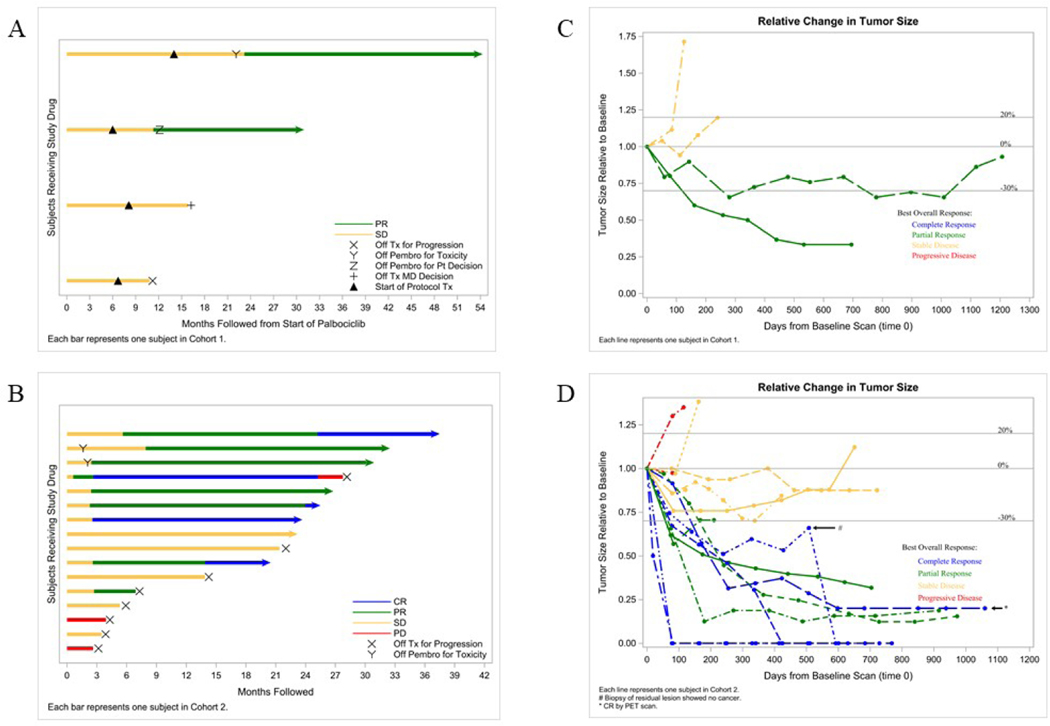
Between November 2016 and July 2020, 23 patients were enrolled with 20 evaluable for response, including 4 patients in cohort 1 and 16 patients in cohort 2. Cohort 1 median age was 48 years (33-70) and cohort 2 median age was 55 (37-75). Cohort 1 closed early due to limited accrual. Grade III-IV adverse events were neutropenia (83%), leucopaenia (65%), thrombocytopenia (17%) and elevated liver enzymes (17%). In cohort 1, 50% achieved a partial response (PR) and 50% had stable disease (SD). In cohort 2, 31% achieved complete response (CR), 25% had PR and 31% had SD by Response Evaluation Criteria in Solid Tumours version 1.1. Median progression-free survival was 25.2 months (95% confidence interval [CI] 5.3, not reached) and median overall survival was 36.9 months (95% CI 36.9, not reached) in cohort 2 with a median follow-up of 24.8 months (95% CI 17.1, not reached). A correlative immune biomarker analysis was published separately.
The combination of palbociclib, pembrolizumab and letrozole is well tolerated, and a complete response rate of 31% was identified in HR MBC patients who received this combination as front-line therapy. Confirmatory trials are required to better understand the immune-priming effects of CDK4/6 inhibitors.
CDK4/6 抑制剂可调节乳腺癌的免疫反应。这项 I/II 期试验旨在测试帕博西尼、帕博利珠单抗和来曲唑在激素受体阳性(HR)人表皮生长因子受体 2 阴性(HER2)转移性乳腺癌(MBC)女性中的安全性和疗效。
招募了 IV 期 HR HER2 MBC 患者,并接受了帕博西尼、帕博利珠单抗和来曲唑治疗。主要终点是安全性、耐受性和疗效。
2016 年 11 月至 2020 年 7 月,共招募了 23 名患者,其中 20 名患者可评估疗效,包括 1 个队列 1 的 4 名患者和 1 个队列 2 的 16 名患者。队列 1 的中位年龄为 48 岁(33-70 岁),队列 2 的中位年龄为 55 岁(37-75 岁)。由于入组人数有限,队列 1 提前关闭。3 级-4 级不良事件为中性粒细胞减少症(83%)、白细胞减少症(65%)、血小板减少症(17%)和肝酶升高(17%)。在队列 1 中,50%的患者达到部分缓解(PR),50%的患者疾病稳定(SD)。在队列 2 中,31%的患者完全缓解(CR),25%的患者 PR,31%的患者 SD,根据实体瘤反应评估标准 1.1 版。队列 2 的中位无进展生存期为 25.2 个月(95%置信区间[CI] 5.3,未达到),中位总生存期为 36.9 个月(95%CI 36.9,未达到),中位随访时间为 24.8 个月(95%CI 17.1,未达到)。一项相关的免疫生物标志物分析单独发表。
帕博西尼、帕博利珠单抗和来曲唑联合应用耐受性良好,在接受该联合一线治疗的 HR MBC 患者中,确认的完全缓解率为 31%。需要进行确证性试验,以更好地了解 CDK4/6 抑制剂的免疫启动作用。