The First Clinical College, Shandong University of Traditional Chinese Medicine, Jinan, China.
Reproductive and Genetic Center of Integrative Medicine, Affiliated Hospital of Shandong University of Traditional Chinese Medicine, Jinan, China.
Front Endocrinol (Lausanne). 2021 Jun 17;12:675997. doi: 10.3389/fendo.2021.675997. eCollection 2021.
The primary objective of the study was to assess traditional Chinese formula DKP supplementation in terms of efficacy and safety on reproductive outcomes of expected poor ovarian responder (POR, POSEIDON Group 4) undergoing fertilization-embryo transfer (IVF-ET).
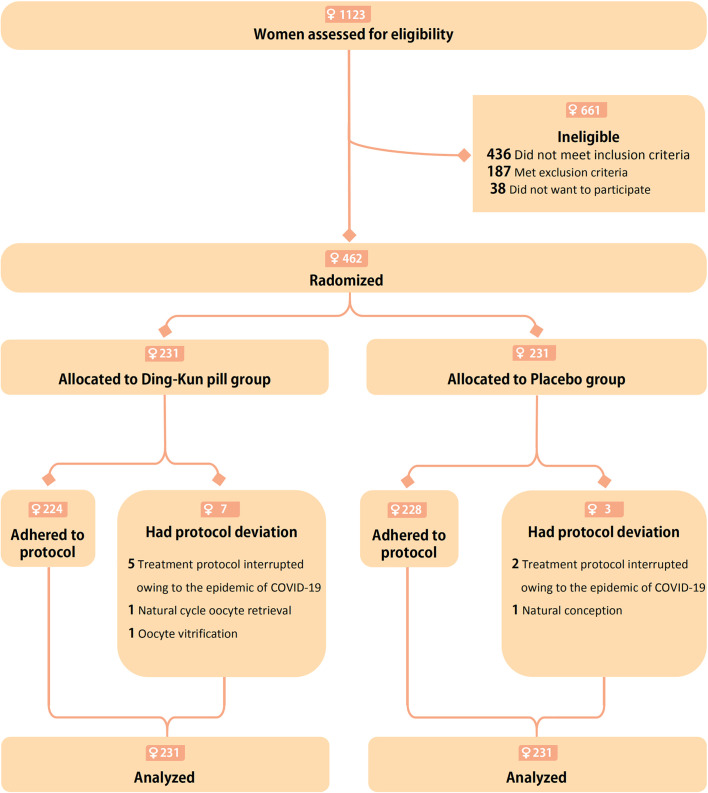
Women eligible for IVF-ET were invited to participate in this randomized, double-blind, placebo-controlled, superiority trial at academic fertility centers of ten public hospitals in Chinese Mainland. A total of 462 patients (35-44 years) equally divided between DKP and placebo groups with antral follicle count (AFC) <5 or anti-müllerian hormone (AMH) <1.2 ng/ml were randomized.
All participants were given DKP or 7 g placebo twice daily on the previous menstrual cycle day 5 until oocyte retrieval, which took approximately 5 to 6 weeks.
The primary outcome was the ongoing pregnancy defined as more than 20 gestational weeks of an intrauterine living fetus confirmed by pelvic ultrasonography.
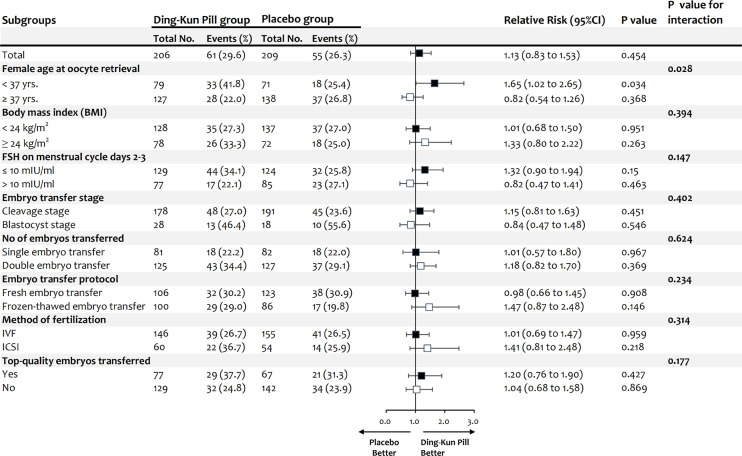
Demographic characteristics were equally distributed between the study populations. Intention-to-treat (ITT) analysis revealed that ongoing pregnancy rate (OPR) was not significantly different between DKP and placebo groups [26.4% (61/231) versus 24.2% (56/231); relative risk (RR) 1.09, 95% confidence interval (CI) 0.80 to 1.49, = 0.593]. No significant differences between groups were observed for the secondary outcomes. The additional per protocol (PP) analysis was in line with ITT results: OPR in DKP group was 27.2% (61/224) versus 24.1% (55/228) in placebo group [RR 1.13, 95%CI (0.82 to 1.55), = 0.449]. After subgroup analysis the findings concluded that POR population of 35-37 years had a significantly higher OPR after 5-6 weeks of oral DKP (41.8%, 33/79) versus placebo (25.4%, 18/71) [RR 1.65, 95% CI (1.02 to 2.65), = 0.034, for interaction = 0.028].
This well-designed randomized controlled trial (RCT) offers new high-quality evidence to supplement existing retrospective literature concerning DKP performance in expected PORs. DKP could be recommended as a safe and natural remedy for expected PORs (aged 35-37 years) who fulfill the POSEIDON group 4 criteria. However, additional interventional clinical studies are undoubtedly required to be conducted in the future to validate this hypothesis.
www.chictr.org.cn, identifier ChiCTR1900026614.
本研究的主要目的是评估中药方剂 DKP 对卵巢反应不良(POR,POSEIDON 组 4)患者接受体外受精-胚胎移植(IVF-ET)的生殖结局的疗效和安全性。
设计、地点和参与者:符合 IVF-ET 条件的女性受邀参加这项在中国内地 10 家公立医院的学术生育中心进行的随机、双盲、安慰剂对照、优效性试验。共有 462 名患者(35-44 岁)按年龄分为两组,每组 231 人,AFC<5 或抗苗勒管激素(AMH)<1.2ng/ml,分别给予 DKP 或安慰剂治疗。
所有患者在上次月经周期第 5 天开始每天服用 DKP 或安慰剂 7g,持续约 5-6 周,直至取卵。
主要结局是通过盆腔超声检查确认的超过 20 周的宫内活胎妊娠。
两组患者的人口统计学特征分布均衡。意向治疗(ITT)分析显示,DKP 组和安慰剂组的持续妊娠率(OPR)无显著差异[26.4%(61/231)与 24.2%(56/231);相对风险(RR)1.09,95%置信区间(CI)0.80 至 1.49,=0.593]。两组间次要结局无显著差异。补充的符合方案(PP)分析与 ITT 结果一致:DKP 组的 OPR 为 27.2%(61/224),安慰剂组为 24.1%(55/228)[RR 1.13,95%CI(0.82 至 1.55),=0.449]。亚组分析结果表明,35-37 岁的 POR 人群在接受 5-6 周的 DKP 治疗后,OPR 明显更高(41.8%,33/79),而安慰剂组为 25.4%(18/71)[RR 1.65,95%CI(1.02 至 2.65),=0.034,交互检验=0.028]。
这项精心设计的随机对照试验(RCT)提供了新的高质量证据,补充了现有的关于 DKP 在预期 POR 中的表现的回顾性文献。对于符合 POSEIDON 组 4 标准的 35-37 岁预期 POR 患者,DKP 可作为一种安全有效的天然药物。然而,未来无疑需要进行更多的干预性临床研究来验证这一假设。
www.chictr.org.cn,识别码 ChiCTR1900026614。