Laboratory of Molecular and Cellular Pneumonology, Respiratory Medicine Department, School of Medicine, University of Crete, Heraklion, Greece.
National Heart and Lung Institute, Imperial College London, London, United Kingdom.
Front Immunol. 2021 Jun 15;12:661811. doi: 10.3389/fimmu.2021.661811. eCollection 2021.
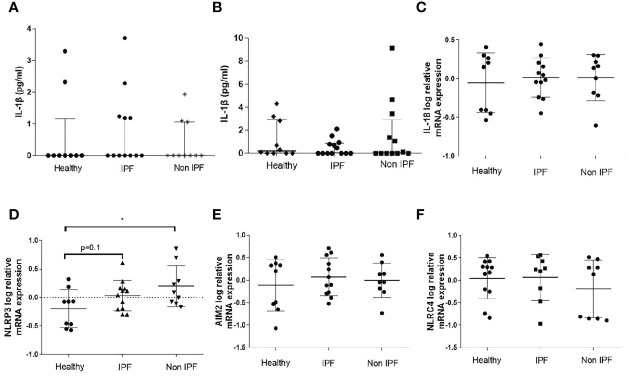
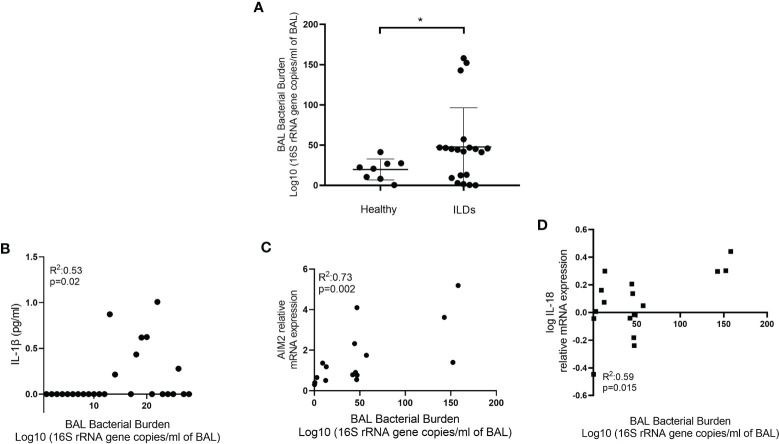
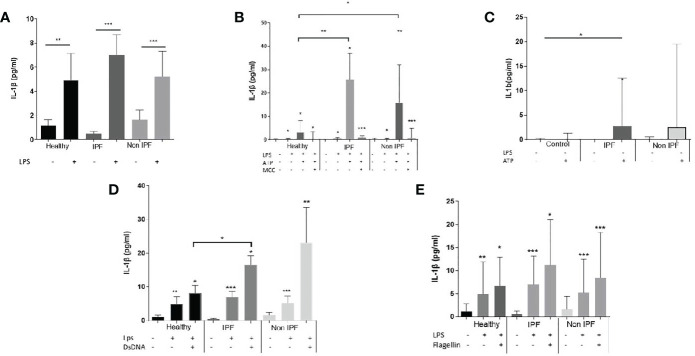
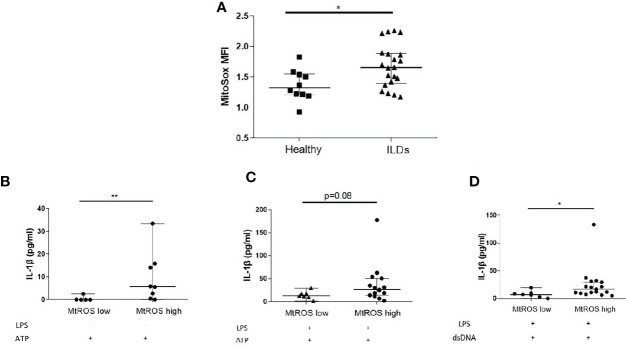
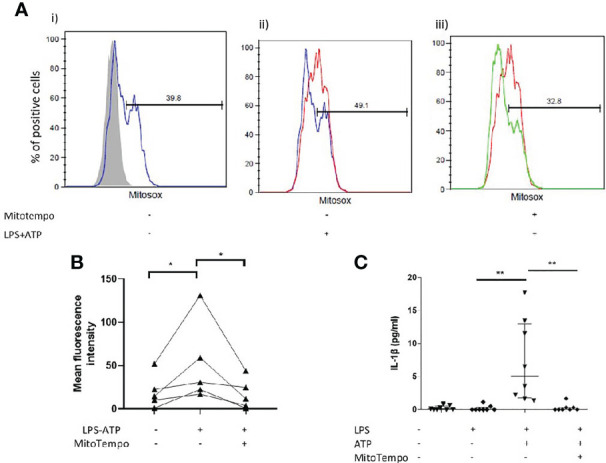
Fibrotic Interstitial lung diseases (ILDs) are complex disorders of variable clinical behaviour. The majority of them cause significant morbidity, whilst Idiopathic Pulmonary Fibrosis (IPF) is recognised as the most relentless. NLRP3, AIM2, and NLRC4 inflammasomes are multiprotein complexes driving IL-1β release; a proinflammatory and profibrotic cytokine. Several pathogenetic factors associated with IPF are identified as inflammasome activators, including increases in mtROS and bacterial burden. Mitochondrial oxidation and alterations in bacterial burden in IPF and other ILDs may lead to augmented inflammasome activity in airway macrophages (AMs). IPF (n=14), non-IPF-ILDs (n=12) patients and healthy subjects (n=12) were prospectively recruited and AMs were isolated from bronchoalveolar lavage. IL-1β release resulting from NLRP3, AIM2 and NLRC4 inflammasomes stimulation in AMs were determined and baseline levels of mitochondrial ROS and microbial burden were also measured. Our results showed that NLRP3 was more inducible in IPF and other ILDs compared to controls. Additionally, following AIM2 activation IL-1β release was significantly higher in IPF compared to controls, whereas similar trends were observed in Non-IPF-ILDs. NLRC4 activation was similar across groups. mtROS was significantly associated with heightened NLRP3 and AIM2 activation, and mitochondrial antioxidant treatment limited inflammasome activation. Importantly, microbial burden was linked to baseline IL-1β release and and relative expression independently of mtROS. In conclusion, the above findings suggested a link between the overactivation of NLRP3 and AIM2 inflammasomes, driven by mitochondrial oxidation, in the pathogenesis of lung fibrosis while changes in the microbiota may prime the inflammasome in the lungs.
纤维化间质性肺疾病(ILDs)是一种临床表型多变的复杂疾病。它们中的大多数都会导致严重的发病率,而特发性肺纤维化(IPF)则被认为是最严重的一种。NLRP3、AIM2 和 NLRC4 炎性小体是驱动 IL-1β释放的多蛋白复合物;一种促炎和促纤维化细胞因子。几种与 IPF 相关的致病因素被确定为炎性小体激活剂,包括 mtROS 和细菌负荷的增加。IPF(n=14)、非 IPF-ILDs(n=12)患者和健康对照者(n=12)前瞻性入组,从支气管肺泡灌洗液中分离出气道巨噬细胞(AMs)。测定 AMs 中 NLRP3、AIM2 和 NLRC4 炎性小体刺激后 IL-1β 的释放,并测量基线 mtROS 和微生物负荷水平。结果表明,与对照组相比,NLRP3 在 IPF 和其他 ILDs 中更易诱导。此外,AIM2 激活后,IPF 组中 IL-1β 的释放明显高于对照组,而非 IPF-ILDs 组也观察到类似趋势。NLRC4 激活在各组间相似。mtROS 与 NLRP3 和 AIM2 激活的增加显著相关,线粒体抗氧化剂治疗可限制炎性小体的激活。重要的是,微生物负荷与基线 IL-1β 释放和 mtROS 独立相关。总之,这些发现表明,在肺纤维化的发病机制中,线粒体氧化驱动 NLRP3 和 AIM2 炎性小体的过度激活,而微生物群的变化可能使肺部的炎性小体处于激活状态。