Zhang Wei, Liu Lu, Zhang Ming, Zhang Feng, Peng Chunyan, Zhang Bin, Chen Jun, Li Lin, He Jian, Xiao Jiangqiang, Feng Yanhong, Wang Xunjiang, Xiong Aizhen, Yang Li, Zou Xiaoping, Yu Yuecheng, Zhuge Yuzheng
Department of Gastroenterology, The Affiliated Drum Tower Hospital of Nanjing University Medical School, Nanjing, Jiangsu, China.
Department of Gastroenterology, The Affiliated Jiangning Hospital of Nanjing Medical University, Nanjing, Jiangsu, China.
J Clin Transl Hepatol. 2021 Jun 28;9(3):345-352. doi: 10.14218/JCTH.2020.00124. Epub 2021 Mar 31.
Hepatic sinusoidal obstruction syndrome (HSOS) is caused by toxic injury to sinusoidal endothelial cells in the liver. The intake of pyrrolizidine alkaloids (PAs) in some Chinese herbal remedies/plants remains the major etiology for HSOS in China. Recently, new diagnostic criteria for PA-induced HSOS (i.e. PA-HSOS) have been developed; however, the efficacy has not been clinically validated. This study aimed to assess the performance of the Nanjing criteria for PA-HSOS.
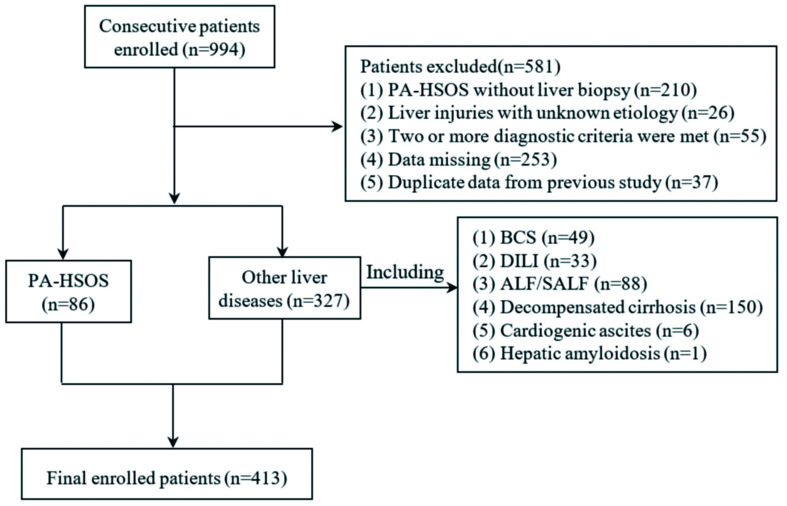
Data obtained from consecutive patients in multiple hospitals, which included 86 PA-HSOS patients and 327 patients with other liver diseases, were retrospectively analyzed. Then, the diagnostic performance of the Nanjing criteria and simplified Nanjing criteria were evaluated and validated. The study is registered in www.chictr.org.cn (ID: ChiCTR1900020784).
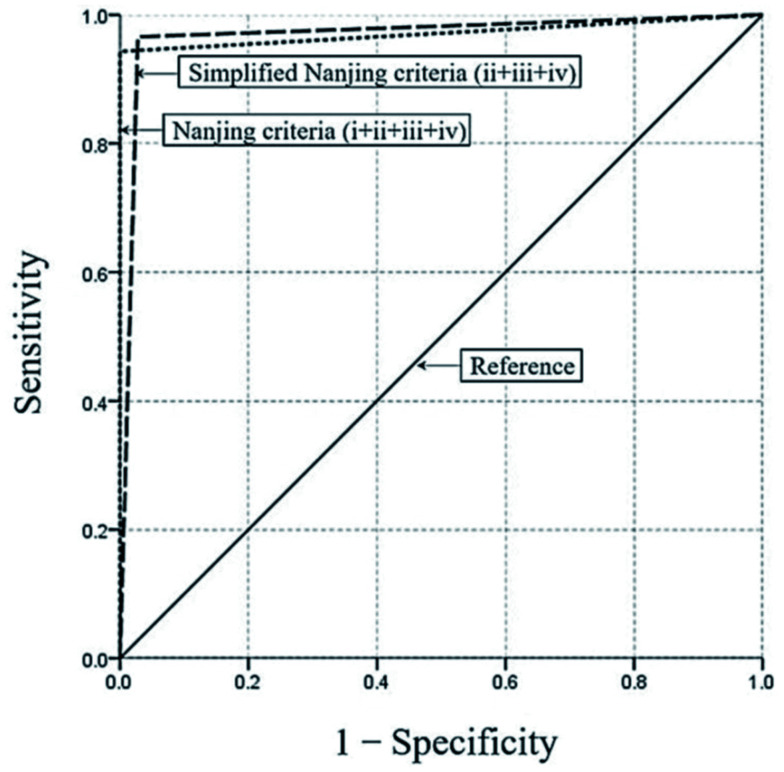
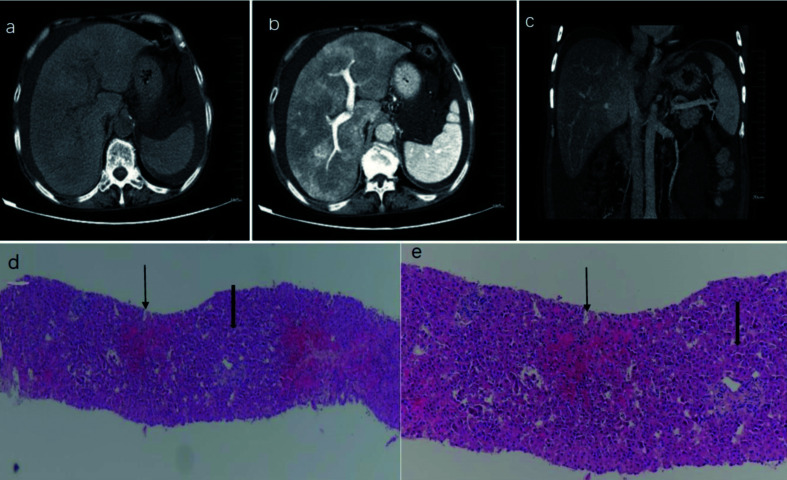
The Nanjing criteria have a sensitivity and specificity of 95.35% and 100%, respectively, while the simplified Nanjing criteria have a sensitivity and specificity of 96.51% and 96.33%, respectively, for the diagnosis of PA-HSOS. Notably, a proportion of patients with Budd-Chiari syndrome (11/49) was misdiagnosed as PA-HSOS on the basis of the simplified Nanjing criteria, and this was mainly due to the overlapping features in the enhanced computed tomography/magnetic resonance imaging examinations. Furthermore, most of these patients (10/11) had occlusion or thrombosis of the hepatic vein, and communicating vessels in the liver were found in 8/11 patients, which were absent in PA-HSOS patients.
The Nanjing criteria and simplified Nanjing criteria exhibit excellent performance in diagnosing PA-HSOS. Thus, both could be valuable diagnostic tools in clinical practice.
肝窦阻塞综合征(HSOS)是由肝脏窦状内皮细胞的毒性损伤引起的。一些中草药/植物中吡咯里西啶生物碱(PAs)的摄入仍是中国HSOS的主要病因。最近,已制定了PA诱导的HSOS(即PA-HSOS)的新诊断标准;然而,其有效性尚未经过临床验证。本研究旨在评估PA-HSOS南京标准的性能。
回顾性分析多家医院连续收治患者的数据,其中包括86例PA-HSOS患者和327例其他肝病患者。然后,对南京标准和简化南京标准的诊断性能进行评估和验证。该研究已在www.chictr.org.cn注册(注册号:ChiCTR1900020784)。
南京标准诊断PA-HSOS的敏感性和特异性分别为95.35%和100%,而简化南京标准的敏感性和特异性分别为96.51%和96.33%。值得注意的是,根据简化南京标准,一部分布加综合征患者(11/49)被误诊为PA-HSOS,这主要是由于增强计算机断层扫描/磁共振成像检查中的特征重叠。此外,这些患者中的大多数(10/11)存在肝静脉闭塞或血栓形成,11例患者中有8例发现肝脏有交通血管,而PA-HSOS患者中不存在这种情况。
南京标准和简化南京标准在诊断PA-HSOS方面表现出色。因此,两者都可能是临床实践中有价值的诊断工具。