Tian Zijian, Meng Lingfeng, Wang Xin, Diao Tongxiang, Hu Maolin, Wang Miao, Zhang Yaqun, Liu Ming
Department of Urology, Beijing Hospital, National Center of Gerontology, Institute of Geriatric Medicine, Chinese Academy of Medical Sciences, Beijing, China.
Graduate School of Peking Union Medical College, Chinese Academy of Medical Sciences, Beijing, China.
Front Oncol. 2021 Jun 16;11:690324. doi: 10.3389/fonc.2021.690324. eCollection 2021.
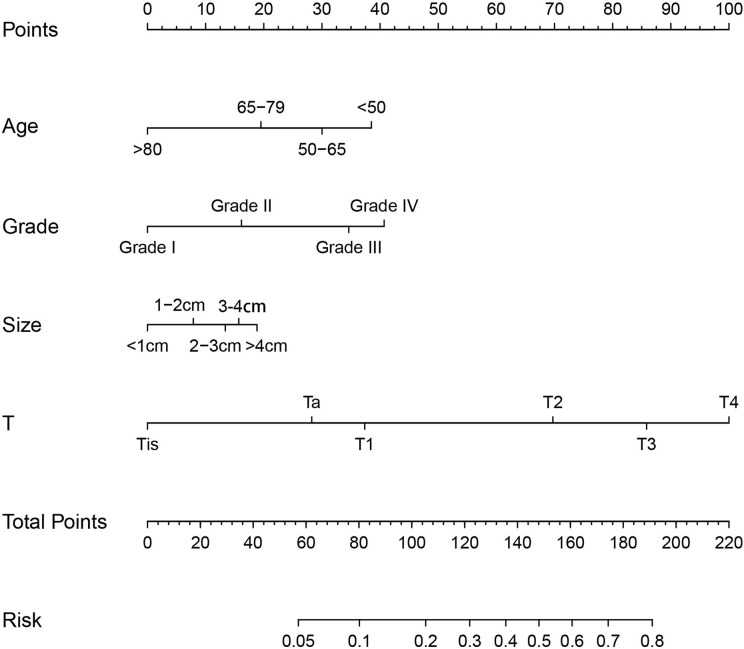
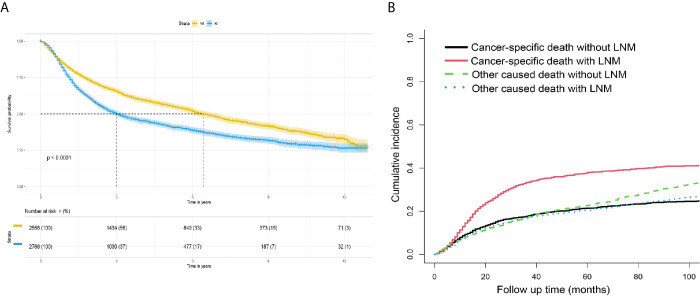
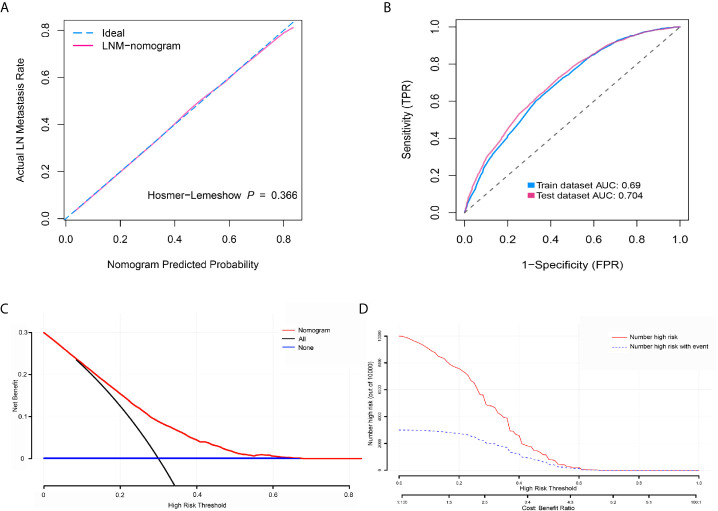
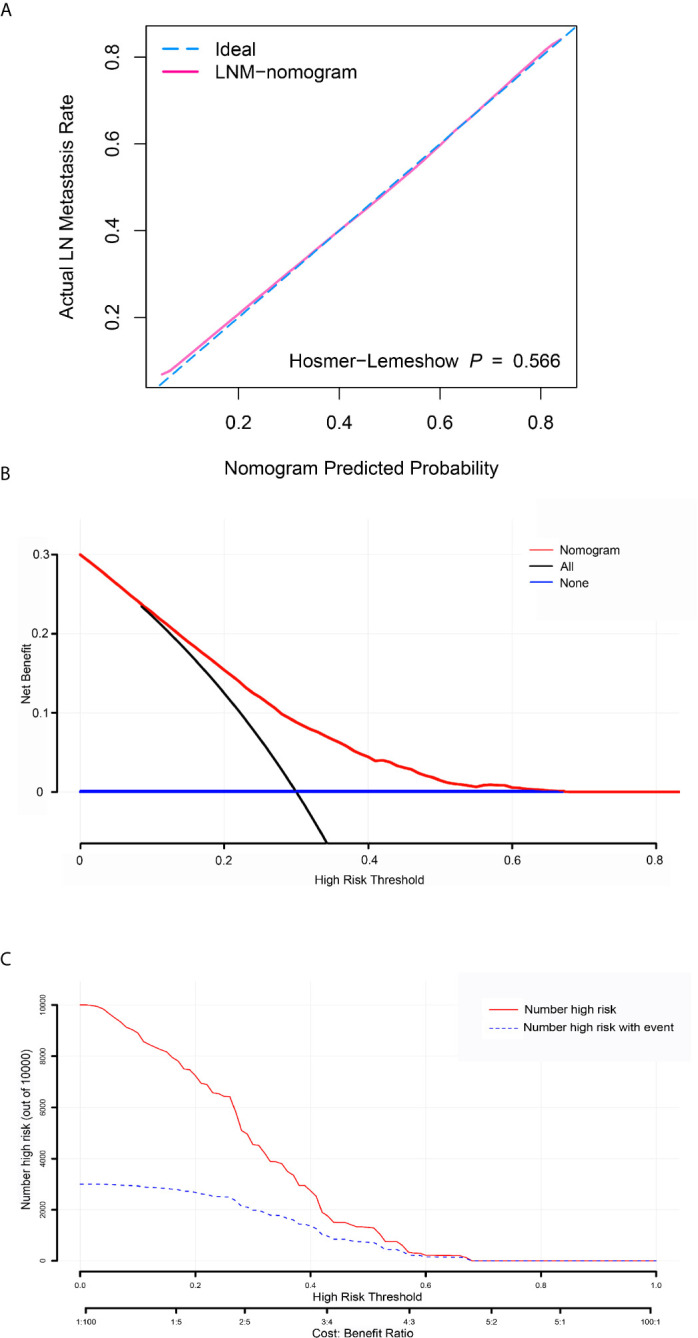
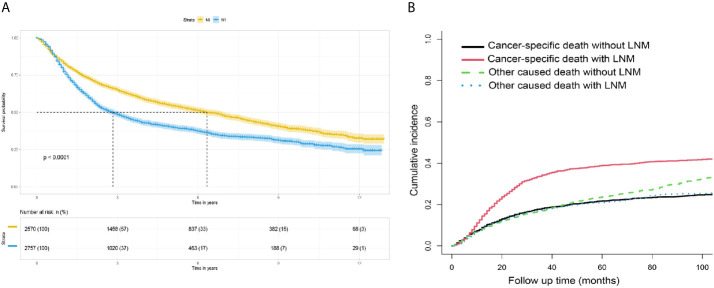
Lymph node metastasis (LNM) is an important prognostic factor for bladder cancer (BCA) and determines the treatment strategy. This study aimed to determine related clinicopathological factors of LNM and analyze the prognosis of BCA. A total of 10,653 eligible patients with BCA were randomly divided into training or verification sets using the 2004-2015 data of the Surveillance, Epidemiology, and End Results database. To identify prognostic factors for the overall survival of BCA, we utilized the Cox proportional hazard model. Independent risk factors for LNM were evaluated logistic regression analysis. T-stage, tumor grade, patient age and tumor size were identified as independent risk factors for LNM and were used to develop the LNM nomogram. The Kaplan-Meier method and competitive risk analyses were applied to establish the influence of lymph node status on BCA prognosis. The accuracy of LNM nomogram was evaluated in the training and verification sets. The areas under the receiver operating characteristic curve (AUC) showed an effective predictive accuracy of the nomogram in both the training (AUC: 0.690) and verification (AUC: 0.704) sets. In addition, the calibration curve indicated good consistency between the prediction of deviation correction and the ideal reference line. The decision curve analysis showed that the nomogram had a high clinical application value. In conclusion, our nomogram displayed high accuracy and reliability in predicting LNM. This could assist the selection of the optimal treatment for patients.
淋巴结转移(LNM)是膀胱癌(BCA)的一个重要预后因素,并决定治疗策略。本研究旨在确定LNM的相关临床病理因素,并分析BCA的预后。利用监测、流行病学和最终结果数据库2004 - 2015年的数据,将总共10653例符合条件的BCA患者随机分为训练集或验证集。为了确定BCA总生存的预后因素,我们使用了Cox比例风险模型。通过逻辑回归分析评估LNM的独立危险因素。T分期、肿瘤分级、患者年龄和肿瘤大小被确定为LNM的独立危险因素,并用于构建LNM列线图。应用Kaplan - Meier法和竞争风险分析来确定淋巴结状态对BCA预后的影响。在训练集和验证集中评估LNM列线图的准确性。受试者操作特征曲线(AUC)下的面积显示,列线图在训练集(AUC:0.690)和验证集(AUC:0.704)中均具有有效的预测准确性。此外,校准曲线表明偏差校正预测与理想参考线之间具有良好的一致性。决策曲线分析表明列线图具有较高的临床应用价值。总之,我们的列线图在预测LNM方面显示出高准确性和可靠性。这有助于为患者选择最佳治疗方案。