Centre for Sustainable Aquatic Ecosystems, Harry Butler Institute, Murdoch University, 90 South Street, Murdoch, Western Australia 6150, Australia.
Anderson Cabot Center for Ocean Life, New England Aquarium, 1 Central Wharf, Boston, MA 02110, USA.
Proc Biol Sci. 2021 Jul 14;288(1954):20210816. doi: 10.1098/rspb.2021.0816. Epub 2021 Jul 7.
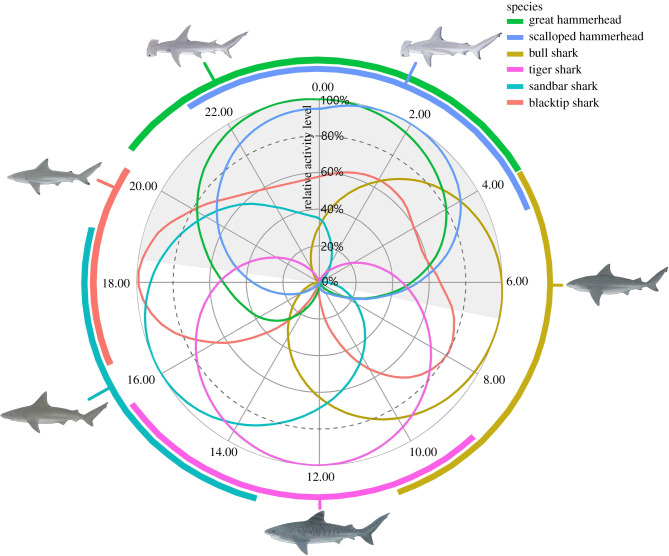
Niche partitioning of time, space or resources is considered the key to allowing the coexistence of competitor species, and particularly guilds of predators. However, the extent to which these processes occur in marine systems is poorly understood due to the difficulty in studying fine-scale movements and activity patterns in mobile underwater species. Here, we used acceleration data-loggers to investigate temporal partitioning in a guild of marine predators. Six species of co-occurring large coastal sharks demonstrated distinct diel patterns of activity, providing evidence of strong temporal partitioning of foraging times. This is the first instance of diel temporal niche partitioning described in a marine predator guild, and is probably driven by a combination of physiological constraints in diel timing of activity (e.g. sensory adaptations) and interference competition (hierarchical predation within the guild), which may force less dominant predators to suboptimal foraging times to avoid agonistic interactions. Temporal partitioning is often thought to be rare compared to other partitioning mechanisms, but the occurrence of temporal partitioning here and similar characteristics in many other marine ecosystems (multiple predators simultaneously present in the same space with dietary overlap) introduces the question of whether this is a common mechanism of resource division in marine systems.
时间、空间或资源的生态位分化被认为是允许竞争物种共存的关键,特别是对于捕食者群体。然而,由于难以研究移动水下物种的精细运动和活动模式,海洋系统中这些过程的发生程度还知之甚少。在这里,我们使用加速度数据记录器来研究海洋捕食者群体中的时间生态位分化。六种共存的大型沿海鲨鱼表现出明显的昼夜活动模式,这为捕食时间的强烈时间生态位分化提供了证据。这是首次在海洋捕食者群体中描述昼夜时间生态位分化,可能是由昼夜活动时间的生理限制(例如感官适应)和干扰竞争(群体内的等级捕食)共同驱动的,这可能迫使不占优势的捕食者选择次优的觅食时间,以避免竞争。与其他分隔机制相比,时间分隔通常被认为较为罕见,但这里出现的时间分隔以及许多其他海洋生态系统中的类似特征(具有重叠食性的多个捕食者同时存在于同一空间中)提出了这样一个问题,即在海洋系统中,这是否是一种常见的资源分配机制。