AP-HP, Hôpital Henri Mondor, Département Médico-Universitaire de Psychiatrie et d'Addictologie (DMU IMPACT), Fédération Hospitalo-Universitaire de Médecine de Précision (FHU ADAPT), Créteil, France.
Université Paris Est Créteil, Laboratoire Neuro-Psychiatrie translationnelle, Créteil, France.
Transl Psychiatry. 2021 Jul 6;11(1):377. doi: 10.1038/s41398-021-01499-0.
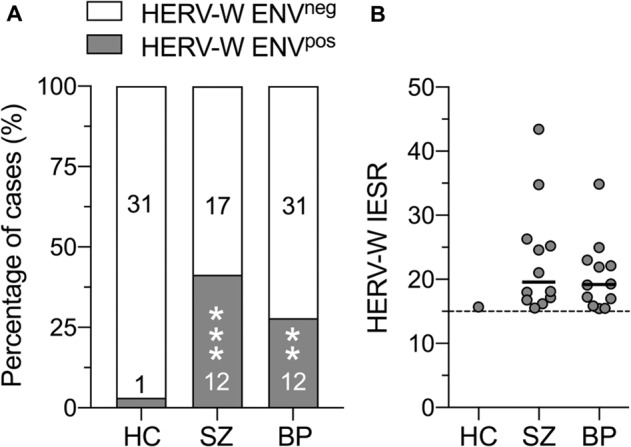
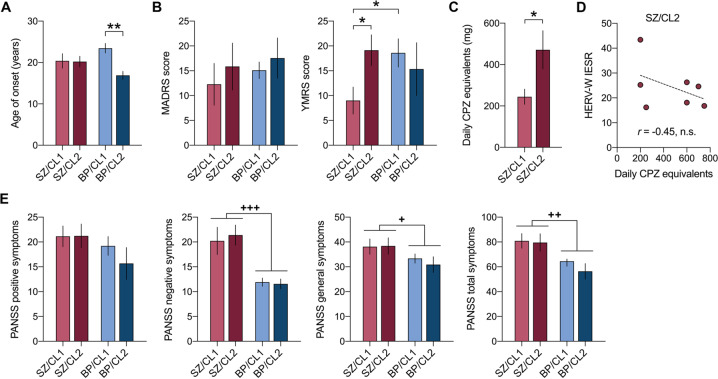
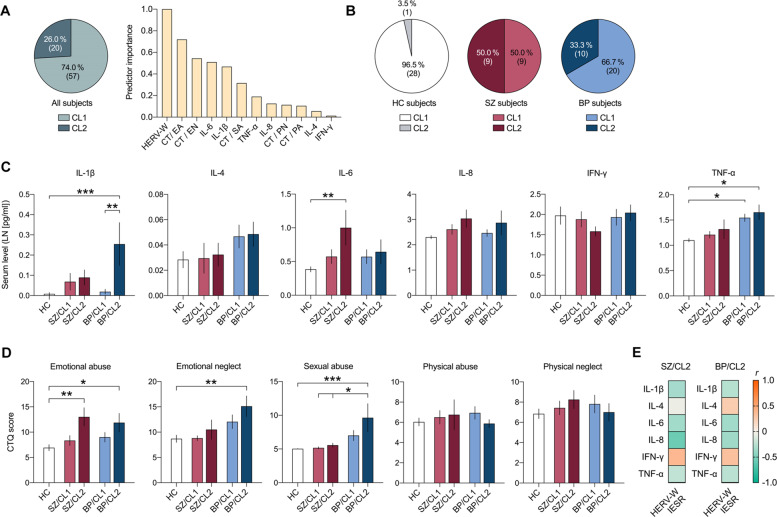
Human endogenous retroviruses (HERVs) are remnants of infections that took place several million years ago and represent around 8% of the human genome. Despite evidence implicating increased expression of HERV type W envelope (HERV-W ENV) in schizophrenia and bipolar disorder, it remains unknown whether such expression is associated with distinct clinical or biological characteristics and symptoms. Accordingly, we performed unsupervised two-step clustering of a multivariate data set that included HERV-W ENV protein antigenemia, serum cytokine levels, childhood trauma scores, and clinical data of cohorts of patients with schizophrenia (n = 29), bipolar disorder (n = 43) and healthy controls (n = 32). We found that subsets of patients with schizophrenia (41%) and bipolar disorder (28%) show positive antigenemia for HERV-W ENV protein, whereas the large majority (96%) of controls was found to be negative for ENV protein. Unsupervised cluster analysis identified the presence of two main clusters of patients, which were best predicted by the presence or absence of HERV-W ENV protein. HERV-W expression was associated with increased serum levels of inflammatory cytokines and higher childhood maltreatment scores. Furthermore, patients with schizophrenia who were positive for HERV-W ENV protein showed more manic symptoms and higher daily chlorpromazine (CPZ) equivalents, whereas HERV-W ENV positive patients with bipolar disorder were found to have an earlier disease onset than those who were negative for HERV-W ENV protein. Taken together, our study suggest that HERV-W ENV protein antigenemia and cytokines can be used to stratify patients with major mood and psychotic disorders into subgroups with differing inflammatory and clinical profiles.
人类内源性逆转录病毒 (HERV) 是数百万年前感染的残余物,约占人类基因组的 8%。尽管有证据表明,HERV-W 包膜(HERV-W ENV)的表达增加与精神分裂症和双相情感障碍有关,但尚不清楚这种表达是否与不同的临床或生物学特征和症状有关。因此,我们对包括 HERV-W ENV 蛋白抗原血症、血清细胞因子水平、儿童期创伤评分和精神分裂症(n=29)、双相情感障碍(n=43)和健康对照组(n=32)患者队列的多变量数据集进行了无监督两步聚类。我们发现,精神分裂症 (41%) 和双相情感障碍 (28%) 的患者亚组表现出 HERV-W ENV 蛋白的阳性抗原血症,而绝大多数 (~96%) 的对照组则被发现为 ENV 蛋白阴性。无监督聚类分析确定了两种主要患者群的存在,这两种患者群最好由 HERV-W ENV 蛋白的存在或不存在来预测。HERV-W 表达与血清中炎症细胞因子水平升高和儿童期受虐待评分升高有关。此外,HERV-W ENV 蛋白阳性的精神分裂症患者表现出更多的躁狂症状和更高的每日氯丙嗪(CPZ)等效物,而 HERV-W ENV 阳性的双相情感障碍患者比 HERV-W ENV 蛋白阴性的患者发病更早。综上所述,我们的研究表明,HERV-W ENV 蛋白抗原血症和细胞因子可用于将主要情绪和精神病性障碍患者分为具有不同炎症和临床特征的亚组。