Zhu Guoxiang, Zhu Wei, Lou Yang, Ma Jun, Yao Wenqing, Zong Ruilong, Zhu Yongfa
Department of Chemistry, Tsinghua University, Beijing, China.
Institute of Chemical Materials, China Academy of Engineering Physics, Mianyang, Sichuan, China.
Nat Commun. 2021 Jul 6;12(1):4152. doi: 10.1038/s41467-021-24424-x.
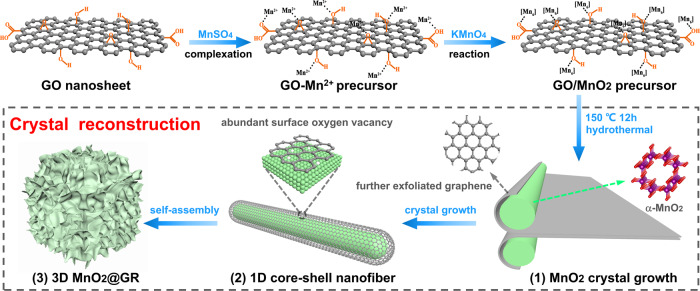
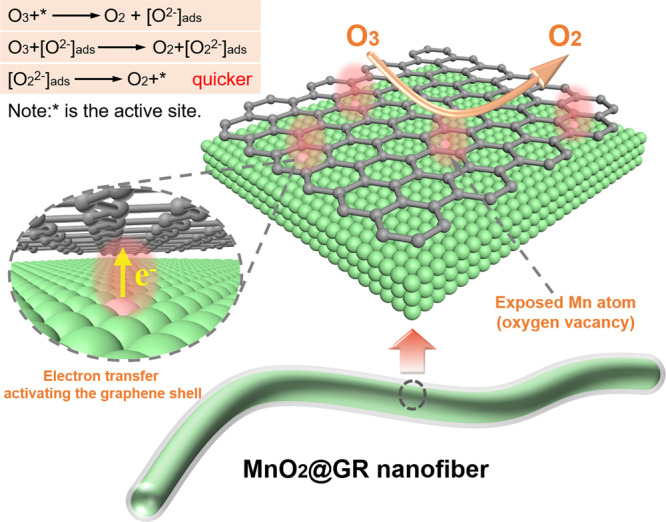
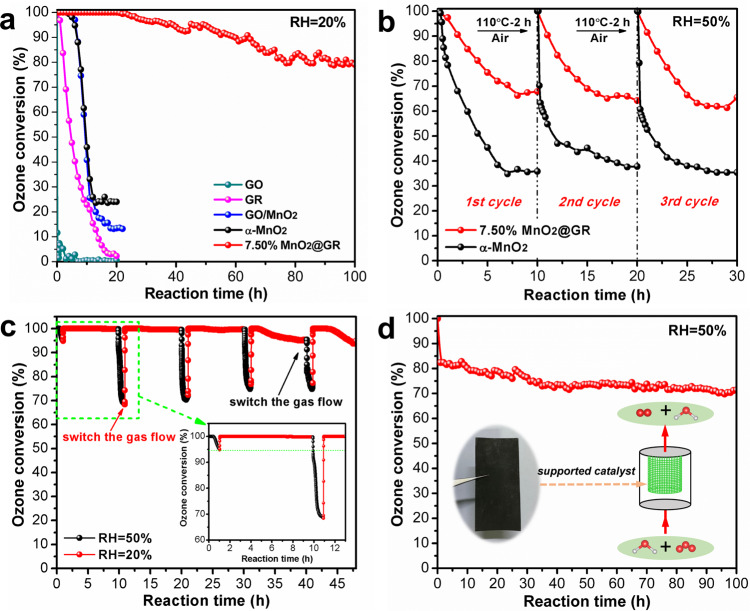
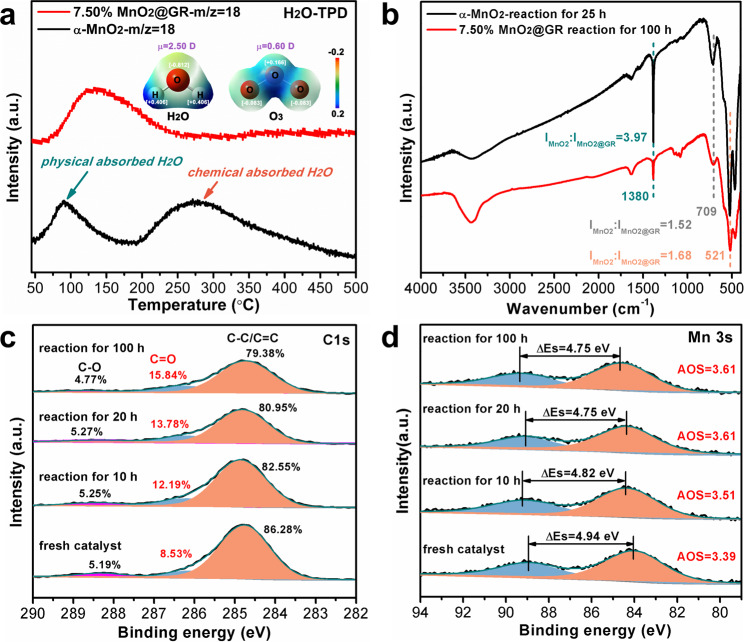
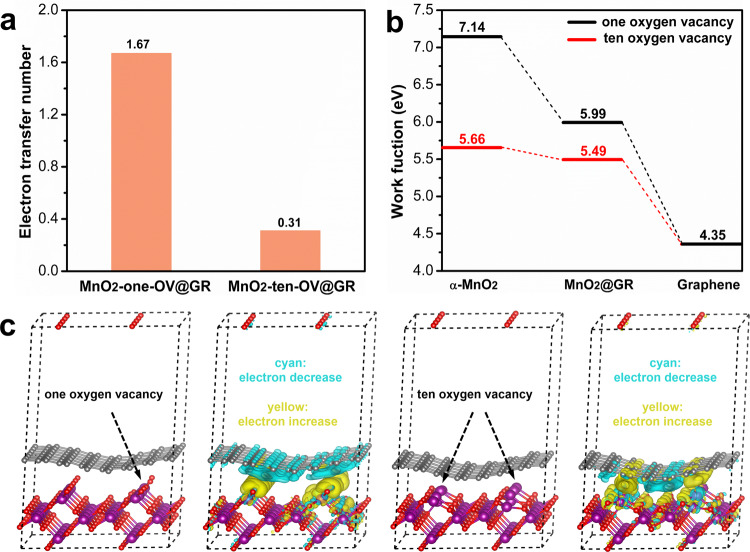
Major challenges encountered when developing manganese-based materials for ozone decomposition are related to the low stability and water inactivation. To solve these problems, a hierarchical structure consisted of graphene encapsulating α-MnO nanofiber was developed. The optimized catalyst exhibited a stable ozone conversion efficiency of 80% and excellent stability over 100 h under a relative humidity (RH) of 20%. Even though the RH increased to 50%, the ozone conversion also reached 70%, well beyond the performance of α-MnO nanofiber. Here, surface graphite carbon was activated by capturing the electron from inner unsaturated Mn atoms. The excellent stability originated from the moderate local work function, which compromised the reaction barriers in the adsorption of ozone molecule and the desorption of the intermediate oxygen species. The hydrophobic graphene shells hindered the chemisorption of water vapour, consequently enhanced its water resistance. This work offered insights for catalyst design and would promote the practical application of manganese-based catalysts in ozone decomposition.
开发用于臭氧分解的锰基材料时遇到的主要挑战与稳定性低和水失活有关。为了解决这些问题,开发了一种由石墨烯包裹α-MnO纳米纤维组成的分级结构。优化后的催化剂在20%的相对湿度(RH)下表现出80%的稳定臭氧转化效率和超过100小时的优异稳定性。即使RH增加到50%,臭氧转化率也达到70%,远远超过α-MnO纳米纤维的性能。在这里,表面石墨碳通过捕获内部不饱和锰原子的电子而被激活。优异的稳定性源于适度的局部功函数,它降低了臭氧分子吸附和解吸中间氧物种的反应势垒。疏水性的石墨烯壳阻碍了水蒸气的化学吸附,从而增强了其耐水性。这项工作为催化剂设计提供了见解,并将促进锰基催化剂在臭氧分解中的实际应用。