Wang Zhenshuo, Li Yan, Zhao Yu, Zhuang Lubo, Yu Yue, Wang Mengyao, Liu Jia, Wang Qi
Department of Plant Pathology, MOA Key Lab of Pest Monitoring and Green Management, College of Plant Protection, China Agricultural University, Beijing, 100193, China.
Chongqing Key Laboratory of Economic Plant Biotechnology, College of Landscape Architecture and Life Science/Institute of Special Plants, Chongqing University of Arts and Sciences, Yongchuan, Chongqing, 402160, China.
Microb Biotechnol. 2021 Sep;14(5):1961-1975. doi: 10.1111/1751-7915.13876. Epub 2021 Jul 7.
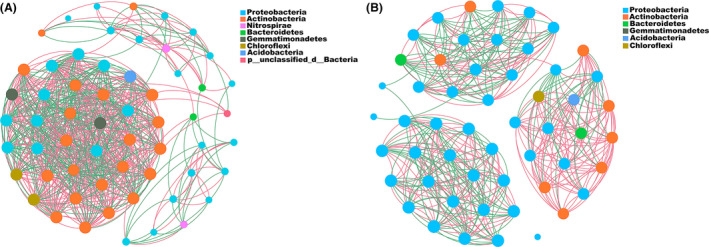
The effect of a microbial consortium-based (MCB) biocontrol product, composed of Bacillus subtilis, Trichoderma harzianum strain and diatomaceous earth as a carrier, on potato yield, and potential modes of action for its effect were investigated. The MCB product (300 kg ha ) was added to furrows in which the potato seed tubers each year for 3 years (2016, 2017 and 2018), while potato planting without the MCB product treatment served as the control. A metagenomic analysis indicated that bacterial phylotypes dominated the microbial community, with a relatively small contribution of archaea and fungal taxa. The relative abundance of beneficial bacterial taxa increased significantly in response to the MCB product treatment. Notably, a higher relative abundance of bacterial taxa with carbon fixation, carbon-degrading and nitrogen metabolism properties were observed in the MCB product-treated potato rhizosphere. This was also reflected in the identification of a greater abundance of genes encoding enzymes involved in nitrogen metabolism, carbon fixation and carbon degradation pathways in the conducted metagenomic analysis. The greater relative abundance of these beneficial bacterial taxa in the rhizosphere of MCB product-treated plots, as well as the higher abundance of genes associated with the indicated cellular processes, were associated with an increase in tuber yield. The observed changes in microbial community structure at an early stage of tuber development appears to have a beneficial impact on tuber yield.
研究了一种基于微生物群落(MCB)的生物防治产品对马铃薯产量的影响及其作用的潜在模式,该产品由枯草芽孢杆菌、哈茨木霉菌株和作为载体的硅藻土组成。在2016年、2017年和2018年这3年中,每年将MCB产品(300 kg/公顷)施用于播种马铃薯种薯的沟中,而未进行MCB产品处理的马铃薯种植作为对照。宏基因组分析表明,细菌系统型主导微生物群落,古菌和真菌类群的贡献相对较小。有益细菌类群的相对丰度在MCB产品处理后显著增加。值得注意的是,在经MCB产品处理的马铃薯根际中,观察到具有固碳、碳降解和氮代谢特性的细菌类群的相对丰度更高。这也反映在宏基因组分析中鉴定出更多参与氮代谢、碳固定和碳降解途径的编码酶的基因。在经MCB产品处理的地块根际中,这些有益细菌类群的相对丰度更高,以及与所示细胞过程相关的基因丰度更高,都与块茎产量的增加有关。在块茎发育早期观察到的微生物群落结构变化似乎对块茎产量有有益影响。