Cata Juan P, Patiño Miguel, Lacagnina Michael J, Li Jiahe, Gorur Aysegul, Agudelo-Jimenez Ruben, Wei Bo, Hagberg Carin A, Dougherty Patrick M, Shureiqi Imad, Yang Peiying, Grace Peter M
Department of Anesthesiology and Perioperative Medicine, The University of Texas MD Anderson Cancer Center, Houston, TX, USA.
Laboratories of Neuroimmunology, Department of Symptom Research, The University of Texas MD Anderson Cancer Center, Houston, TX, USA.
Pain Rep. 2021 Jun 30;6(2):e943. doi: 10.1097/PR9.0000000000000943. eCollection 2021 Jul-Aug.
Major advances in therapies to optimize recovery after surgery have been limited by the lack of an animal model that can mimic major domains of postoperative sickness behavior in humans. We hypothesized that the integration of commonly impaired domains of quality of recovery in humans could be reproduced in a rat model.
To create a rat model that can mimic surgical recovery in humans.
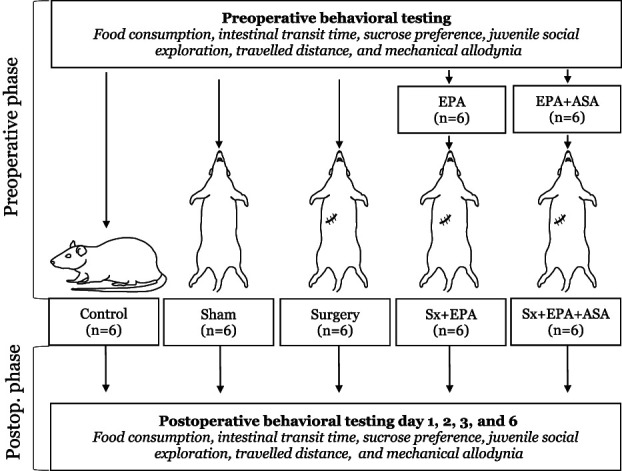
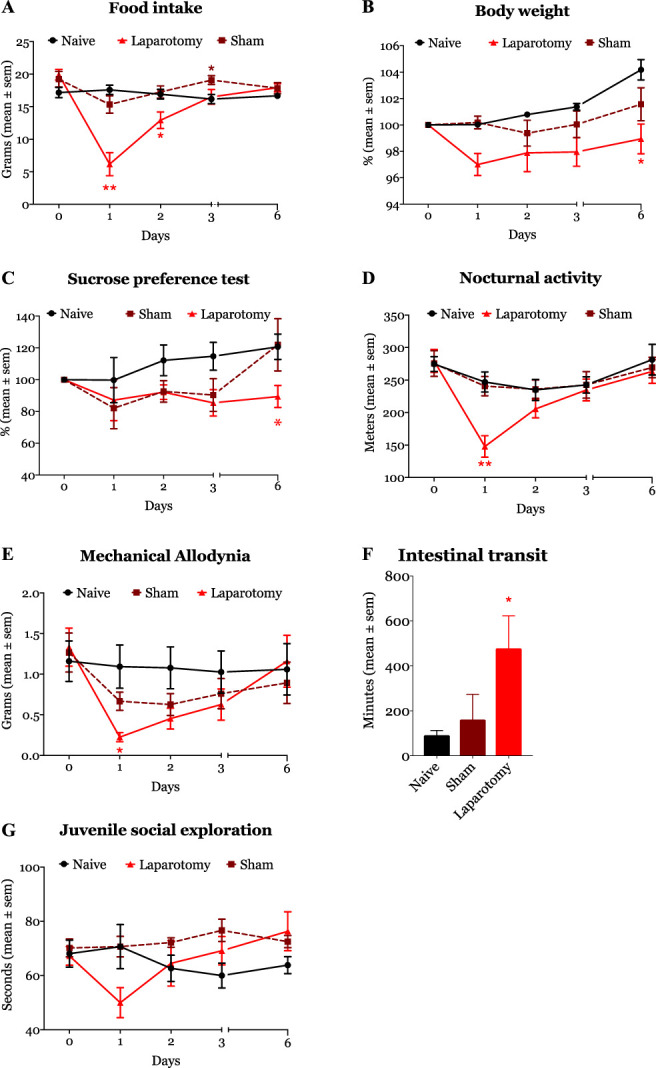
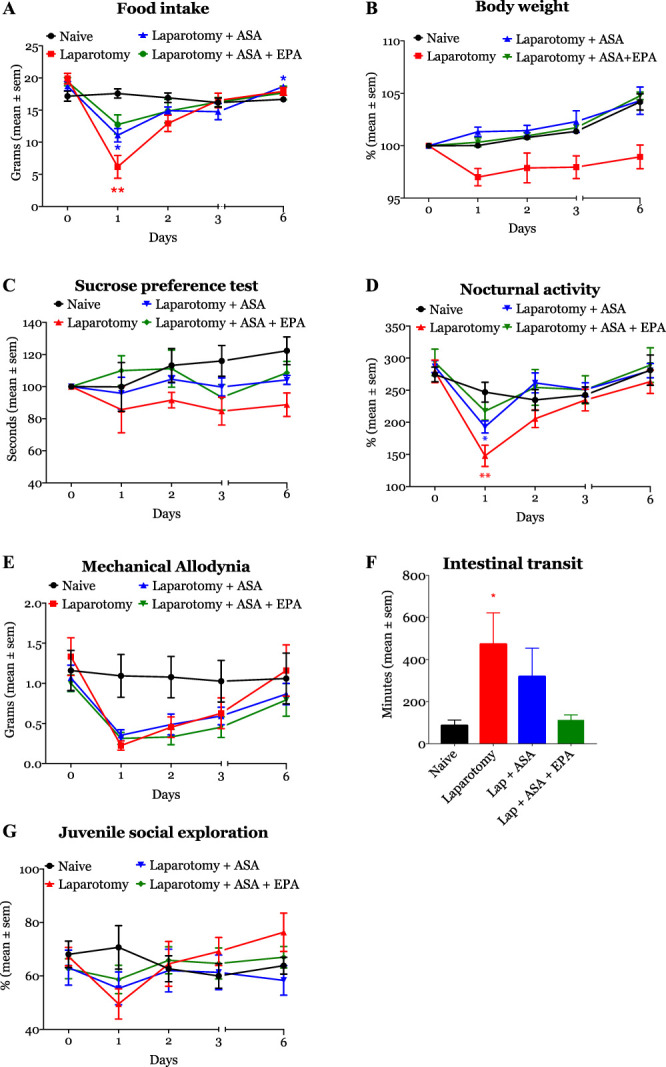
Adult male Sprague-Dawley rats were used in the development of a quality of recovery score after surgery. Six physiological parameters or behaviors were tested in naive, sham, and laparotomized animals. A quality of recovery score was constructed and ranged from 18 (no impairment) to 0 (gross impairment). We treated animals with a nutraceutical intervention consisting of aspirin and eicosapentaenoic acid. Inflammatory markers and specialized proresolving mediators were measured in serum and the intestinal mucosa of rats, respectively.
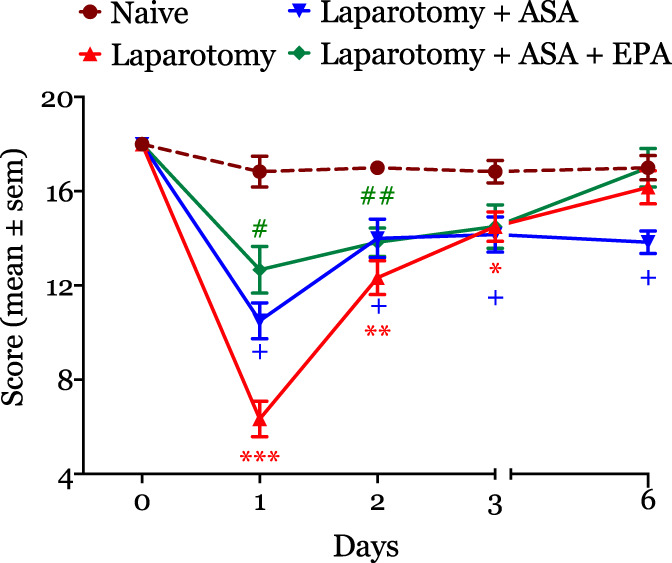
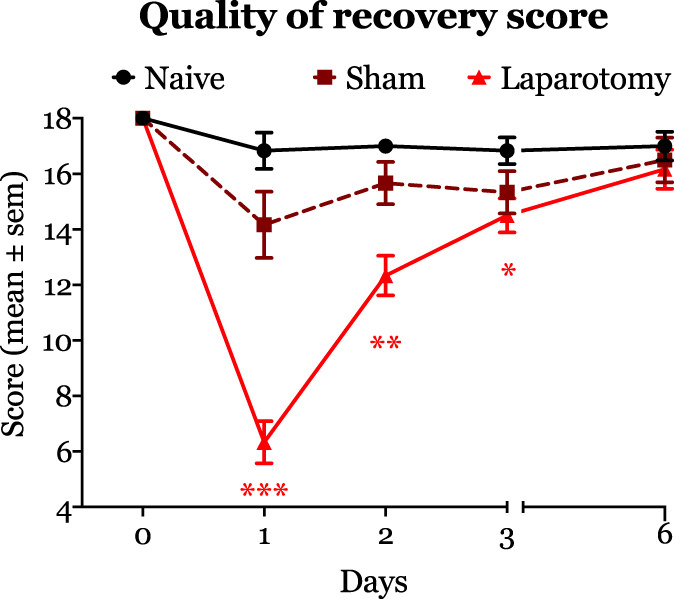
We observed a significant reduction in quality of recovery scores on postoperative days 1 (median, interquartile: 6 [4.75-8.25] vs naive rats: 17.5 [15.5-18]), 2 (median, interquartile: 13 [11.25-13.25], < 0.001 vs naive rats: 17 [17-18], = 0.001), and 3 (median, interquartile: 14.5 [13.5-16] vs naive rats: 17 [15.75-18], < 0.02). Surgery promoted a significant increase in the concentrations of inflammatory cytokines, but it reduced levels of interleukin-12p70 and macrophage colony-stimulating factor. Lipoxin B4 and 13-HODE were significantly higher in laparotomized rats. Aspirin + eicosapentaenoic acid substantially improved recovery scores and modulated the postsurgical inflammatory response.
Our novel rat model can be used to study mechanisms governing surgical recovery in rats.
由于缺乏能够模拟人类术后疾病行为主要方面的动物模型,优化术后恢复的治疗方法的重大进展受到了限制。我们假设,人类恢复质量中常见受损领域的整合可以在大鼠模型中重现。
创建一种能够模拟人类手术恢复情况的大鼠模型。
成年雄性Sprague-Dawley大鼠用于建立术后恢复质量评分。对未处理、假手术和开腹手术的动物测试了六个生理参数或行为。构建了一个恢复质量评分,范围从18(无损伤)到0(严重损伤)。我们用包含阿司匹林和二十碳五烯酸的营养补充剂干预动物。分别在大鼠的血清和肠黏膜中测量炎症标志物和特异性促消退介质。
我们观察到术后第1天(中位数,四分位间距:6 [4.75 - 8.25] 对比未处理大鼠:17.5 [15.5 - 18])、第2天(中位数,四分位间距:13 [11.25 - 13.25],与未处理大鼠:17 [17 - 18] 相比,P < 0.001)和第3天(中位数,四分位间距:14.5 [13.5 - 16] 对比未处理大鼠:17 [15.75 - 18],P < 0.02)恢复质量评分显著降低。手术促进了炎症细胞因子浓度的显著升高,但降低了白细胞介素-12p70和巨噬细胞集落刺激因子的水平。脂氧素B4和13-羟基十八碳二烯酸在开腹手术大鼠中显著更高。阿司匹林 + 二十碳五烯酸显著改善了恢复评分并调节了术后炎症反应。
我们的新型大鼠模型可用于研究大鼠手术恢复的调控机制。