Quer Giorgio, Gadaleta Matteo, Radin Jennifer M, Andersen Kristian G, Baca-Motes Katie, Ramos Edward, Topol Eric J, Steinhubl Steven R
Scripps Research Translational Institute, 3344N Torrey Pines Ct Plaza Level, La Jolla, CA, 92037, USA.
CareEvolution, 625N Main Street, Ann Arbor, MI, 48104, USA.
NPJ Digit Med. 2022 Apr 19;5(1):49. doi: 10.1038/s41746-022-00591-z.
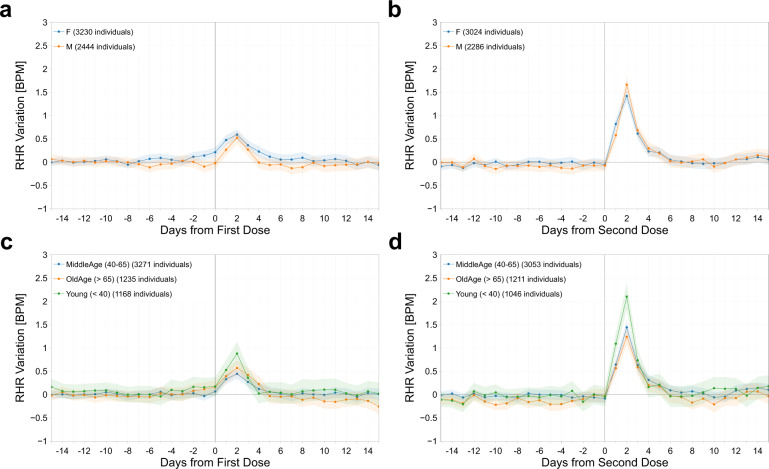
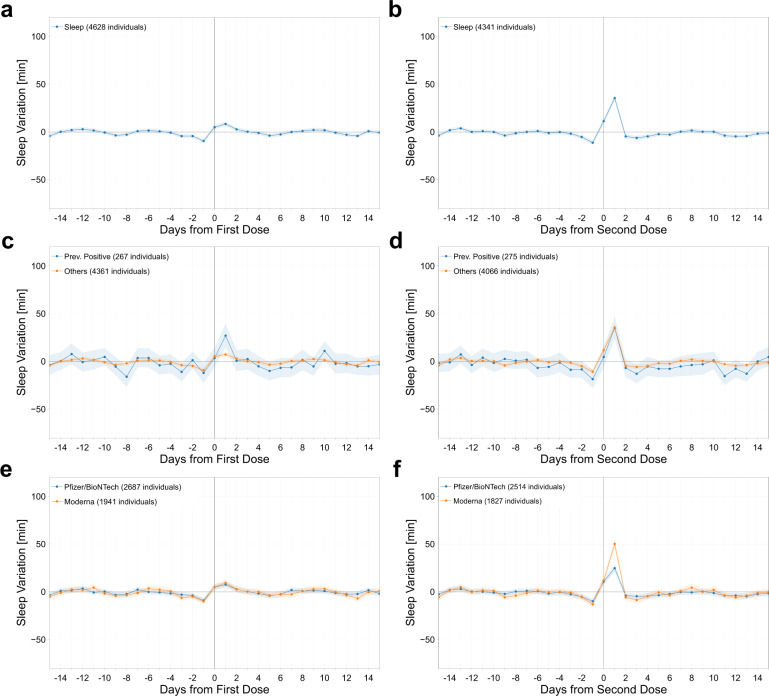
The ability to identify who does or does not experience the intended immune response following vaccination could be of great value in not only managing the global trajectory of COVID-19 but also helping guide future vaccine development. Vaccine reactogenicity can potentially lead to detectable physiologic changes, thus we postulated that we could detect an individual's initial physiologic response to a vaccine by tracking changes relative to their pre-vaccine baseline using consumer wearable devices. We explored this possibility using a smartphone app-based research platform that enabled volunteers (39,701 individuals) to share their smartwatch data, as well as self-report, when appropriate, any symptoms, COVID-19 test results, and vaccination information. Of 7728 individuals who reported at least one vaccination dose, 7298 received an mRNA vaccine, and 5674 provided adequate data from the peri-vaccine period for analysis. We found that in most individuals, resting heart rate (RHR) increased with respect to their individual baseline after vaccination, peaked on day 2, and returned to normal by day 6. This increase in RHR was greater than one standard deviation above individuals' normal daily pattern in 47% of participants after their second vaccine dose. Consistent with other reports of subjective reactogenicity following vaccination, we measured a significantly stronger effect after the second dose relative to the first, except those who previously tested positive to COVID-19, and a more pronounced increase for individuals who received the Moderna vaccine. Females, after the first dose only, and those aged <40 years, also experienced a greater objective response after adjusting for possible confounding factors. These early findings show that it is possible to detect subtle, but important changes from an individual's normal as objective evidence of reactogenicity, which, with further work, could prove useful as a surrogate for vaccine-induced immune response.
能够识别接种疫苗后哪些人产生了预期的免疫反应,哪些人没有产生,这不仅对管理新冠疫情的全球发展态势具有重要价值,还能为未来疫苗研发提供指导。疫苗反应原性可能会导致可检测到的生理变化,因此我们推测,通过使用消费级可穿戴设备追踪个体相对于接种前基线的变化,我们可以检测到个体对疫苗的初始生理反应。我们使用了一个基于智能手机应用程序的研究平台来探索这种可能性,该平台使志愿者(39701人)能够分享他们的智能手表数据,并在适当的时候自行报告任何症状、新冠病毒检测结果和疫苗接种信息。在报告至少接种一剂疫苗的7728人中,7298人接种了mRNA疫苗,5674人提供了疫苗接种前后时期的充分数据用于分析。我们发现,在大多数个体中,接种疫苗后静息心率(RHR)相对于其个体基线有所增加,在第2天达到峰值,并在第6天恢复正常。在47%的参与者接种第二剂疫苗后,RHR的增加超过了其正常日常模式的一个标准差。与其他关于接种疫苗后主观反应原性的报告一致,我们发现,除了那些之前新冠病毒检测呈阳性的人之外,第二剂疫苗后的效果相对于第一剂显著更强,而且接种Moderna疫苗的个体反应更明显。仅在接种第一剂疫苗后,女性以及年龄小于40岁的人,在调整可能的混杂因素后,也经历了更大的客观反应。这些早期发现表明,有可能检测到个体正常状态下细微但重要的变化,作为反应原性的客观证据,随着进一步研究,这可能被证明是疫苗诱导免疫反应的一个替代指标。