Schippers Michaéla C, Rus Diana C
Department of Technology and Operations Management, Rotterdam School of Management, Erasmus University, Rotterdam, Netherlands.
Faculty of Behavioural and Social Sciences, Organizational Psychology, University of Groningen, Groningen, Netherlands.
Front Psychol. 2021 Jun 22;12:650525. doi: 10.3389/fpsyg.2021.650525. eCollection 2021.
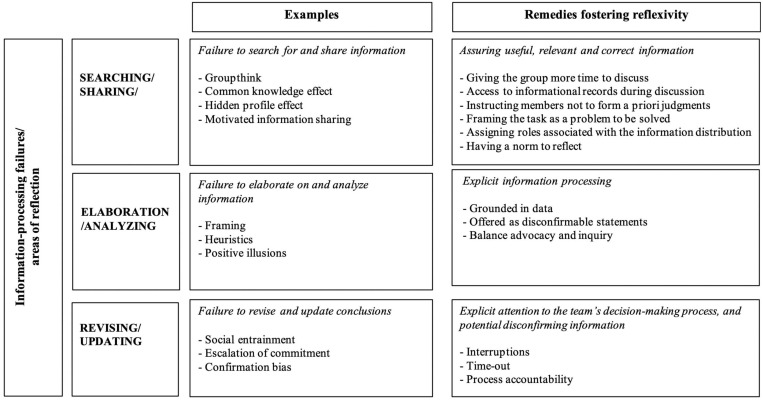
The effectiveness of policymakers' decision-making in times of crisis depends largely on their ability to integrate and make sense of information. The COVID-19 crisis confronts governments with the difficult task of making decisions in the interest of public health and safety. Essentially, policymakers have to react to a threat, of which the extent is unknown, and they are making decisions under time constraints in the midst of immense uncertainty. The stakes are high, the issues involved are complex and require the careful balancing of several interests, including (mental) health, the economy, and human rights. These circumstances render policymakers' decision-making processes vulnerable to errors and biases in the processing of information, thereby increasing the chances of faulty decision-making processes with poor outcomes. Prior research has identified three main information-processing failures that can distort group decision-making processes and can lead to negative outcomes: (1) failure to search for and share information, (2) failure to elaborate on and analyze information that is not in line with earlier information and (3) failure to revise and update conclusions and policies in the light of new information. To date, it has not yet been explored how errors and biases underlying these information-processing failures impact decision-making processes in times of crisis. In this narrative review, we outline how groupthink, a narrow focus on the problem of containing the virus, and escalation of commitment may pose real risks to decision-making processes in handling the COVID-19 crisis and may result in widespread societal damages. Hence, it is vital that policymakers take steps to maximize the quality of the decision-making process and increase the chances of positive outcomes as the crisis goes forward. We propose group reflexivity-a deliberate process of discussing team goals, processes, or outcomes-as an antidote to these biases and errors in decision-making. Specifically, we recommend several evidence-based reflexivity tools that could easily be implemented to counter these information-processing errors and improve decision-making processes in uncertain times.
危机时期政策制定者的决策有效性在很大程度上取决于他们整合信息并理解其意义的能力。新冠疫情危机使各国政府面临着出于公共卫生和安全利益做出决策的艰巨任务。从本质上讲,政策制定者必须应对一种范围未知的威胁,并且他们是在巨大的不确定性中,在时间限制下做出决策。 stakes很高,所涉及的问题很复杂,需要仔细平衡包括(心理)健康、经济和人权在内的多种利益。这些情况使政策制定者的决策过程容易在信息处理中出现错误和偏差,从而增加了决策过程出现失误并导致不良结果的可能性。先前的研究已经确定了三种主要的信息处理失误,这些失误会扭曲群体决策过程并导致负面结果:(1)未能搜索和共享信息,(2)未能详细阐述和分析与早期信息不符的信息,以及(3)未能根据新信息修订和更新结论及政策。迄今为止,尚未探讨这些信息处理失误背后的错误和偏差如何影响危机时期的决策过程。在这篇叙述性综述中,我们概述了群体思维、对遏制病毒问题的狭隘关注以及承诺升级如何可能给应对新冠疫情危机的决策过程带来真正风险,并可能导致广泛的社会损害。因此,至关重要的是,随着危机的发展,政策制定者应采取措施最大限度地提高决策过程的质量,并增加取得积极成果的机会。我们提出群体反思——一个讨论团队目标、过程或结果的刻意过程——作为应对这些决策偏差和错误的解药。具体而言,我们推荐几种基于证据的反思工具,这些工具可以轻松实施,以对抗这些信息处理错误,并在不确定时期改善决策过程。