Brust Michelle, Gebhardt Winifred A, Numans Mattijs E, Kiefte-de Jong Jessica C
Department of Public Health and Primary Care/LUMC Campus The Hague, Leiden University Medical Center, The Hague, Netherlands.
Department of Health, Medical and Neuropsychology, Leiden University, Leiden, Netherlands.
Front Psychol. 2021 Jun 22;12:678513. doi: 10.3389/fpsyg.2021.678513. eCollection 2021.
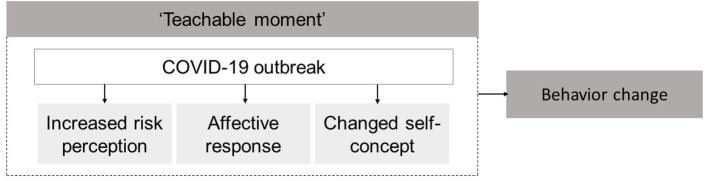
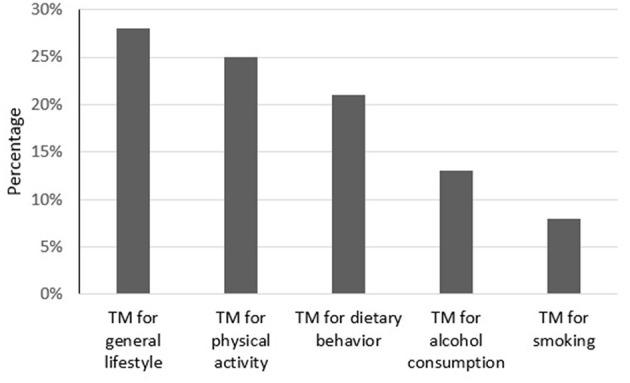
When lifestyle changes are needed, life events or crises such as COVID-19 may function as "teachable moments". This study aimed to explore whether the pandemic can provoke a teachable moment regarding lifestyle change in cardiovascular disease patients. In this cross-sectional survey study, 830 cardiovascular disease patients reported their intentions to change lifestyle, instigated by the corona crisis, together with risk perception, affective impact, and changed self-concept, based on a "teachable moments" framework. Between 8 and 28% of the sample reported increased intentions to optimize lifestyle behaviors, particularly related to general lifestyle (28%), physical activity (25%), and diet (21%). Multivariate regression analyses revealed that changed self-concept was associated with higher intentions to improve general lifestyle ( = 0.26; CI = 0.19-0.33), physical activity ( = 0.23; CI = 0.16-0.30), and smoking ( = 0.29; CI = 0.01-0.57). In addition, changed self-concept and affective impact were both significantly associated with higher intentions to improve diet (resp. = 0.29; CI = 0.21-0.36 and = 0.12; CI = 0.04-0.21) and to limit alcohol consumption (resp. = 0.22; CI = 0.13-0.30 and = 0.11; CI = 0.01-0.20). We did not find evidence for an important role of risk perception on behavior change intentions. The COVID-19 crisis evoked a potential teachable moment for lifestyle change in cardiovascular disease patients, driven by a change in a patient's self-concept and to a lesser extent by an affective impact of the COVID-19 crisis. These results suggest an important window of opportunity for healthcare professionals to utilize the pandemic to promote a healthy lifestyle to their patients.
当需要改变生活方式时,诸如新冠疫情这样的生活事件或危机可能会成为“可教育时刻”。本研究旨在探讨这一疫情是否能引发心血管疾病患者在生活方式改变方面的可教育时刻。在这项横断面调查研究中,830名心血管疾病患者基于“可教育时刻”框架,报告了他们受新冠危机激发的改变生活方式的意愿,以及风险认知、情感影响和自我概念的变化。样本中8%至28%的人表示有更强的意愿去优化生活方式行为,特别是与一般生活方式(28%)、体育活动(25%)和饮食(21%)相关的行为。多变量回归分析显示,自我概念的改变与改善一般生活方式(β = 0.26;置信区间 = 0.19 - 0.33)、体育活动(β = 0.23;置信区间 = 0.16 - 0.30)和吸烟(β = 0.29;置信区间 = 0.01 - 0.57)的更高意愿相关。此外,自我概念的改变和情感影响均与改善饮食(分别为β = 0.29;置信区间 = 0.21 - 0.36和β = 0.12;置信区间 = 0.04 - 0.21)以及限制饮酒(分别为β = 0.22;置信区间 = 0.13 - 0.30和β = 0.11;置信区间 = 0.01 - 0.20)的更高意愿显著相关。我们没有发现风险认知对行为改变意愿有重要作用的证据。新冠疫情危机在心血管疾病患者中引发了生活方式改变的潜在可教育时刻,这是由患者自我概念的变化驱动的,在较小程度上也是由新冠疫情危机的情感影响驱动的。这些结果表明,医疗保健专业人员有一个重要的机会窗口,可以利用这一疫情向患者推广健康的生活方式。