CORE Group Polio Project, India, 303, Bestech Chambers, B-Block, Sushant Lok-1, Gurgaon, Haryana, 122002, India.
Indian Institute of Health Management Research (IIHMR) University, Jaipur, Rajasthan, 302020, India.
BMC Public Health. 2021 Jul 10;21(1):1371. doi: 10.1186/s12889-021-11425-0.
A social mobilization (SM) initiative contributed to India's success in polio elimination. This was the CORE Group Polio Project (CGPP) India, a partner of the Uttar Pradesh (UP) SM Network and which continued its SM activities, even during the polio-free period through a network of multi-level social mobilizers. This paper assesses the effects of this community-level SM (CLSM) intervention on the extent of community engagement and performance of polio Supplementary Immunization Activity campaigns (SIAs) during the post-polio-endemic period (i.e., from March 2012 to September 2017).
This study followed a quasi-experimental design. We used secondary, cluster-level data from CGPP India's Management Information System, including 52 SIAs held from January 2008 to September 2017, covering 56 blocks from 12 districts of UP. We computed various indicators and performed Generalized Estimating Equations based analysis to assess the statistical significance of differences between the outcomes of intervention and non-intervention areas. We then estimated the effects of the SM intervention using Interrupted time-series, Difference-in-Differences and Synthetic Control Methods. Finally, we estimated the population influenced by the intervention.
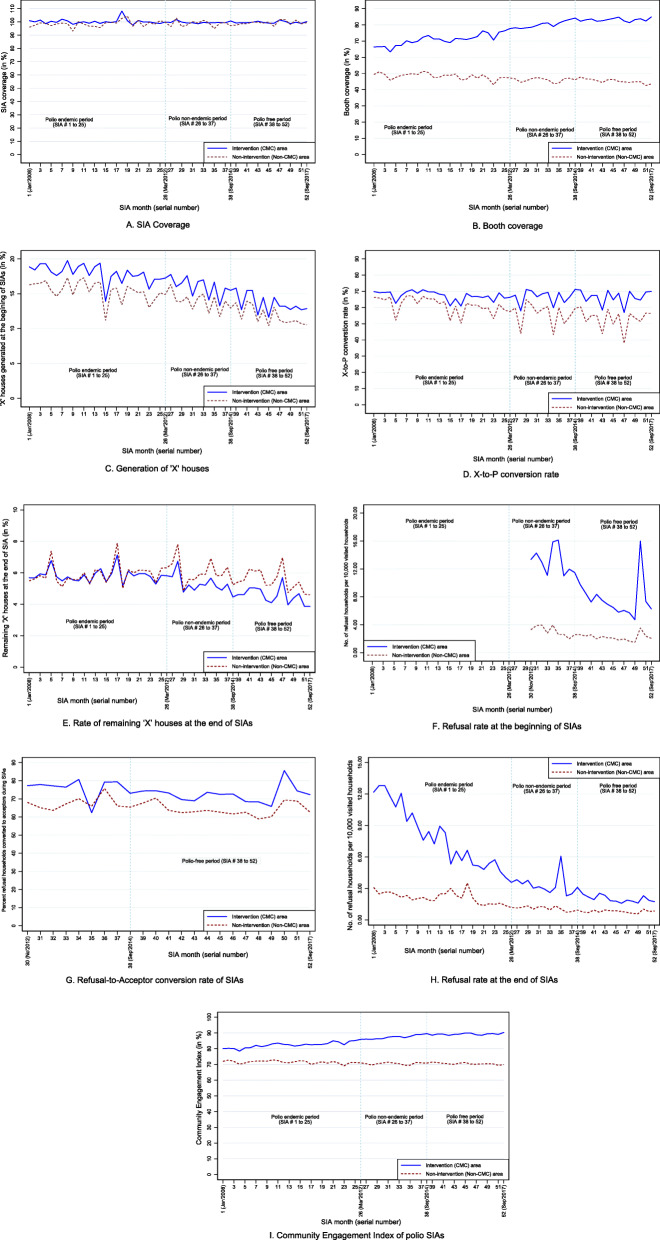
The performance of polio SIAs changed over time, with the intervention areas having better outcomes than non-intervention areas. The absence of CLSM intervention during the post-polio-endemic period would have negatively impacted the outcomes of polio SIAs. The percentage of children vaccinated at polio SIA booths, percentage of 'X' houses (i.e., households with unvaccinated children or households with out-of-home/out-of-village children or locked households) converted to 'P' (i.e., households with all vaccinated children or households without children eligible for vaccination), and percentage of resistant houses converted to polio acceptors would have gone down by 14.1 (Range: 12.7 to 15.5), 6.3 (Range: 5.2 to 7.3) and 7.4 percentage points, respectively. Community engagement would have reduced by 7.2 (Range: 6.6 to 7.7) percentage points.
The absence of CLSM intervention would have significantly decreased the level of community engagement and negatively impacted the performance of polio SIAs of the post-polio-endemic period. The study provides evidence of an added value of deploying additional human resource dedicated to social mobilization to achieve desired vaccination outcomes in hard-to-reach or programmatically challenging areas.
社会动员(SM)倡议为印度消除小儿麻痹症的成功做出了贡献。这是 CORE 小组脊髓灰质炎项目(CGPP)印度,是北方邦(UP)社会动员网络的合作伙伴,即使在无脊髓灰质炎期间,它也通过多层次的社会动员者网络继续开展社会动员活动。本文评估了这种社区层面的 SM(CLSM)干预对社区参与程度和脊髓灰质炎补充免疫活动(SIAs)在脊髓灰质炎后流行期间(即 2012 年 3 月至 2017 年 9 月)表现的影响。
本研究采用准实验设计。我们使用 CGPP 印度管理信息系统的二级、集群级数据,包括 2008 年 1 月至 2017 年 9 月期间举行的 52 次 SIA,涵盖 UP 12 个区的 56 个街区。我们计算了各种指标,并进行了广义估计方程分析,以评估干预和非干预地区结果之间差异的统计学意义。然后,我们使用中断时间序列、差异中的差异和综合控制方法来估计 SM 干预的效果。最后,我们估计了受干预影响的人口。
脊髓灰质炎 SIA 的表现随时间发生了变化,干预地区的结果优于非干预地区。在脊髓灰质炎后流行期间缺乏 CLSM 干预会对脊髓灰质炎 SIA 的结果产生负面影响。脊髓灰质炎 SIA 摊位接种儿童的百分比、“X”房屋(即未接种儿童或外出/离村儿童或上锁房屋的家庭)转为“P”(即所有接种儿童或无接种儿童的家庭)的百分比和抗疫苗接种房屋的百分比将分别下降 14.1%(范围:12.7%至 15.5%)、6.3%(范围:5.2%至 7.3%)和 7.4%。社区参与度将下降 7.2%(范围:6.6%至 7.7%)。
缺乏 CLSM 干预会显著降低社区参与度,并对脊髓灰质炎后流行期间的脊髓灰质炎 SIA 表现产生负面影响。该研究提供了在难以到达或具有挑战性的计划地区部署专门从事社会动员的额外人力资源以实现预期疫苗接种结果的附加值证据。