Dudeja Nonita, Khan Tila, Varughese Deepak Thomas, Abraham Sebin George, Ninan Marilyn Mary, Prasad Christie Leya, Sarkar Rajiv, Kang Gagandeep
Centre for Health Research and Development, Society for Applied Studies, New Delhi, India.
School of Medical Science & Technology, Indian Institute of Technology Kharagpur, West Bengal, India.
Lancet Reg Health Southeast Asia. 2023 Aug 8;23:100251. doi: 10.1016/j.lansea.2023.100251. eCollection 2024 Apr.
Immunization coverage varies across India in different settings, geographic areas and populations. Technologies for improving immunization access can reduce disparities in coverage. This systematic review, which follows PRISMA guidelines, aims to examine the technologies for strengthening immunization coverage in India.
Studies published between January 1, 2011 and July 31, 2021 were searched in Medline (through PubMed), Cochrane Library and Google Scholar. All observational and experimental studies, except qualitative studies, were included. Studies published in the English language and related to technologies for strengthening immunization, conducted on children, pregnant women, adults, elderly, healthcare personnel, caregivers and vulnerable populations across all Indian settings were included. Non-English articles, protocols, commentaries, letters, abstracts, correspondence, opinion articles, modelling, narrative and systematic reviews were excluded. Two reviewers screened studies independently, extracted data in a standardized sheet and appraised the study quality using the Mixed Methods Appraisal Tool. The primary outcome was technologies that improved immunization coverage. The protocol is registered with OSF (https://osf.io/r42gm).
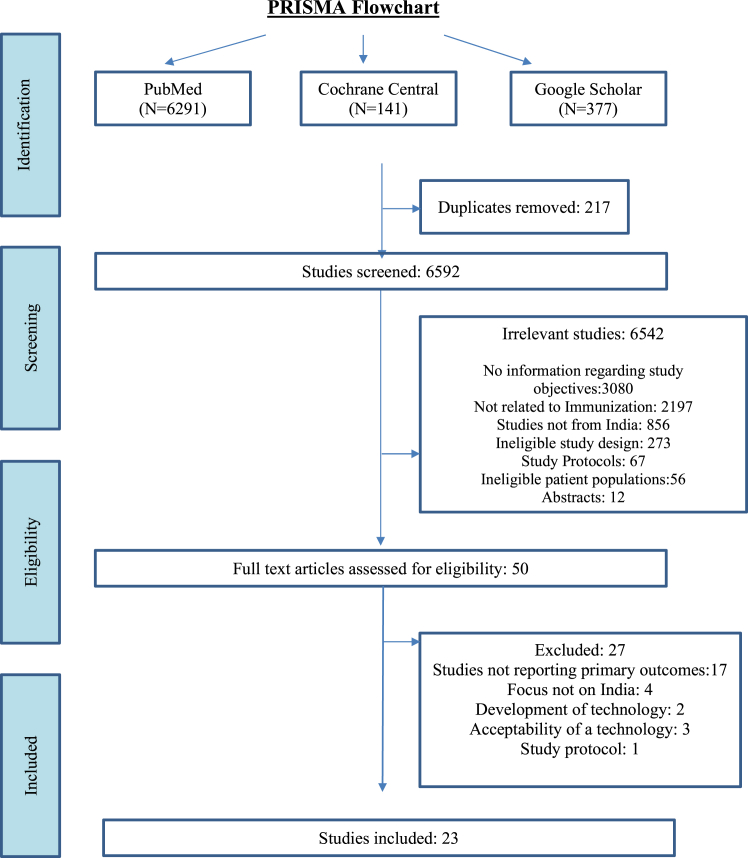
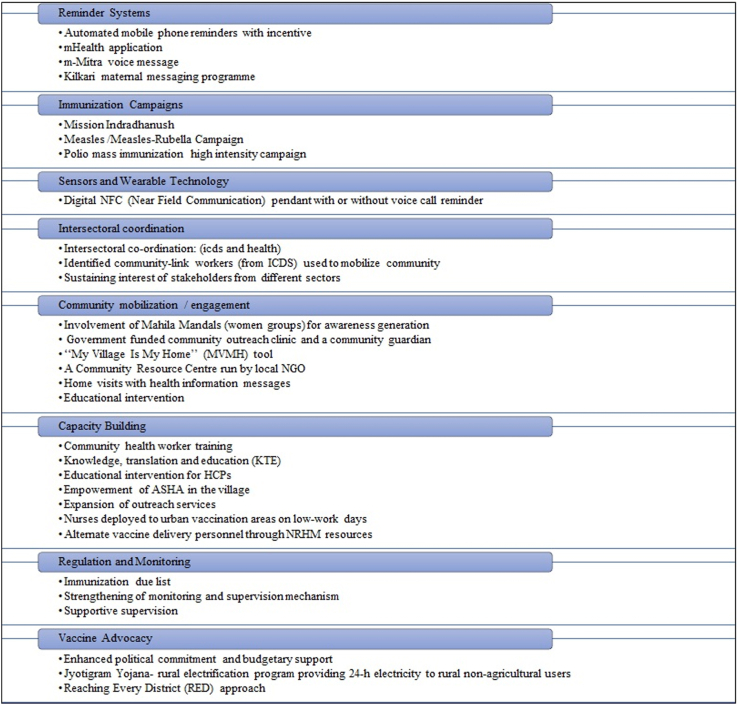
6592 titles and abstracts were screened, and data extracted from 23 India-specific studies. Quality of 22/23 studies was average or above. Technologies identified included reminder systems, capacity building, community engagement and wearable technologies. Automated incentivised mobile phone reminders, immunization due-list, computerized data tracking, community mobilization and campaigns improved vaccine coverage, although effectiveness of some varied viz., reminder systems, and across states. Newer technologies included the Jyotigram Yojana, Digital Near-field Communication Pendants, "Reaching Every District" Programme and the "My Village My Home" tool.
Technologies for improving immunization systems, capacity building and community engagement were effective. Newer technologies on vaccine delivery, mapping and cold chain logistics were not evaluated in India or were ineffective. There were limited studies in populations other than children and pregnant women. Future work is needed to evaluate the effectiveness of identified technologies across diverse settings.
No funding was received for preparing this manuscript.
印度不同环境、地理区域和人群的免疫接种覆盖率各不相同。改善免疫接种可及性的技术能够减少覆盖率方面的差异。本项遵循PRISMA指南的系统评价旨在研究加强印度免疫接种覆盖率的技术。
检索了2011年1月1日至2021年7月31日期间发表在Medline(通过PubMed)、Cochrane图书馆和谷歌学术上的研究。纳入了除定性研究外的所有观察性和实验性研究。纳入了以英文发表的、与加强免疫接种技术相关的、针对印度所有环境下的儿童、孕妇、成年人、老年人、医护人员、照料者和弱势群体开展的研究。排除非英文文章、方案、评论、信函、摘要、通信、观点文章、建模、叙述性综述和系统评价。两名评审员独立筛选研究,在标准化表格中提取数据,并使用混合方法评估工具评估研究质量。主要结局是改善免疫接种覆盖率的技术。该方案已在开放科学框架(https://osf.io/r42gm)注册。
筛选了6592个标题和摘要,并从23项印度特定研究中提取了数据。23项研究中有22项的质量为中等或以上。确定的技术包括提醒系统、能力建设、社区参与和可穿戴技术。自动化激励手机提醒、免疫接种应种清单、计算机化数据跟踪、社区动员和宣传活动提高了疫苗接种覆盖率,尽管某些技术(如提醒系统)的效果在不同邦有所不同。较新的技术包括 Jyotigram Yojana、数字近场通信吊坠、“覆盖每个区”计划和“我的村庄我的家”工具。
改善免疫接种系统、能力建设和社区参与的技术是有效的。关于疫苗接种、地图绘制和冷链物流的较新技术在印度未得到评估或效果不佳。除儿童和孕妇外,其他人群的研究有限。未来需要开展工作,评估已确定技术在不同环境中的有效性。
撰写本稿件未获得资金支持。