Nagy Csaba, Thiel Kati, Mulaku Edita, Mustila Henna, Tamagnini Paula, Aro Eva-Mari, Pacheco Catarina C, Kallio Pauli
Molecular Plant Biology, Department of Life Technologies, University of Turku, Itäinen Pitkäkatu 4 C, 20520, Turku, Finland.
i3S-Instituto de Investigação e Inovação em Saúde, Universidade do Porto, Rua Alfredo Allen, 208, 4200-135, Porto, Portugal.
Microb Cell Fact. 2021 Jul 10;20(1):130. doi: 10.1186/s12934-021-01622-2.
Synechocystis sp. PCC 6803 provides a well-established reference point to cyanobacterial metabolic engineering as part of basic photosynthesis research, as well as in the development of next-generation biotechnological production systems. This study focused on expanding the current knowledge on genomic integration of expression constructs in Synechocystis, targeting a range of novel sites in the chromosome and in the native plasmids, together with established loci used in literature. The key objective was to obtain quantitative information on site-specific expression in reference to replicon copy numbers, which has been speculated but never compared side by side in this host.
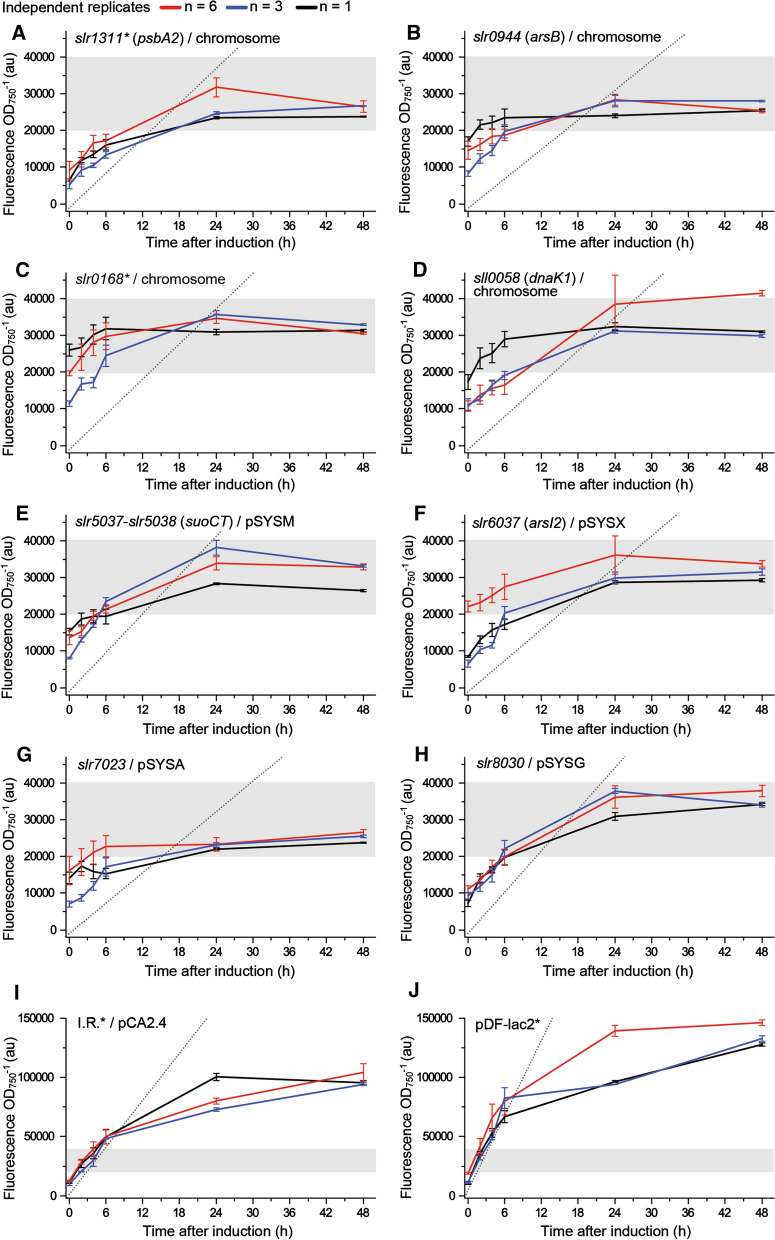
An optimized sYFP2 expression cassette was successfully integrated in two novel sites in Synechocystis chromosome (slr0944; sll0058) and in all four endogenous megaplasmids (pSYSM/slr5037-slr5038; pSYSX/slr6037; pSYSA/slr7023; pSYSG/slr8030) that have not been previously evaluated for the purpose. Fluorescent analysis of the segregated strains revealed that the expression levels between the megaplasmids and chromosomal constructs were very similar, and reinforced the view that highest expression in Synechocystis can be obtained using RSF1010-derived replicative vectors or the native small plasmid pCA2.4 evaluated in comparison. Parallel replicon copy number analysis by RT-qPCR showed that the expression from the alternative loci is largely determined by the gene dosage in Synechocystis, thereby confirming the dependence formerly proposed based on literature.
This study brings together nine different integrative loci in the genome of Synechocystis to demonstrate quantitative differences between target sites in the chromosome, the native plasmids, and a RSF1010-based replicative expression vector. To date, this is the most comprehensive comparison of alternative integrative sites in Synechocystis, and provides the first direct reference between expression efficiency and replicon gene dosage in the context. In the light of existing literature, the findings support the view that the small native plasmids can be notably more difficult to target than the chromosome or the megaplasmids, and that the RSF1010-derived vectors may be surprisingly well maintained under non-selective culture conditions in this cyanobacterial host. Altogether, the work broadens our views on genomic integration and the rational use of different integrative loci versus replicative plasmids, when aiming at expressing heterologous genes in Synechocystis.
集胞藻PCC 6803作为基础光合作用研究以及下一代生物技术生产系统开发的一部分,为蓝藻代谢工程提供了一个成熟的参考点。本研究旨在扩展当前关于集胞藻中表达构建体基因组整合的知识,针对染色体和天然质粒中的一系列新位点以及文献中使用的既定位点。关键目标是获得关于特定位点表达相对于复制子拷贝数的定量信息,这一点虽有推测但在该宿主中从未进行过并排比较。
一个优化的sYFP2表达盒成功整合到集胞藻染色体的两个新位点(slr0944;sll0058)以及所有四个内源性大质粒(pSYSM/slr5037 - slr5038;pSYSX/slr6037;pSYSA/slr7023;pSYSG/slr8030)中,此前尚未针对此目的对这些质粒进行评估。对分离菌株的荧光分析表明,大质粒和染色体构建体之间的表达水平非常相似,并强化了这样一种观点,即使用RSF1010衍生的复制载体或经比较评估的天然小质粒pCA2.4可在集胞藻中获得最高表达。通过RT - qPCR进行的平行复制子拷贝数分析表明,来自替代位点的表达在很大程度上由集胞藻中的基因剂量决定,从而证实了先前基于文献提出的依赖性。
本研究汇集了集胞藻基因组中的九个不同整合位点,以证明染色体、天然质粒和基于RSF1010的复制表达载体中目标位点之间的定量差异。迄今为止,这是集胞藻中替代整合位点最全面的比较,并在此背景下首次提供了表达效率与复制子基因剂量之间的直接参考。根据现有文献,这些发现支持这样一种观点,即天然小质粒可能比染色体或大质粒更难靶向,并且基于RSF1010的载体在该蓝藻宿主的非选择性培养条件下可能出人意料地得到良好维持。总体而言,这项工作拓宽了我们对基因组整合以及在集胞藻中表达异源基因时不同整合位点与复制性质粒合理使用的认识。