Almazov National Medical Research Centre, Institute of Endocrinology, 15 Parkhomenko street, St. Petersburg, 194156, Russia.
ITMO University, 9 Lomonosova street, Saint Petersburg, 191002, Russia.
BMC Endocr Disord. 2021 Jul 11;21(1):150. doi: 10.1186/s12902-021-00809-3.
Thyrotoxic atrial fibrillation (TAF) is a recognized significant complication of hyperthyroidism. Early identification of the individuals predisposed to TAF would improve thyrotoxic patients' management. However, to our knowledge, an instrument that establishes an individual risk of the condition is unavailable. Therefore, the aim of this study is to build a TAF prediction model and rank TAF predictors in order of importance using machine learning techniques.
In this retrospective study, we have investigated 36 demographic and clinical features for 420 patients with overt hyperthyroidism, 30% of which had TAF. At first, the association of these features with TAF was evaluated by classical statistical methods. Then, we developed several TAF prediction models with eight different machine learning classifiers and compared them by performance metrics. The models included ten features that were selected based on their clinical effectuality and importance for model output. Finally, we ranked TAF predictors, elicited from the optimal final model, by the machine learning tehniques.
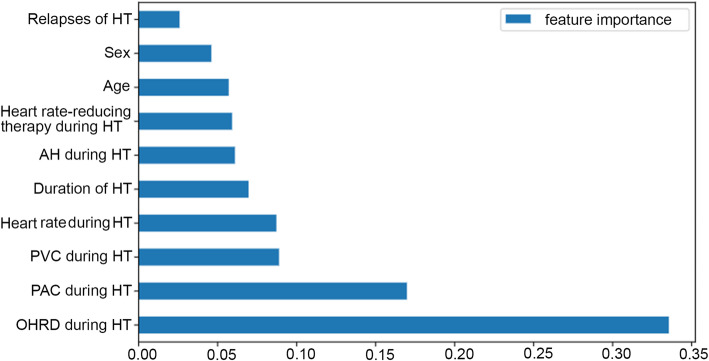
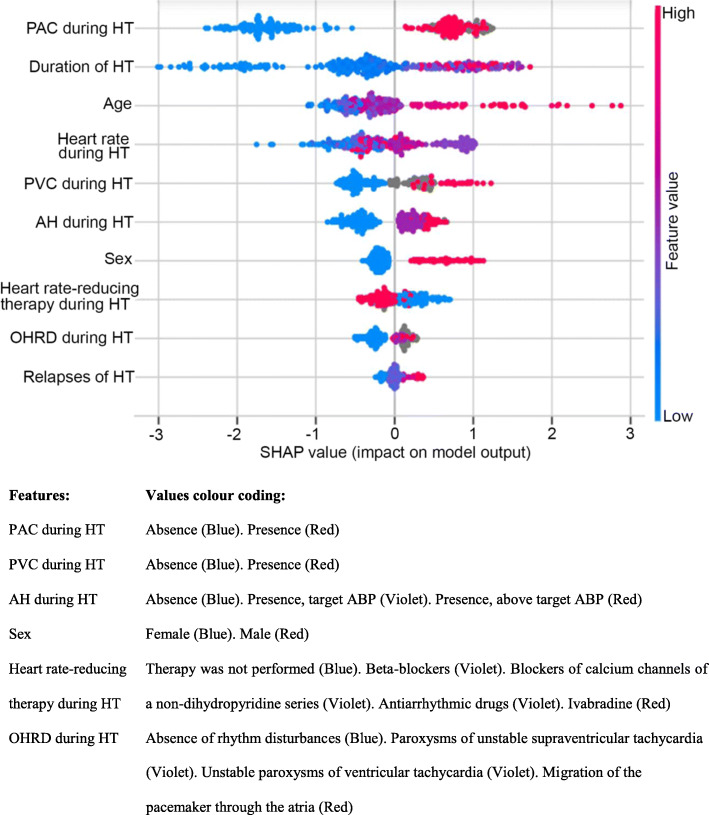
The best performance metrics prediction model was built with the extreme gradient boosting classifier. It had the reasonable accuracy of 84% and AUROC of 0.89 on the test set. The model confirmed such well-known TAF risk factors as age, sex, hyperthyroidism duration, heart rate and some concomitant cardiovascular diseases (arterial hypertension and conjestive heart rate). We also identified premature atrial contraction and premature ventricular contraction as new TAF predictors. The top five TAF predictors, elicited from the model, included (in order of importance) PAC, PVC, hyperthyroidism duration, heart rate during hyperthyroidism and age.
We developed a machine learning model for TAF prediction. It seems to be the first available analytical tool for TAF risk assessment. In addition, we defined five most important TAF predictors, including premature atrial contraction and premature ventricular contraction as the new ones. These results have contributed to TAF prediction investigation and may serve as a basis for further research focused on TAF prediction improvement and facilitation of thyrotoxic patients' management.
甲状腺毒症性心房颤动(TAF)是甲状腺功能亢进的一种公认的严重并发症。早期识别易患 TAF 的个体将改善甲状腺毒症患者的管理。然而,据我们所知,目前尚无确定该疾病个体风险的工具。因此,本研究旨在使用机器学习技术构建 TAF 预测模型,并按重要性对 TAF 预测因子进行排序。
在这项回顾性研究中,我们研究了 420 例显性甲状腺功能亢进患者的 36 项人口统计学和临床特征,其中 30%患有 TAF。首先,通过经典统计学方法评估这些特征与 TAF 的关联。然后,我们使用八种不同的机器学习分类器开发了几个 TAF 预测模型,并通过性能指标进行比较。模型中包含了基于临床有效性和对模型输出重要性选择的十个特征。最后,我们通过机器学习技术对最优最终模型中的 TAF 预测因子进行排序。
使用极端梯度提升分类器构建的预测模型具有最佳的性能指标。它在测试集上的准确率为 84%,AUROC 为 0.89。该模型证实了年龄、性别、甲状腺功能亢进持续时间、心率和一些伴随的心血管疾病(动脉高血压和充血性心力衰竭)等众所周知的 TAF 危险因素。我们还确定了房性期前收缩和室性期前收缩为新的 TAF 预测因子。从模型中得出的五个最重要的 TAF 预测因子(按重要性排序)包括房性期前收缩、室性期前收缩、甲状腺功能亢进持续时间、甲状腺功能亢进期间的心率和年龄。
我们开发了一种用于 TAF 预测的机器学习模型。它似乎是第一个用于 TAF 风险评估的分析工具。此外,我们确定了五个最重要的 TAF 预测因子,包括房性期前收缩和室性期前收缩,这是新的预测因子。这些结果有助于 TAF 预测的研究,并可能为进一步研究提供基础,重点关注 TAF 预测的改善和甲状腺毒症患者管理的便利。