Bristol-Myers Squibb Pharmaceutical Ltd, Uxbridge, United Kingdom.
Health Economics and Outcomes Research Ltd, Cardiff, United Kingdom.
PLoS One. 2019 Nov 1;14(11):e0224582. doi: 10.1371/journal.pone.0224582. eCollection 2019.
Atrial fibrillation (AF) is the most common sustained heart arrhythmia. However, as many cases are asymptomatic, a large proportion of patients remain undiagnosed until serious complications arise. Efficient, cost-effective detection of the undiagnosed may be supported by risk-prediction models relating patient factors to AF risk. However, there exists a need for an implementable risk model that is contemporaneous and informed by routinely collected patient data, reflecting the real-world pathology of AF.
This study sought to develop and evaluate novel and conventional statistical and machine learning models for risk-predication of AF. This was a retrospective, cohort study of adults (aged ≥30 years) without a history of AF, listed on the Clinical Practice Research Datalink, from January 2006 to December 2016. Models evaluated included published risk models (Framingham, ARIC, CHARGE-AF), machine learning models, which evaluated baseline and time-updated information (neural network, LASSO, random forests, support vector machines), and Cox regression.
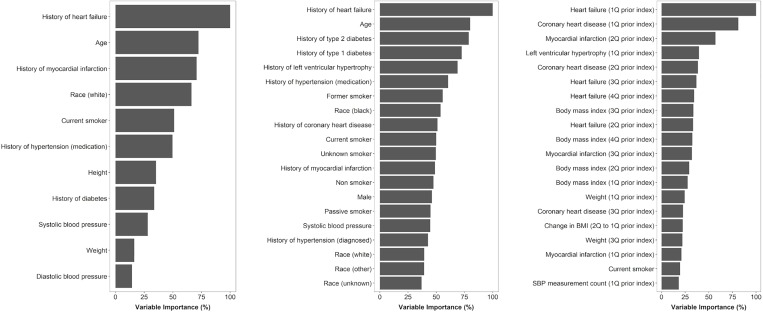
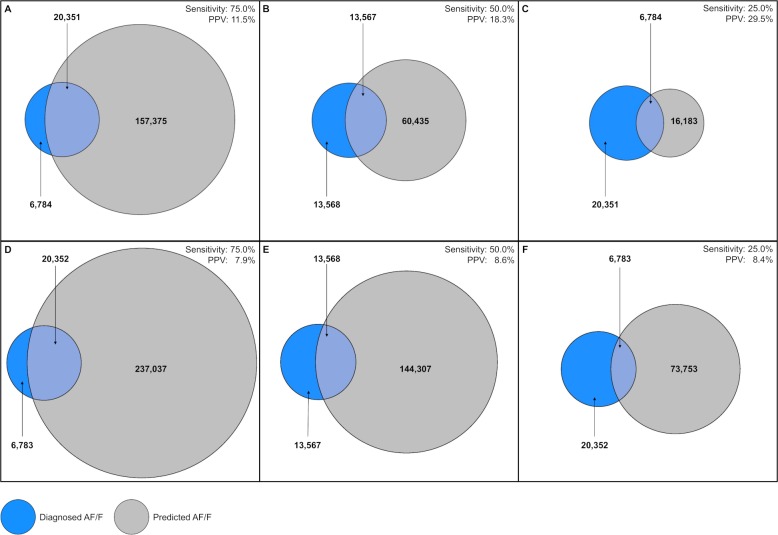
Analysis of 2,994,837 individuals (3.2% AF) identified time-varying neural networks as the optimal model achieving an AUROC of 0.827 vs. 0.725, with number needed to screen of 9 vs. 13 patients at 75% sensitivity, when compared with the best existing model CHARGE-AF. The optimal model confirmed known baseline risk factors (age, previous cardiovascular disease, antihypertensive medication usage) and identified additional time-varying predictors (proximity of cardiovascular events, body mass index (both levels and changes), pulse pressure, and the frequency of blood pressure measurements).
The optimal time-varying machine learning model exhibited greater predictive performance than existing AF risk models and reflected known and new patient risk factors for AF.
心房颤动(AF)是最常见的持续性心律失常。然而,由于许多病例无症状,很大一部分患者在出现严重并发症之前未被诊断。通过将患者因素与 AF 风险相关联的风险预测模型,可以有效地、具有成本效益地检测未被诊断的病例。然而,需要有一种可实施的风险模型,该模型与常规收集的患者数据相关联,反映 AF 的真实病理,并具有时效性。
本研究旨在开发和评估用于预测 AF 风险的新型和传统统计及机器学习模型。这是一项回顾性队列研究,纳入了 2006 年 1 月至 2016 年 12 月期间 Clinical Practice Research Datalink 中无 AF 病史的成年人(年龄≥30 岁)。评估的模型包括已发表的风险模型(Framingham、ARIC、CHARGE-AF)、机器学习模型,这些模型评估了基线和时间更新信息(神经网络、LASSO、随机森林、支持向量机)和 Cox 回归。
对 2994837 名个体(3.2%的 AF)进行分析,发现时变神经网络是最佳模型,其 AUC 为 0.827,优于最佳现有模型 CHARGE-AF 的 0.725,当灵敏度为 75%时,所需的筛查人数为 9 人,而不是 13 人。最佳模型证实了已知的基线风险因素(年龄、既往心血管疾病、降压药物使用),并确定了其他时变预测因素(心血管事件的临近、体重指数(水平和变化)、脉压和血压测量的频率)。
最佳时变机器学习模型的预测性能优于现有的 AF 风险模型,并反映了 AF 的已知和新的患者风险因素。