Chettinad College of Nursing (CCN), Chettinad Academy of Research and Education (CARE), Chettinad Health City, Rajiv Gandhi Salai, OMR, 603103, Kelambakkam, Tamil Nadu, Chennai, India.
Dr. M.G.R Educational and Research Institute, Maduravoil, Chennai, India.
Int J Equity Health. 2021 Jul 12;20(1):160. doi: 10.1186/s12939-021-01493-4.
Appropriate choice of research design is essential to rightly understand the research problem and derive optimal solutions. The Comorbidity Action in the North project sought to better meet the needs of local people affected by drug, alcohol and mental health comorbidity. The aim of the study focused on the needs of Aboriginal peoples and on developing a truly representative research process. A methodology evolved that best suited working with members of a marginalised Aboriginal community. This paper discusses the process of co-design of a Western methodology (participatory action research) in conjunction with the Indigenous methodologies Dadirri and Ganma. This co-design enabled an international PhD student to work respectfully with Aboriginal community members and Elders, health professionals and consumers, and non-Indigenous service providers in a drug and alcohol and mental health comorbidity project in Adelaide, South Australia.
The PhD student, Aboriginal Elder mentor, Aboriginal Working Party, and supervisors (the research team) sought to co-design a methodology and applied it to address the following challenges: the PhD student was an international student with no existing relationship with local Aboriginal community members; many Aboriginal people deeply distrust Western research due to past poor practices and a lack of implementation of findings into practice; Aboriginal people often remain unheard, unacknowledged and unrecognised in research projects; drug and alcohol and mental health comorbidity experiences are often distressing for Aboriginal community members and their families; attempts to access comorbidity care often result in limited or no access; and Aboriginal community members experience acts of racism and discrimination as health professionals and consumers of health and support services. The research team considered deeply how knowledge is shared, interpreted, owned and controlled, by whom and how, within research, co-morbidity care and community settings. The PhD student was supported to co-design a methodology that was equitable, democratic, liberating and life-enhancing, with real potential to develop feasible solutions.
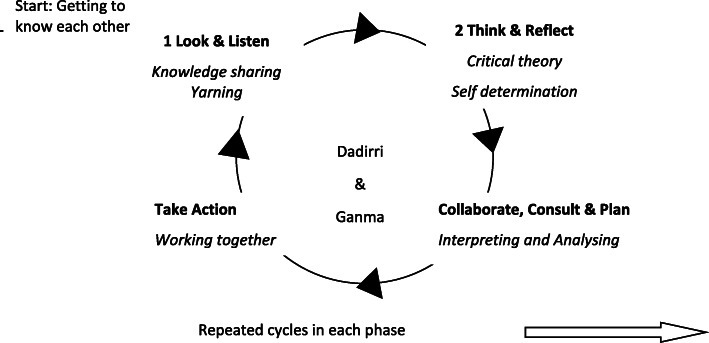
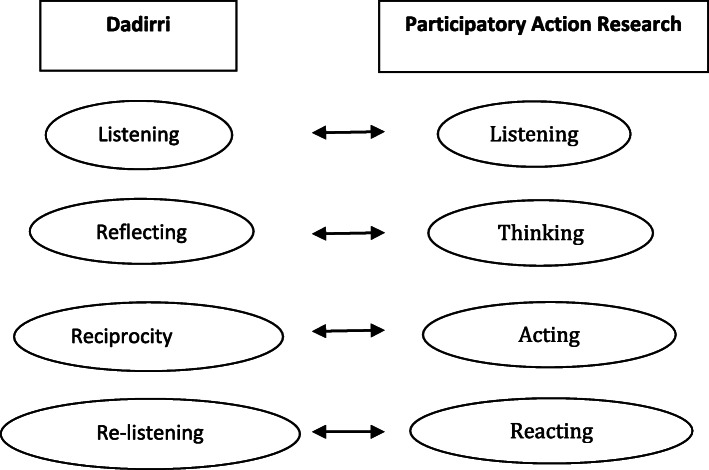
The resulting combined Participatory Action Research (PAR)-Dadirri-Ganma methodology sought to create a bridge across Western and Aboriginal knowledges, understanding and experiences. Foundation pillars of this bridge were mentoring of the PhD student by senior Elders, who explained and demonstrated the critical importance of Yarning (consulting) and Indigenous methodologies of Dadirri (deep listening) and Ganma (two-way knowledge sharing), and discussions among all involved about the principles of Western PAR.
Concepts within this paper are shared from the perspective of the PhD student with the permission and support of local Elders and Working Group members. The intention is to share what was learned for the benefit of other students, research projects and community members who are beginning a similar journey.
适当选择研究设计对于正确理解研究问题并得出最佳解决方案至关重要。“北方共病行动”项目旨在更好地满足受药物、酒精和精神健康共病影响的当地民众的需求。该研究的重点是满足原住民的需求,并开发一种真正具有代表性的研究过程。为此,我们制定了一种最适合与边缘化的原住民社区成员合作的方法。本文讨论了将西方方法论(参与式行动研究)与本土方法 Dadirri 和 Ganma 共同设计的过程。这种共同设计使一名国际博士生能够在南澳大利亚阿德莱德的一个药物、酒精和精神健康共病项目中,尊重地与原住民社区成员、长者、卫生专业人员和消费者以及非原住民服务提供者合作。
博士生、原住民长者导师、原住民工作组和导师(研究团队)试图共同设计一种方法,并将其应用于以下挑战:博士生是一名国际学生,与当地原住民社区成员没有现有关系;许多原住民因过去的不良做法以及研究结果未能付诸实践而对西方研究深感不信任;原住民在研究项目中往往被忽视、不被承认和不被认可;药物、酒精和精神健康共病经历常常使原住民社区成员及其家人感到痛苦;尝试获得共病护理通常导致有限或无法获得护理;原住民社区成员在作为卫生专业人员和卫生及支持服务的消费者时会经历种族主义和歧视行为。研究团队深入考虑了在研究、共病护理和社区环境中,知识是如何由谁以何种方式共享、解释、拥有和控制的。博士生在导师的支持下共同设计了一种公平、民主、解放和增强生活的方法,具有切实可行的解决方案的发展潜力。
由此产生的结合参与式行动研究(PAR)-Dadirri-Ganma 方法旨在在西方和原住民知识、理解和经验之间架起一座桥梁。这座桥梁的基础支柱是由资深长者对博士生进行指导,他们解释并强调了 Yarning(咨询)和原住民方法 Dadirri(深度倾听)和 Ganma(双向知识共享)的重要性,并让所有相关人员讨论了西方 PAR 的原则。
本文的概念是在当地长者和工作组成员的许可和支持下,从博士生的角度分享的。目的是为其他学生、研究项目和正在开始类似旅程的社区成员分享经验。