Department of Transplantation, Xinhua Hospital Affiliated to Shanghai Jiao Tong University School of Medicine, Shanghai, China.
Front Immunol. 2021 Jun 23;12:690869. doi: 10.3389/fimmu.2021.690869. eCollection 2021.
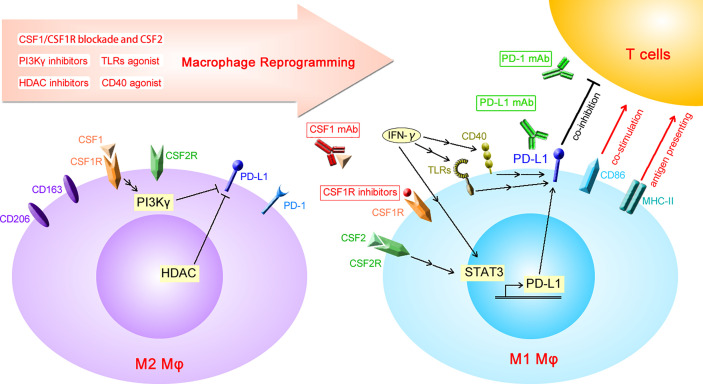
Classically activated M1 macrophages and alternatively activated M2 macrophages are two polarized subsets of macrophages at the extreme ends of a constructed continuum. In the field of cancer research, M2 macrophage reprogramming is defined as the repolarization of pro-tumoral M2 to anti-tumoral M1 macrophages. It is known that colony-stimulating factor 1 (CSF1)/CSF1 receptor (CSF1R) and CSF2/CSF2R signaling play important roles in macrophage polarization. Targeting CSF1/CSF1R for M2 macrophage reprogramming has been widely performed in clinical trials for cancer therapy. Other targets for M2 macrophage reprogramming include Toll-like receptor 7 (TLR7), TLR8, TLR9, CD40, histone deacetylase (HDAC), and PI3Kγ. Although macrophages are involved in innate and adaptive immune responses, M1 macrophages are less effective at phagocytosis and antigen presenting, which are required properties for the activation of T cells and eradication of cancer cells. Similar to T and dendritic cells, the "functionally exhausted" status might be attributed to the high expression of programmed death-ligand 1 (PD-L1) or programmed cell death protein 1 (PD-1). PD-L1 is expressed on both M1 and M2 macrophages. Macrophage reprogramming from M2 to M1 might increase the expression of PD-L1, which can be transcriptionally activated by STAT3. Macrophage reprogramming or PD-L1/PD-1 blockade alone is less effective in the treatment of most cancers. Since PD-L1/PD-1 blockade could make up for the defect in macrophage reprogramming, the combination of macrophage reprogramming and PD-L1/PD-1 blockade might be a novel treatment strategy for cancer therapy.
经典激活的 M1 巨噬细胞和选择性激活的 M2 巨噬细胞是处于构建连续体两端的两种极化的巨噬细胞亚群。在癌症研究领域,M2 巨噬细胞重编程被定义为将促肿瘤的 M2 巨噬细胞重编程为抗肿瘤的 M1 巨噬细胞。众所周知,集落刺激因子 1(CSF1)/CSF1 受体(CSF1R)和 CSF2/CSF2R 信号在巨噬细胞极化中发挥重要作用。针对 CSF1/CSF1R 进行 M2 巨噬细胞重编程已广泛应用于癌症治疗的临床试验。M2 巨噬细胞重编程的其他靶点包括 Toll 样受体 7(TLR7)、TLR8、TLR9、CD40、组蛋白去乙酰化酶(HDAC)和 PI3Kγ。尽管巨噬细胞参与先天和适应性免疫反应,但 M1 巨噬细胞在吞噬作用和抗原呈递方面的效果较差,而这些特性是 T 细胞激活和癌细胞消除所必需的。与 T 细胞和树突状细胞类似,“功能耗竭”状态可能归因于程序性死亡配体 1(PD-L1)或程序性细胞死亡蛋白 1(PD-1)的高表达。PD-L1 在 M1 和 M2 巨噬细胞上均有表达。M2 巨噬细胞向 M1 巨噬细胞的重编程可能会增加 PD-L1 的表达,PD-L1 可被 STAT3 转录激活。单独进行巨噬细胞重编程或 PD-L1/PD-1 阻断在治疗大多数癌症方面效果较差。由于 PD-L1/PD-1 阻断可以弥补巨噬细胞重编程的缺陷,因此巨噬细胞重编程和 PD-L1/PD-1 阻断的联合可能是癌症治疗的一种新的治疗策略。