Department of Medical Microbiology and Immunology, University of Toledo College of Medicine and Life Sciences, Toledo, OH, USA.
Department of Neurosciences, University of Toledo College of Medicine and Life Sciences, Toledo, OH, USA.
Neuropsychopharmacol Rep. 2021 Sep;41(3):325-335. doi: 10.1002/npr2.12194. Epub 2021 Jul 13.
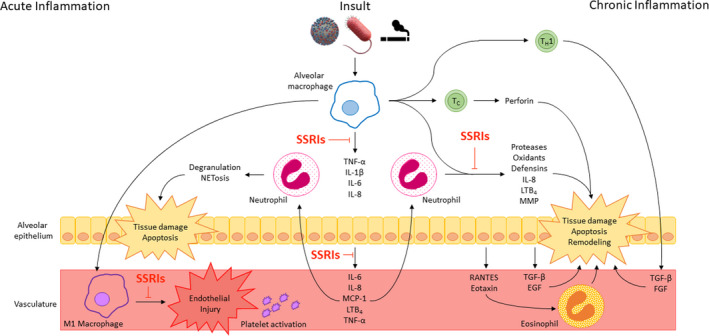
Selective serotonin reuptake inhibitors (SSRIs) have anti-inflammatory properties that may have clinical utility in treating severe pulmonary manifestations of COVID-19. SSRIs exert anti-inflammatory effects at three mechanistic levels: (a) inhibition of proinflammatory transcription factor activity, including NF-κB and STAT3; (b) downregulation of lung tissue damage and proinflammatory cell recruitment via inhibition of cytokines, including IL-6, IL-8, TNF-α, and IL-1β; and (c) direct suppression inflammatory cells, including T cells, macrophages, and platelets. These pathways are implicated in the pathogenesis of COVID-19. In this review, we will compare the pathogenesis of lung inflammation in pulmonary diseases including COVID-19, ARDS, and chronic obstructive pulmonary disease (COPD), describe the anti-inflammatory properties of SSRIs, and discuss the applications of SSRIS in treating COVID-19-associated inflammatory lung disease.
选择性 5-羟色胺再摄取抑制剂(SSRIs)具有抗炎特性,可能在治疗 COVID-19 的严重肺部表现方面具有临床应用价值。SSRIs 通过三种机制水平发挥抗炎作用:(a)抑制包括 NF-κB 和 STAT3 在内的促炎转录因子活性;(b)通过抑制细胞因子(包括 IL-6、IL-8、TNF-α和 IL-1β)来下调肺组织损伤和促炎细胞募集;(c)通过直接抑制包括 T 细胞、巨噬细胞和血小板在内的炎症细胞。这些途径与 COVID-19 的发病机制有关。在这篇综述中,我们将比较包括 COVID-19、ARDS 和慢性阻塞性肺疾病(COPD)在内的肺部疾病中肺炎症的发病机制,描述 SSRIs 的抗炎特性,并讨论 SSRIs 在治疗 COVID-19 相关炎症性肺病中的应用。