Department of Pediatrics, Stanford University School of Medicine, Palo Alto, CA, United States.
Operations, Information, and Technology, Stanford University Graduate School of Business, Stanford, CA, United States.
J Med Internet Res. 2021 Jul 6;23(7):e26817. doi: 10.2196/26817.
New technology adoption is common in health care, but it may elicit frustration if end users are not sufficiently considered in their design or trained in their use. These frustrations may contribute to burnout.
This study aimed to evaluate and quantify health care workers' frustration with technology and its relationship with emotional exhaustion, after controlling for measures of work-life integration that may indicate excessive job demands.
This was a cross-sectional, observational study of health care workers across 31 Michigan hospitals. We used the Safety, Communication, Operational Reliability, and Engagement (SCORE) survey to measure work-life integration and emotional exhaustion among the survey respondents. We used mixed-effects hierarchical linear regression to evaluate the relationship among frustration with technology, other components of work-life integration, and emotional exhaustion, with adjustment for unit and health care worker characteristics.
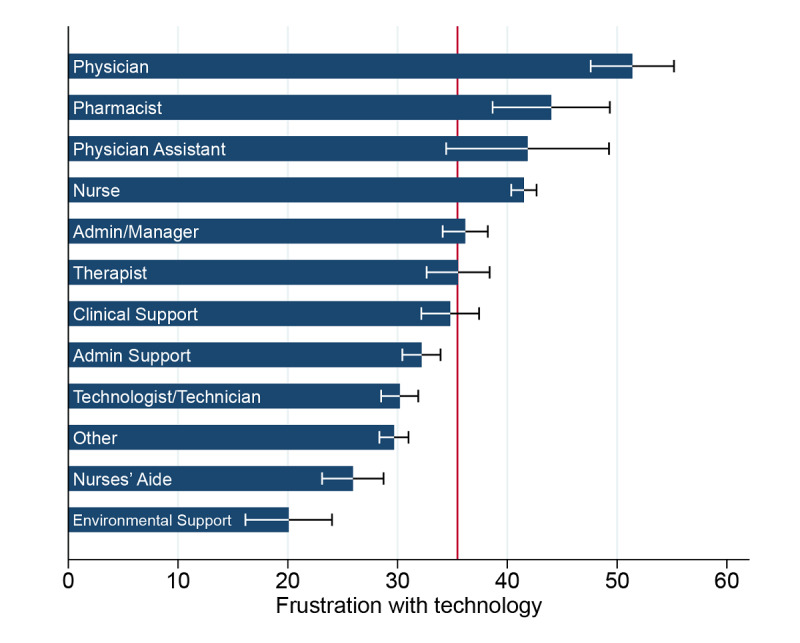
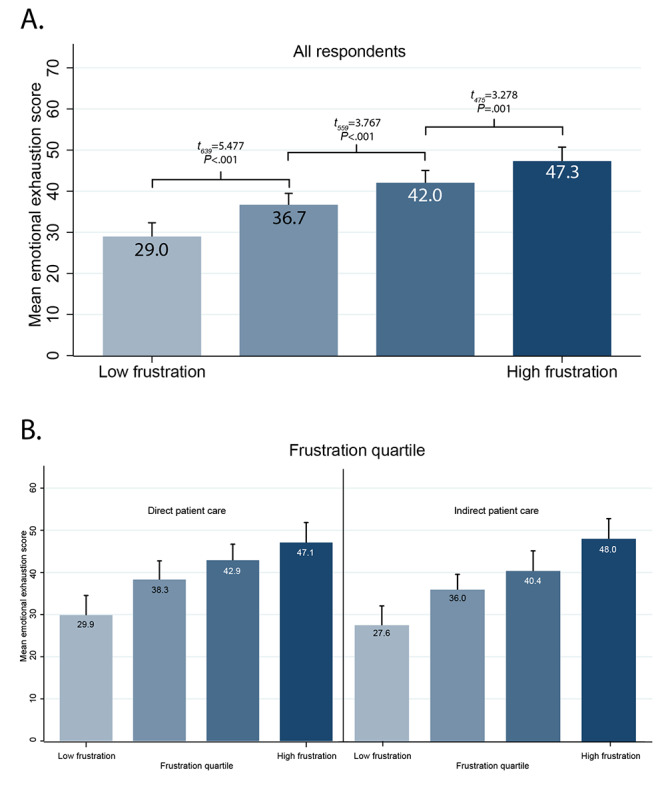
Of 15,505 respondents, 5065 (32.7%) reported that they experienced frustration with technology on at least 3-5 days per week. Frustration with technology was associated with higher scores for the composite Emotional Exhaustion scale (r=0.35, P<.001) and each individual item on the Emotional Exhaustion scale (r=0.29-0.36, P<.001 for all). Each 10-point increase in the frustration with technology score was associated with a 1.2-point increase (95% CI 1.1-1.4) in emotional exhaustion (both measured on 100-point scales), after adjustment for other work-life integration items and unit and health care worker characteristics.
This study found that frustration with technology and several other markers of work-life integration are independently associated with emotional exhaustion among health care workers. Frustration with technology is common but not ubiquitous among health care workers, and it is one of several work-life integration factors associated with emotional exhaustion. Minimizing frustration with health care technology may be an effective approach in reducing burnout among health care workers.
新科技在医疗保健领域很常见,但如果在设计过程中没有充分考虑终端用户的需求,或者没有对他们进行使用培训,可能会引起用户的不满。这些不满可能会导致职业倦怠。
本研究旨在评估和量化医疗保健工作者对技术的不满,并在控制可能表明工作需求过高的工作-生活整合措施后,量化其与情绪疲惫之间的关系。
这是一项在密歇根州 31 家医院进行的横断面、观察性研究。我们使用安全、沟通、操作可靠性和参与度(SCORE)调查来衡量调查对象的工作-生活整合和情绪疲惫程度。我们使用混合效应分层线性回归来评估技术不满与工作-生活整合的其他组成部分以及情绪疲惫之间的关系,同时调整单位和医疗保健工作者特征。
在 15505 名受访者中,有 5065 名(32.7%)报告称,他们每周至少有 3-5 天对技术感到不满。对技术的不满与综合情绪疲惫评分较高相关(r=0.35,P<.001),与情绪疲惫评分的每个单独项目也都相关(r=0.29-0.36,P<.001)。在调整其他工作-生活整合项目以及单位和医疗保健工作者特征后,对技术不满评分每增加 10 分,情绪疲惫评分就会增加 1.2 分(95%CI 1.1-1.4)(均在 100 分量表上测量)。
本研究发现,对技术的不满以及其他几个工作-生活整合指标与医疗保健工作者的情绪疲惫独立相关。对技术的不满在医疗保健工作者中很常见,但并非普遍存在,它是与情绪疲惫相关的几个工作-生活整合因素之一。减少对医疗保健技术的不满可能是减少医疗保健工作者职业倦怠的有效方法。