Department of Environmental Medicine and Public Health, Icahn School of Medicine at Mount Sinai, New York, NY, USA.
Department of Statistical Science, Duke University, Durham, NC, USA.
Environ Int. 2021 Nov;156:106750. doi: 10.1016/j.envint.2021.106750. Epub 2021 Jul 10.
Birthweight is an indicator of fetal growth and environmental-related alterations of birthweight have been linked with multiple disorders and conditions progressing into adulthood. Although a few studies have assessed the association between birthweight and the totality of exogenous exposures and their downstream molecular responses in maternal urine and cord blood; no prior research has considered a) the maternal serum prenatal metabolome, which is enriched for hormones, and b) non-linear and synergistic associations among exposures.
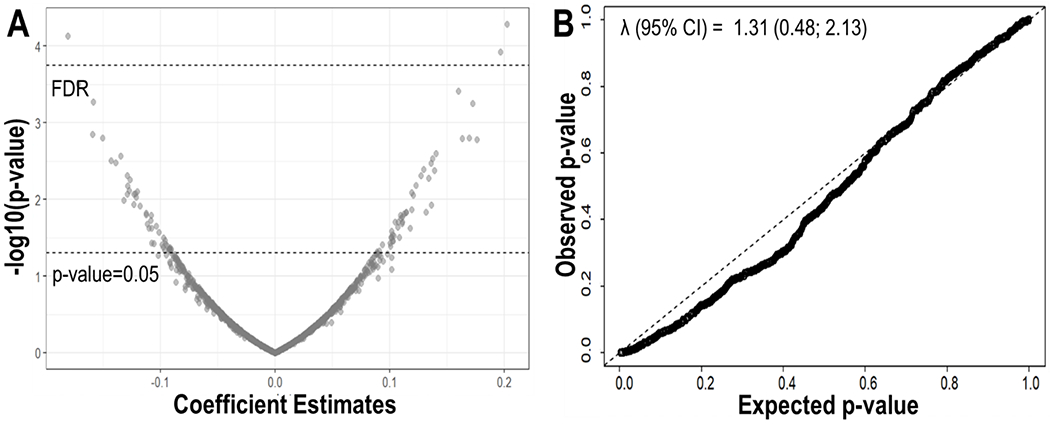
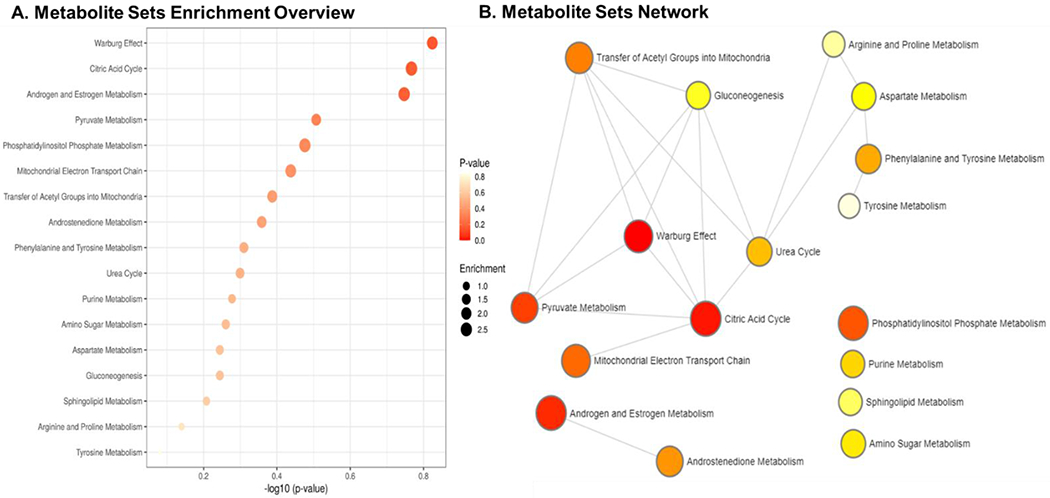
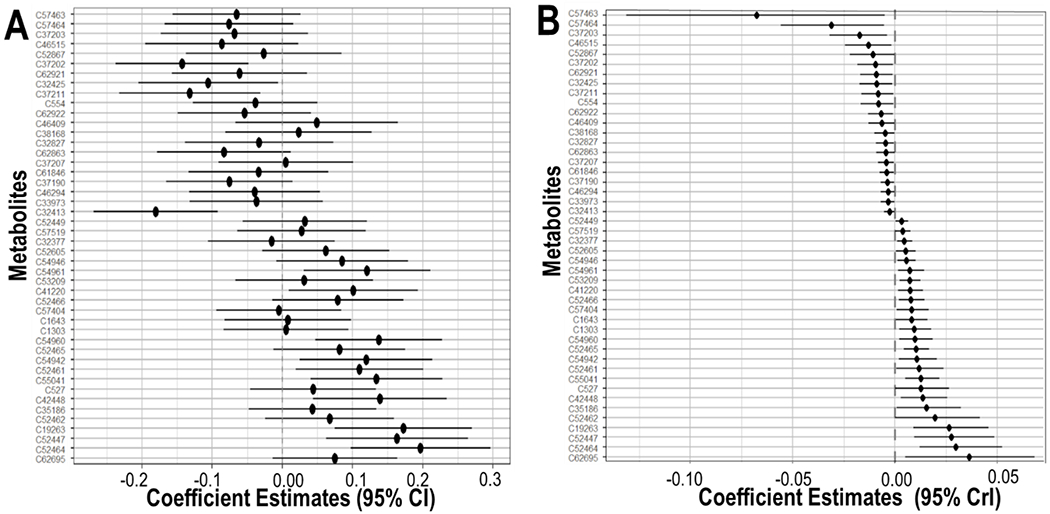
We measured the maternal serum metabolome during pregnancy using an untargeted metabolomics approach and birthweight for gestational age (BWGA) z-score in 410 mother-child dyads enrolled in the PRogramming of Intergenerational Stress Mechanisms (PRISM) cohort. We leveraged a Bayesian factor analysis for interaction to select the most important metabolites associated with BWGA z-score and to evaluate their linear, non-linear and non-additive associations. We also assessed the primary biological functions of the identified proteins using the MetaboAnalyst, a centralized repository of curated functional information. We compared our findings with those of a traditional metabolite-wide association study (MWAS) in which metabolites are individually associated with BWGA z-score.
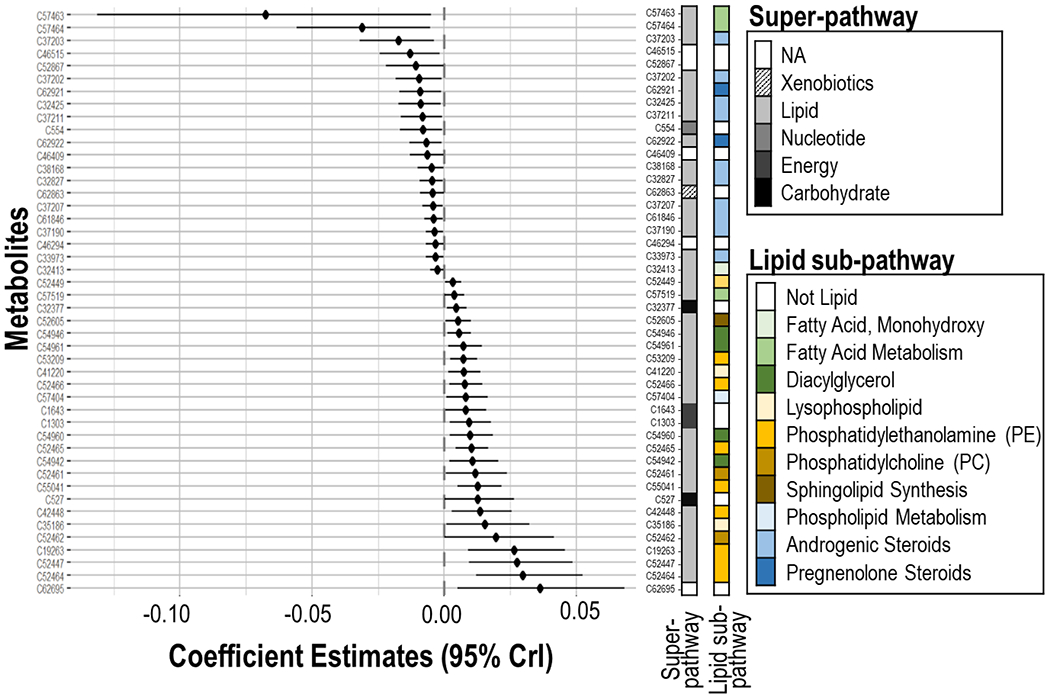
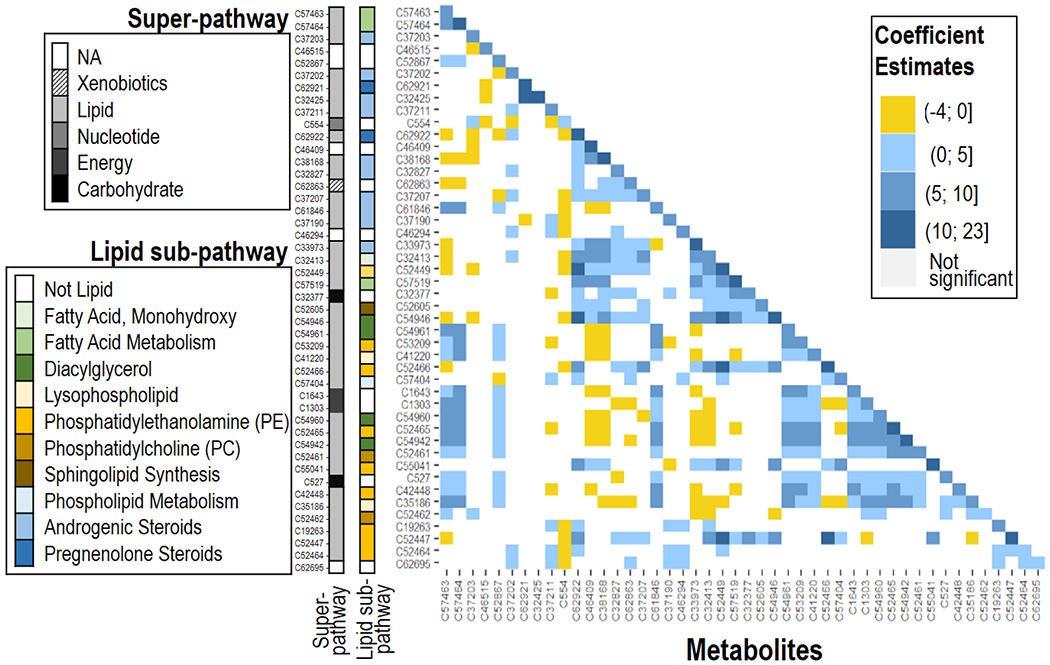
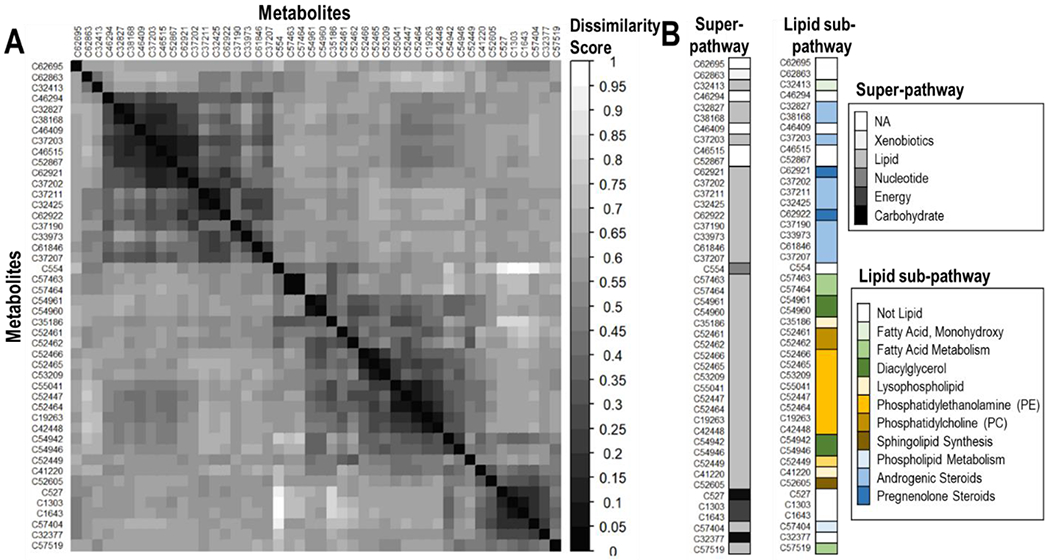
Among 1110 metabolites, 46 showed evidence of U-shape associations with BWGA z-score. Most of the identified metabolites (85%) were lipids primarily enriched for pathways central to energy production, immune function, and androgen and estrogen metabolism, which are essential for pregnancy and parturition processes. Metabolites within the same class, i.e. steroids and phospholipids, showed synergistic relationships with each other.
Our results support that the aspects of the maternal metabolome during pregnancy contribute linearly, non-linearly and synergistically to variation in newborn birthweight.
出生体重是胎儿生长的一个指标,与出生体重相关的环境改变与多种疾病和成年后出现的状况有关。虽然有一些研究评估了出生体重与母体尿液和脐带血中外源暴露及其下游分子反应的总和之间的关系,但之前的研究没有考虑到:a)母体血清产前代谢组学,它富含激素;b)暴露之间的非线性和协同关系。
我们使用非靶向代谢组学方法测量了 410 对母子对在 PRogramming of Intergenerational Stress Mechanisms(PRISM)队列中妊娠期间的母体血清代谢组学,并测量了出生体重与胎龄(BWGA)z 评分。我们利用贝叶斯因子分析交互作用来选择与 BWGA z 评分最相关的最重要代谢物,并评估它们的线性、非线性和非加性关联。我们还使用 MetaboAnalyst(一个集中的功能信息库)评估了所鉴定蛋白的主要生物学功能。我们将我们的发现与传统的代谢物全关联研究(MWAS)进行了比较,其中代谢物单独与 BWGA z 评分相关联。
在 1110 种代谢物中,有 46 种代谢物与 BWGA z 评分呈 U 形关联。所鉴定的代谢物中(85%)大多数是脂质,主要富集在能量产生、免疫功能和雄激素和雌激素代谢的中心途径,这些途径对妊娠和分娩过程至关重要。同一类别的代谢物,如类固醇和磷脂,彼此之间表现出协同关系。
我们的结果支持妊娠期间母体代谢组的各个方面以线性、非线性和协同的方式对新生儿出生体重的变化做出贡献。