1st Department of Pathology and Experimental Cancer Research, Semmelweis University, Budapest, Hungary.
2nd Department of Pathology, Semmelweis University, Budapest, Hungary.
Pathol Oncol Res. 2021 May 3;27:1609802. doi: 10.3389/pore.2021.1609802. eCollection 2021.
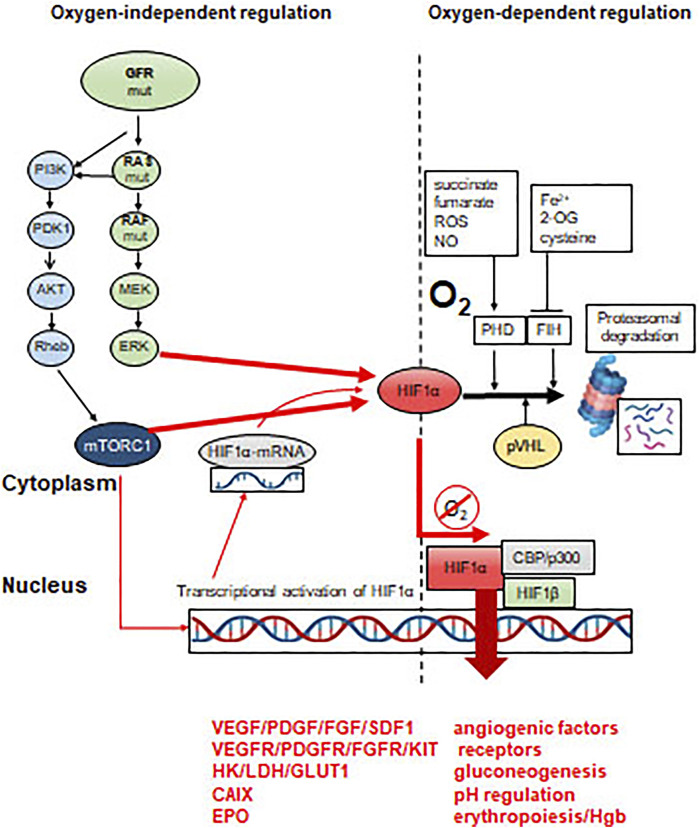
Cancer hypoxia, recognized as one of the most important hallmarks of cancer, affects gene expression, metabolism and ultimately tumor biology-related processes. Major causes of cancer hypoxia are deficient or inappropriate vascularization and systemic hypoxia of the patient (frequently induced by anemia), leading to a unique form of genetic reprogramming by hypoxia induced transcription factors (HIF). However, constitutive activation of oncogene-driven signaling pathways may also activate hypoxia signaling independently of oxygen supply. The consequences of HIF activation in tumors are the angiogenic phenotype, a novel metabolic profile and the immunosuppressive microenvironment. Cancer hypoxia and the induced adaptation mechanisms are two of the major causes of therapy resistance. Accordingly, it seems inevitable to combine various therapeutic modalities of cancer patients by existing anti-hypoxic agents such as anti-angiogenics, anti-anemia therapies or specific signaling pathway inhibitors. It is evident that there is an unmet need in cancer patients to develop targeted therapies of hypoxia to improve efficacies of various anti-cancer therapeutic modalities. The case has been opened recently due to the approval of the first-in-class HIF2α inhibitor.
癌症缺氧被认为是癌症最重要的特征之一,它影响基因表达、代谢,并最终影响肿瘤生物学相关过程。癌症缺氧的主要原因是血管生成不足或不当以及患者的系统性缺氧(常由贫血引起),导致缺氧诱导转录因子(HIF)的独特形式的基因重编程。然而,癌基因驱动的信号通路的组成性激活也可能独立于氧供应激活缺氧信号。HIF 激活在肿瘤中的后果是血管生成表型、新的代谢特征和免疫抑制的微环境。癌症缺氧和诱导的适应机制是治疗耐药性的两个主要原因。因此,通过现有的抗缺氧药物(如抗血管生成剂、抗贫血治疗或特定信号通路抑制剂)联合癌症患者的各种治疗方法似乎是不可避免的。显然,癌症患者需要开发针对缺氧的靶向治疗方法来提高各种抗癌治疗方法的疗效。由于批准了首个 HIF2α 抑制剂,这个案例最近已经得到解决。