Department of Critical Care Medicine, The Fourth Hospital of Hebei Medical University, 12 Jiankang Road, Shijiazhuang, 050011, Hebei, China.
Sci Rep. 2021 Jul 15;11(1):14511. doi: 10.1038/s41598-021-93861-x.
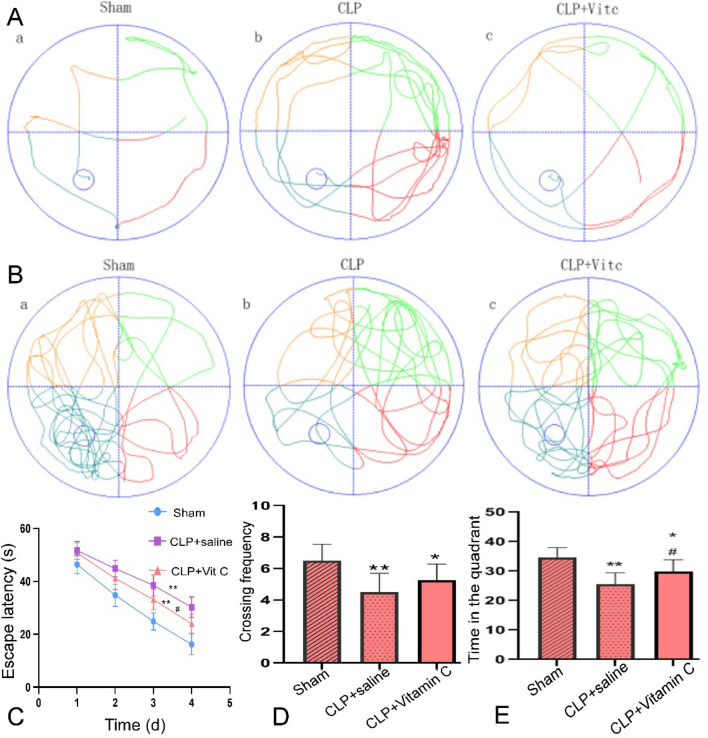
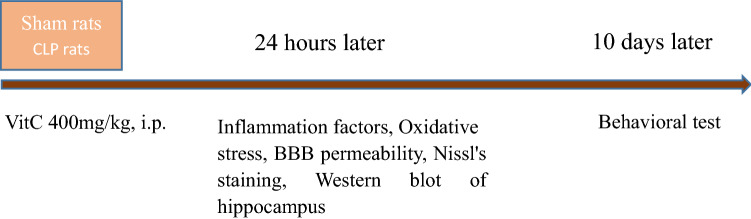
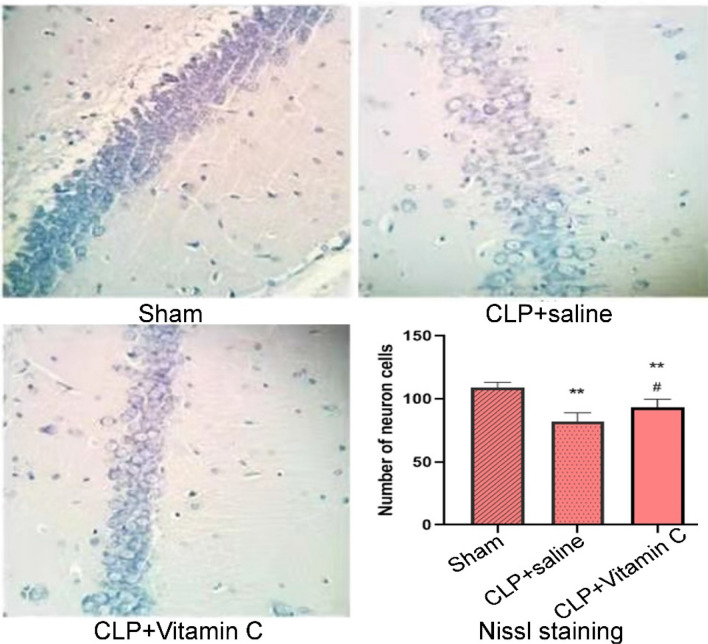
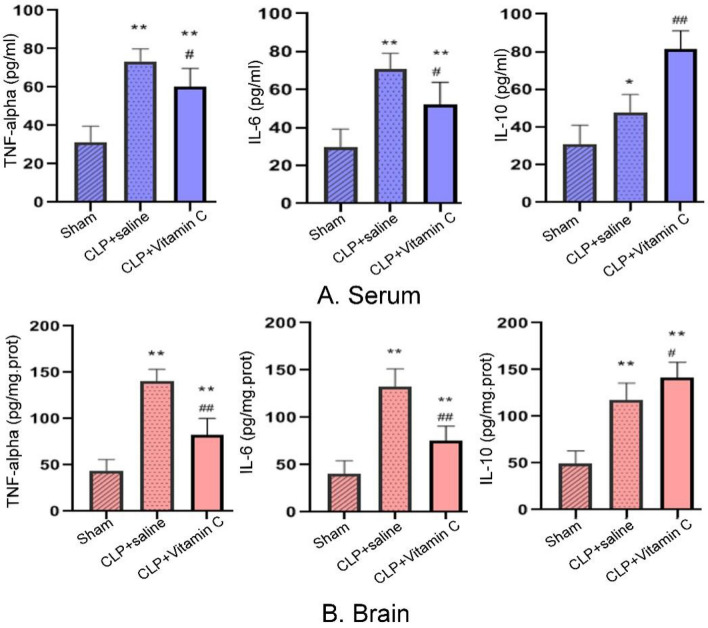
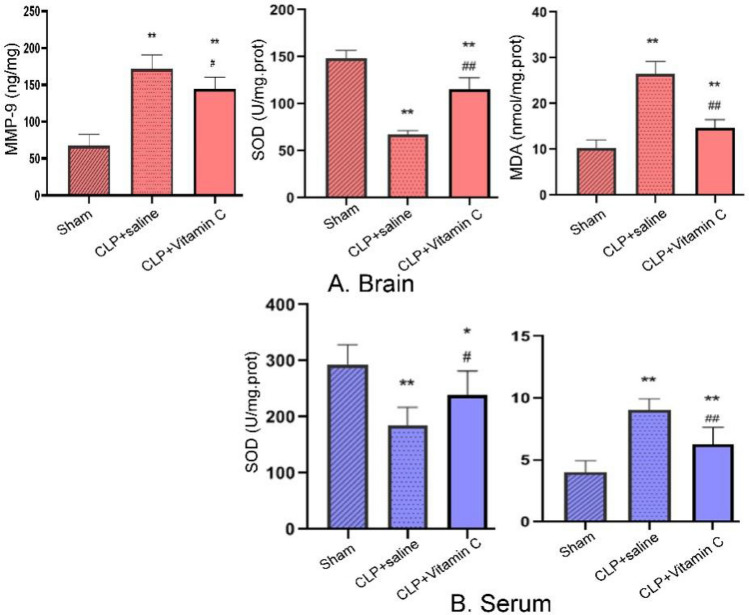
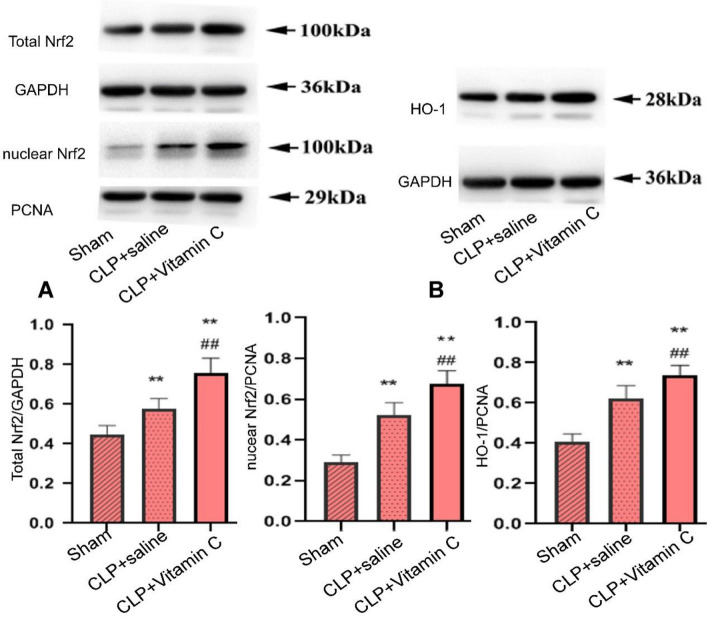
Sepsis survivors present long-term cognitive deficits. The present study was to investigate the effect of early administration of high-dose vitamin C on cognitive function in septic rats and explore its possible cerebral protective mechanism. Rat sepsis models were established by cecal ligation and puncture (CLP). Ten days after surgery, the Morris water maze test was performed to evaluate the behavior and cognitive function. Histopathologic changes in the hippocampus were evaluated by nissl staining. The inflammatory cytokines, activities of antioxidant enzymes (superoxide dismutase or SOD) and oxidative products (malondialdehyde or MDA) in the serum and hippocampus were tested 24 h after surgery. The activity of matrix metalloproteinase-9 (MMP-9) and expressions of nuclear factor erythroid 2-related factor 2 (Nrf2) and heme oxygenase-1(HO-1) in the hippocampus were measured 24 h after surgery. Compared with the sham group in the Morris water maze test, the escape latency of sepsis rats was significantly (P = 0.001) prolonged in the navigation test, whereas the frequency to cross the platform and the time spent in the target quadrant were significantly (P = 0.003) reduced. High-dose vitamin C significantly decreased the escape latency (P = 0.01), but increased the time spent in the target quadrant (P = 0.04) and the frequency to cross the platform (P = 0.19). In the CLP+ saline group, the pyramidal neurons were reduced and distributed sparsely and disorderly, the levels of inflammatory cytokines of tumor necrosis factor (TNF)-α, interleukin (IL)-6, and IL-10 in the serum and hippocampus were significantly increased (P = 0.000), the blood brain barrier (BBB) permeability in the hippocampus was significantly (P = 0.000) increased, the activities of SOD in the serum and hippocampus were significantly (P = 0.000 and P = 0.03, respectively) diminished while the levels of MDA in the serum and hippocampus were significantly (P = 0.007) increased. High-dose vitamin C mitigated hippocampus histopathologic changes, reduced systemic inflammation and neuroinflammation, attenuated BBB disruption, inhibited oxidative stress in brain tissue, and up-regulated the expression of nuclear and total Nrf2 and HO-1. High-dose vitamin C significantly (P < 0.05) decreased the levels of tumor necrosis factor- (TNF)-α, interleukin-6 (IL-6), MDA in the serum and hippocampus, and the activity of MMP-9 in the hippocampus, but significantly (P < 0.05) increased the levels of SOD, the anti-inflammatory cytokine (IL-10) in the serum and hippocampus, and nuclear and total Nrf2, and HO-1 in the hippocampus. In conclusion, high-dose vitamin C can improve cognition impairment in septic rats, and the possible protective mechanism may be related to inhibition of inflammatory factors, alleviation of oxidative stress, and activation of the Nrf2/HO-1 pathway.
败血症幸存者存在长期认知缺陷。本研究旨在探讨早期给予大剂量维生素 C 对败血症大鼠认知功能的影响,并探讨其可能的脑保护机制。通过盲肠结扎穿孔(CLP)建立大鼠败血症模型。术后 10 天,进行 Morris 水迷宫测试以评估行为和认知功能。通过尼氏染色评估海马组织病理变化。术后 24 小时检测血清和海马中超氧化物歧化酶(SOD)或超氧化物歧化酶活性、丙二醛(MDA)等抗氧化酶和氧化产物、基质金属蛋白酶-9(MMP-9)的活性以及核因子红细胞 2 相关因子 2(Nrf2)和血红素加氧酶-1(HO-1)在海马中的表达。与 Morris 水迷宫测试中的假手术组相比,败血症大鼠在导航测试中的逃避潜伏期明显延长(P = 0.001),而穿越平台的频率和在目标象限花费的时间明显减少(P = 0.003)。大剂量维生素 C 显著降低逃避潜伏期(P = 0.01),但增加了在目标象限花费的时间(P = 0.04)和穿越平台的频率(P = 0.19)。在 CLP+生理盐水组中,锥体神经元减少,分布稀疏且紊乱,血清和海马中肿瘤坏死因子(TNF)-α、白细胞介素(IL)-6 和 IL-10 的水平显著升高(P = 0.000),海马中血脑屏障(BBB)通透性显著升高(P = 0.000),血清和海马中 SOD 活性显著降低(P = 0.000 和 P = 0.03,分别),而血清和海马中 MDA 水平显著升高(P = 0.007)。大剂量维生素 C 减轻了海马组织病理学变化,减少了全身和神经炎症,减弱了 BBB 破坏,抑制了脑组织氧化应激,并上调了核和总 Nrf2 和 HO-1 的表达。大剂量维生素 C 显著降低了(P < 0.05)血清和海马中 TNF-α、IL-6、MDA 的水平,海马中 MMP-9 的活性,但显著增加了(P < 0.05)血清和海马中 SOD、抗炎细胞因子(IL-10)以及核和总 Nrf2 和 HO-1 的水平。总之,大剂量维生素 C 可改善败血症大鼠的认知障碍,其可能的保护机制与抑制炎症因子、减轻氧化应激和激活 Nrf2/HO-1 通路有关。