Department of Livestock and One Health, Institute of Infection, Veterinary and Ecological Sciences, University of Liverpool, Brownlow Hill, Liverpool, United Kingdom.
International Livestock Research Institute, Addis Ababa, Ethiopia.
PLoS Negl Trop Dis. 2021 Jul 16;15(7):e0009607. doi: 10.1371/journal.pntd.0009607. eCollection 2021 Jul.
One Health is particularly relevant to the Horn of Africa where many people's livelihoods are highly dependent on livestock and their shared environment. In this context, zoonoses may have a dramatic impact on both human and animal health, but also on country economies. This scoping review aimed to characterise and evaluate the nature of zoonotic disease research in the Horn region. Specifically, it addressed the following questions: (i) what specific zoonotic diseases have been prioritised for research, (ii) what data have been reported (human, animal or environment), (iii) what methods have been applied, and (iv) who has been doing the research?
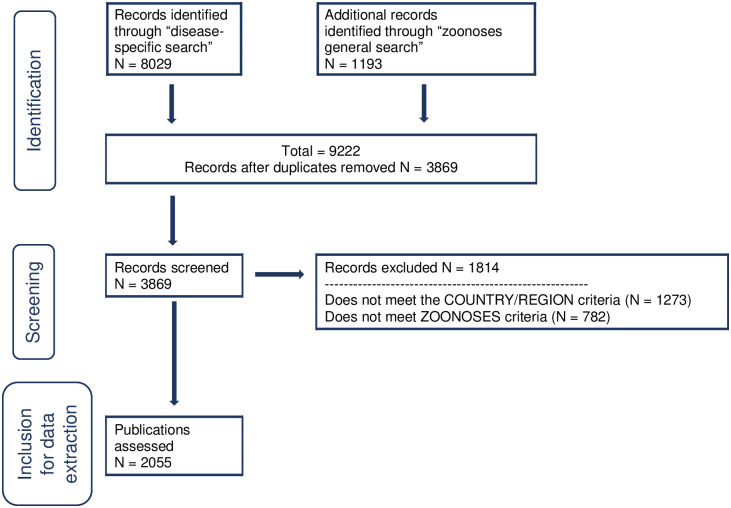
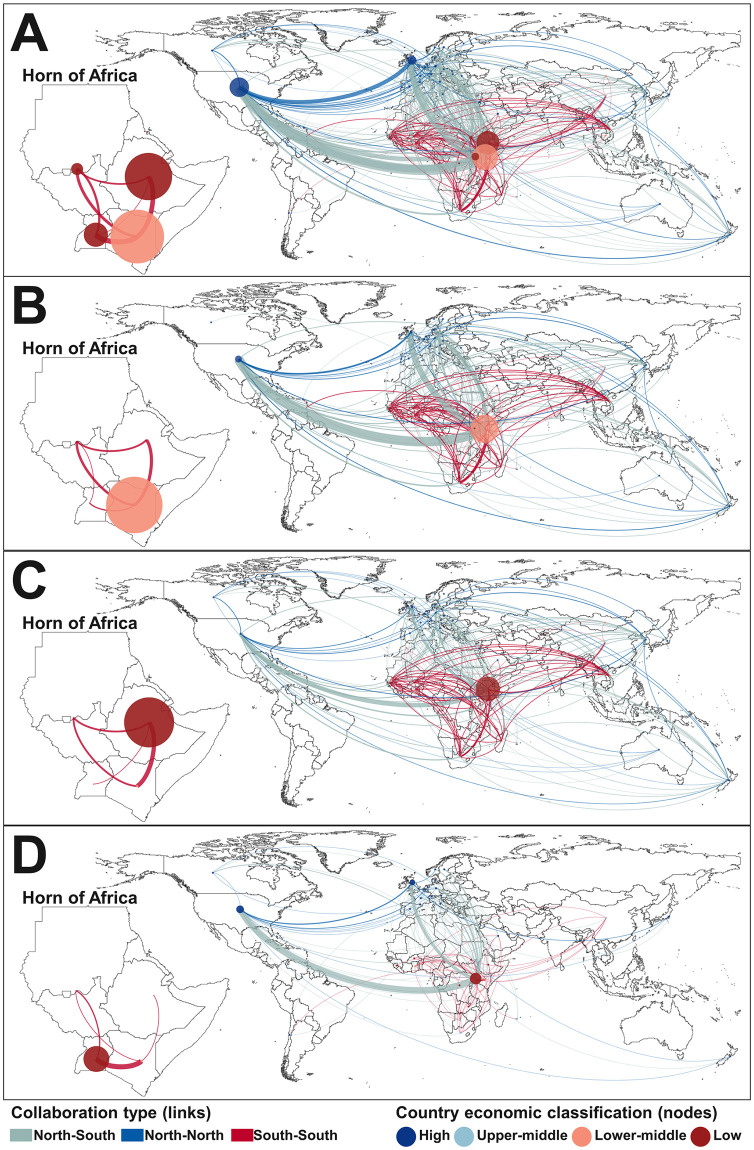
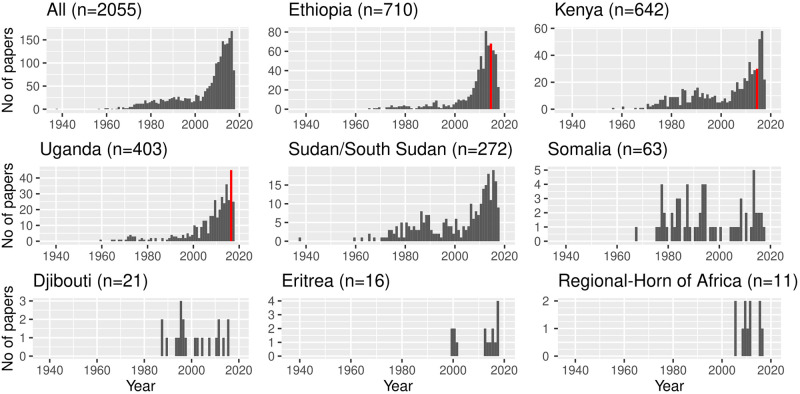
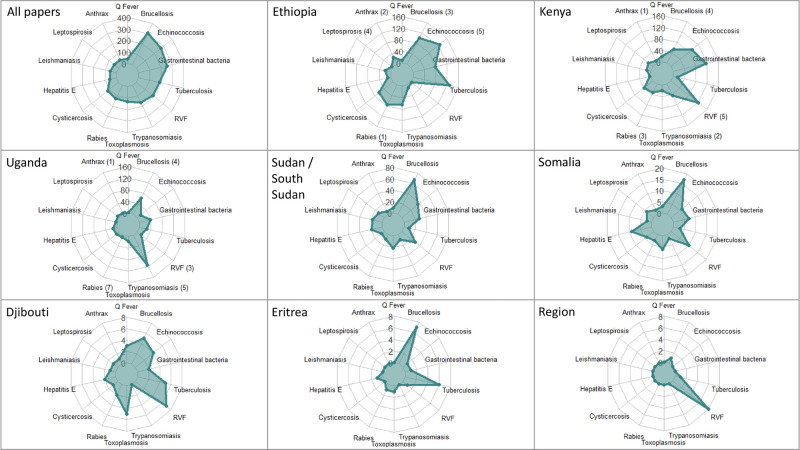
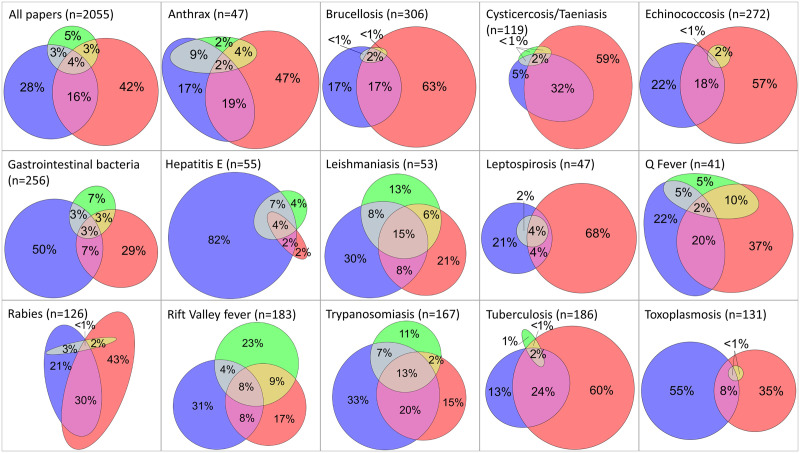
METHODOLOGY/PRINCIPAL FINDINGS: We used keyword combinations to search online databases for peer-reviewed papers and theses. Screening and data extraction (disease, country, domain and method) was performed using DistillerSR. A total of 2055 studies focusing on seven countries and over 60 zoonoses were included. Brucellosis attracted the highest attention in terms of research while anthrax, Q fever and leptospirosis have been comparatively under-studied. Research efforts did not always align with zoonoses priorities identified at national levels. Despite zoonoses being a clear target for 'One Health' research, a very limited proportion of studies report data on the three domains of human, animal and environment. Descriptive and observational epidemiological studies were dominant and only a low proportion of publications were multidisciplinary. Finally, we found that a minority of international collaborations were between Global South countries with a high proportion of authors having affiliations from outside the Horn of Africa.
CONCLUSIONS/SIGNIFICANCE: There is a growing interest in zoonoses research in the Horn of Africa. Recommendations arising from this scoping review include: (i) ensuring zoonoses research aligns with national and global research agendas; (ii) encouraging researchers to adopt a holistic, transdisciplinary One Health approach following high quality reporting standards (COHERE, PRISMA, etc.); and (iii) empowering local researchers supported by regional and international partnerships to engage in zoonoses research.
One Health 尤其与非洲之角相关,那里许多人的生计高度依赖牲畜及其共同的环境。在这种情况下,人畜共患病可能对人类和动物健康以及国家经济产生重大影响。本范围界定审查旨在描述和评估非洲之角人畜共患病研究的性质。具体而言,它解决了以下问题:(i)已优先研究哪些特定的人畜共患病,(ii)报告了哪些数据(人类、动物或环境),(iii)应用了哪些方法,以及(iv)谁在进行研究?
方法/主要发现:我们使用关键词组合在在线数据库中搜索同行评审的论文和论文。使用 DistillerSR 进行筛选和数据提取(疾病、国家、领域和方法)。共纳入 2055 项针对七个国家和 60 多种人畜共患病的研究。从研究角度来看,布鲁氏菌病受到的关注最高,而炭疽、Q 热和钩端螺旋体病的研究相对较少。研究工作并不总是与国家一级确定的人畜共患病重点一致。尽管人畜共患病是“One Health”研究的明确目标,但只有很少比例的研究报告了人类、动物和环境三个领域的数据。描述性和观察性流行病学研究占主导地位,只有很少比例的出版物是多学科的。最后,我们发现,国际合作中很少有来自南部国家的合作,而且很大比例的作者来自非洲之角以外的地区。
结论/意义:非洲之角人畜共患病研究的兴趣日益浓厚。本范围界定审查提出的建议包括:(i)确保人畜共患病研究与国家和全球研究议程保持一致;(ii)鼓励研究人员采用整体、跨学科的 One Health 方法,并遵循高质量报告标准(如 COHERE、PRISMA 等);(iii)通过区域和国际伙伴关系为当地研究人员提供支持,使他们能够参与人畜共患病研究。