Department of Radiology, University of Pennsylvania, Philadelphia, PA 19104.
Department of Radiology, University of Pennsylvania, Philadelphia, PA 19104.
Acad Radiol. 2022 Feb;29 Suppl 2(Suppl 2):S127-S136. doi: 10.1016/j.acra.2021.05.021. Epub 2021 Jul 14.
This study aims to develop and validate a parametric response mapping (PRM) methodology to accurately identify diseased regions of the lung by using variable thresholds to account for alterations in regional lung function between the gravitationally-independent (anterior) and gravitationally-dependent (posterior) lung in CT images acquired in the supine position.
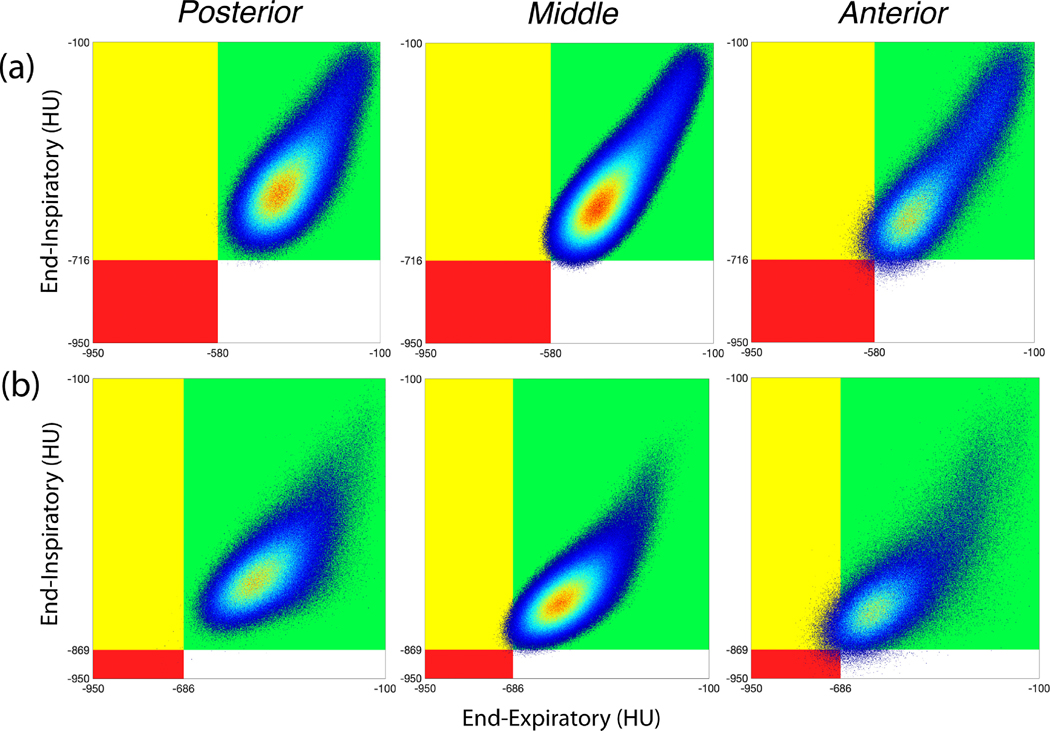
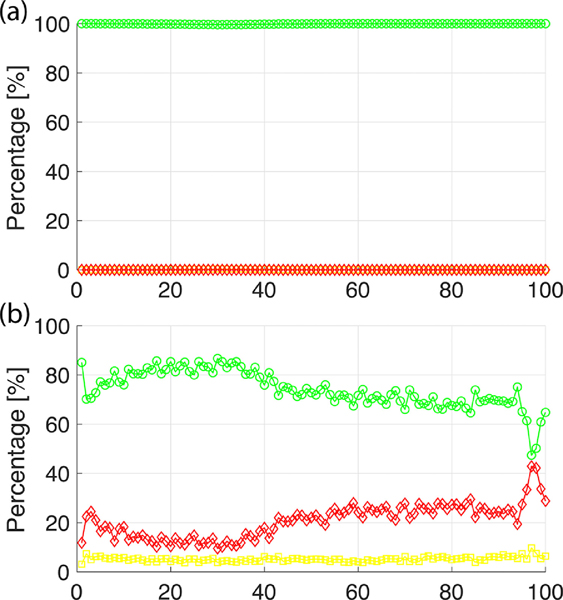
34 male Sprague-Dawley rats (260-540 g) were imaged, 4 of which received elastase injection (100 units/kg) as a model for emphysema (EMPH). Gated volumetric CT was performed at end-inspiration (EI) and end-expiration (EE) on separate groups of free-breathing (n = 20) and ventilated (n = 10) rats in the supine position. To derive variable thresholds for the new PRM methodology, voxels were first grouped into 100 bins based on the fractional distance along the anterior-to-posterior direction. Lower limits of normal (LLN) for x-ray attenuation in each bin were set by determining the smallest region that enclosed 98% of voxels from healthy, ventilated animals.
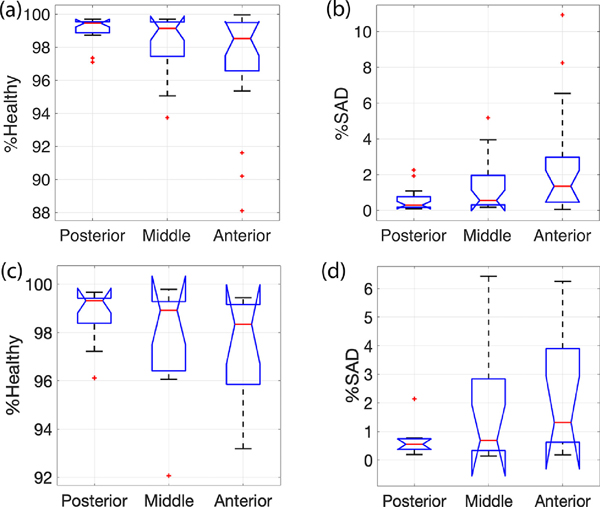
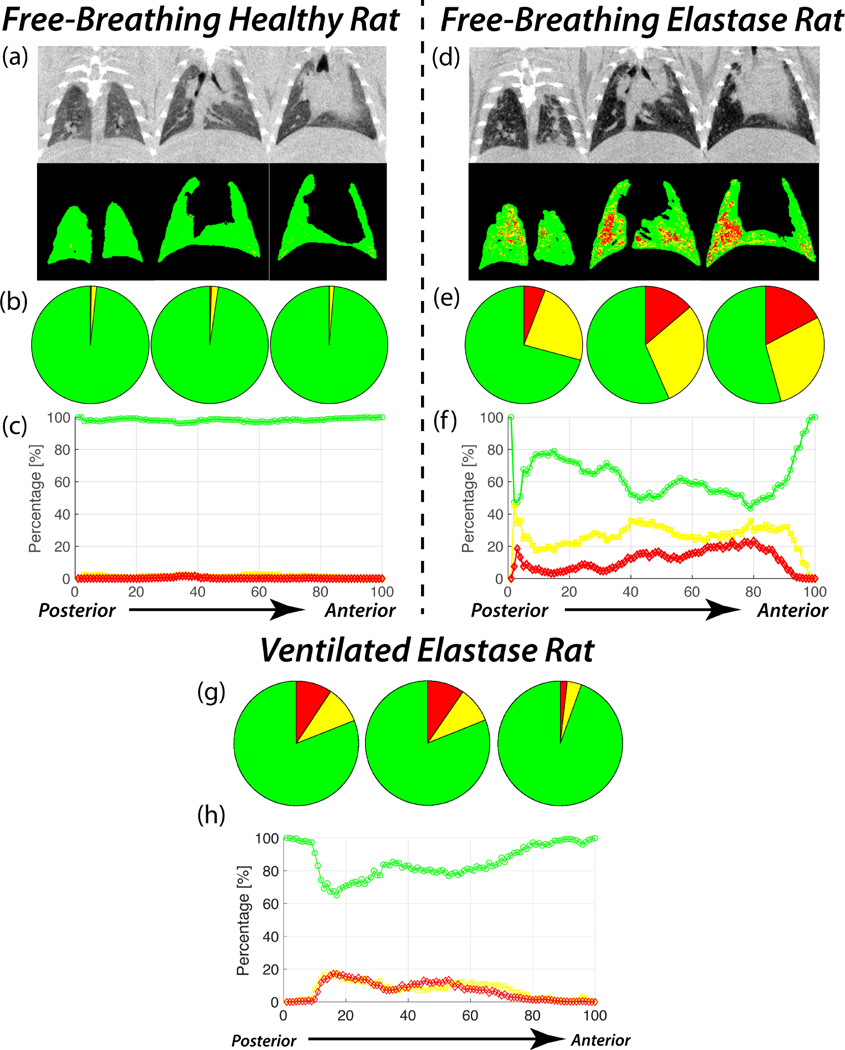
When utilizing fixed thresholds in the conventional PRM methodology, a distinct posterior-anterior gradient was seen, in which nearly the entire posterior region of the lung was identified as HEALTHY, while the anterior lung was labeled as significantly less so (t(29) = -3.27, p = 0.003). In both cohorts, %SAD progressively increased from posterior to anterior, while %HEALTHY lung decreased in the same direction. After applying our PRM methodology with variable thresholds to the same rat images, the posterior-anterior trend in %SAD quantification was removed from all rats and the significant increase of diseased lung in the anterior was removed.
The PRM methodology using variable thresholds provides regionally specific markers of %SAD and %EMPH by correcting for alterations in regional lung function associated with the naturally occurring vertical gradient of dependent vs. non-dependent lung density and compliance.
本研究旨在开发和验证一种参数响应映射(PRM)方法,通过使用可变阈值来准确识别肺部病变区域,该方法考虑了仰卧位 CT 图像中重力独立(前)和重力依赖(后)肺区域的局部肺功能变化。
对 34 只雄性 Sprague-Dawley 大鼠(260-540g)进行成像,其中 4 只接受弹性蛋白酶注射(100 单位/kg)作为肺气肿(EMPH)模型。在仰卧位,分别对自由呼吸(n=20)和通气(n=10)大鼠进行门控容积 CT 在吸气末(EI)和呼气末(EE)成像。为了为新的 PRM 方法导出可变阈值,首先根据沿前后方向的分数距离将体素分为 100 个bin。通过确定包含来自健康通气动物的 98%体素的最小区域来为每个 bin 设置 X 射线衰减的下限正常值(LLN)。
当使用传统 PRM 方法中的固定阈值时,在后前方向上观察到明显的后前梯度,其中几乎整个肺的后区被确定为健康,而前肺则被标记为明显较少(t(29)=-3.27,p=0.003)。在后前方向上,在后前方向上,%SAD 逐渐增加,而%HEALTHY 肺则朝着同一方向减少。在用相同的大鼠图像应用我们的具有可变阈值的 PRM 方法后,所有大鼠的%SAD 定量的后前趋势都被去除,并且在前部去除了明显增加的患病肺。
使用可变阈值的 PRM 方法通过校正与重力依赖性和非依赖性肺密度和顺应性的自然垂直梯度相关的局部肺功能变化,提供了局部特定的%SAD 和%EMPH 标志物。