Samidurai Manikandan, Palanisamy Bharathi N, Bargues-Carot Alejandra, Hepker Monica, Kondru Naveen, Manne Sireesha, Zenitsky Gary, Jin Huajun, Anantharam Vellareddy, Kanthasamy Anumantha G, Kanthasamy Arthi
Department of Biomedical Sciences, Iowa Center for Advanced Neurotoxicology, Iowa State University, Ames, IA, United States.
Front Aging Neurosci. 2021 Jul 2;13:661505. doi: 10.3389/fnagi.2021.661505. eCollection 2021.
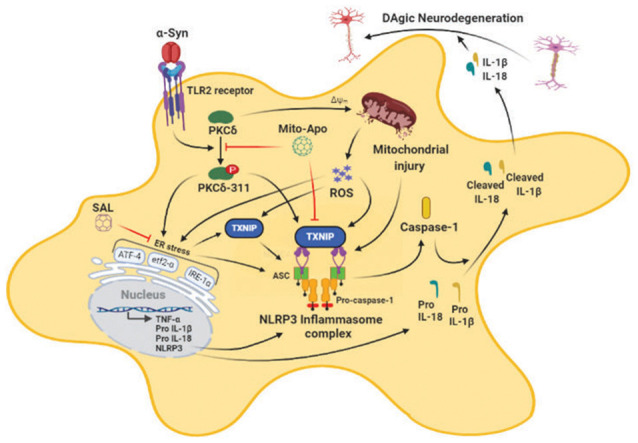
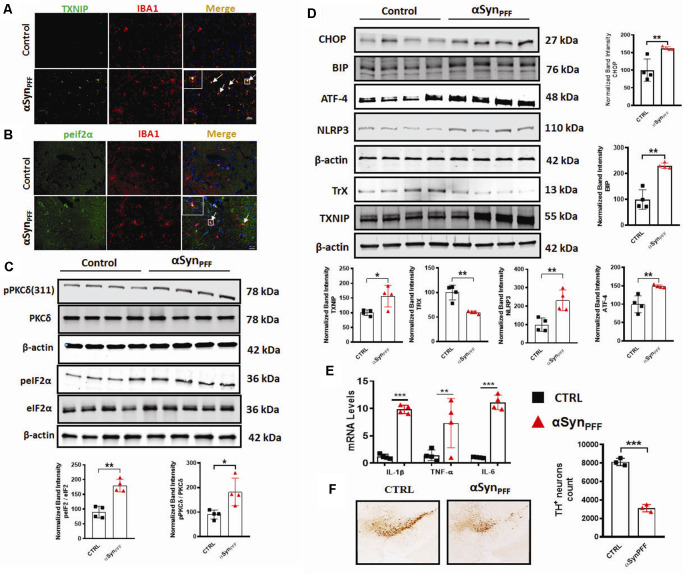
A classical hallmark of Parkinson's disease (PD) pathogenesis is the accumulation of misfolded alpha-synuclein (αSyn) within Lewy bodies and Lewy neurites, although its role in microglial dysfunction and resultant dopaminergic (DAergic) neurotoxicity is still elusive. Previously, we identified that protein kinase C delta (PKCδ) is activated in post mortem PD brains and experimental Parkinsonism and that it participates in reactive microgliosis; however, the relationship between PKCδ activation, endoplasmic reticulum stress (ERS) and the reactive microglial activation state in the context of α-synucleinopathy is largely unknown. Herein, we show that oxidative stress, mitochondrial dysfunction, NLR family pyrin domain containing 3 (NLRP3) inflammasome activation, and PKCδ activation increased concomitantly with ERS markers, including the activating transcription factor 4 (ATF-4), serine/threonine-protein kinase/endoribonuclease inositol-requiring enzyme 1α (p-IRE1α), p-eukaryotic initiation factor 2 (eIF2α) as well as increased generation of neurotoxic cytokines, including IL-1β in aggregated αSyn-stimulated primary microglia. Importantly, in mouse primary microglia-treated with αSyn we observed increased expression of Thioredoxin-interacting protein (TXNIP), an endogenous inhibitor of the thioredoxin (Trx) pathway, a major antioxidant protein system. Additionally, αSyn promoted interaction between NLRP3 and TXNIP in these cells. knockdown of PKCδ using siRNA reduced ERS and led to reduced expression of TXNIP and the NLRP3 activation response in αSyn-stimulated mouse microglial cells (MMCs). Additionally, attenuation of mitochondrial reactive oxygen species (mitoROS) mito-apocynin and amelioration of ERS the eIF2α inhibitor salubrinal (SAL) reduced the induction of the ERS/TXNIP/NLRP3 signaling axis, suggesting that mitochondrial dysfunction and ERS may act in concert to promote the αSyn-induced microglial activation response. Likewise, knockdown of TXNIP by siRNA attenuated the αSyn-induced NLRP3 inflammasome activation response. Finally, unilateral injection of αSyn preformed fibrils (αSyn) into the striatum of wild-type mice induced a significant increase in the expression of nigral p-PKCδ, ERS markers, and upregulation of the TXNIP/NLRP3 inflammasome signaling axis prior to delayed loss of TH neurons. Together, our results suggest that inhibition of ERS and its downstream signaling mediators TXNIP and NLRP3 might represent novel therapeutic avenues for ameliorating microglia-mediated neuroinflammation in PD and other synucleinopathies.
帕金森病(PD)发病机制的一个经典特征是错误折叠的α-突触核蛋白(αSyn)在路易小体和路易神经突内积累,尽管其在小胶质细胞功能障碍及由此导致的多巴胺能(DAergic)神经毒性中的作用仍不明确。此前,我们发现蛋白激酶Cδ(PKCδ)在帕金森病患者的尸检脑和实验性帕金森病模型中被激活,且它参与了反应性小胶质细胞增生;然而,在α-突触核蛋白病背景下,PKCδ激活、内质网应激(ERS)与反应性小胶质细胞激活状态之间的关系在很大程度上尚不清楚。在此,我们表明氧化应激、线粒体功能障碍、含NLR家族吡啶结构域蛋白3(NLRP3)炎性小体激活和PKCδ激活与ERS标志物同时增加,包括激活转录因子4(ATF-4)、丝氨酸/苏氨酸蛋白激酶/内切核糖核酸酶肌醇需求酶1α(p-IRE1α)、磷酸化真核起始因子2(eIF2α)以及在聚集的αSyn刺激的原代小胶质细胞中神经毒性细胞因子(包括IL-1β)生成增加。重要的是,在用αSyn处理的小鼠原代小胶质细胞中,我们观察到硫氧还蛋白相互作用蛋白(TXNIP)表达增加,TXNIP是硫氧还蛋白(Trx)途径的内源性抑制剂,Trx途径是一个主要的抗氧化蛋白系统。此外,αSyn促进了这些细胞中NLRP3与TXNIP之间的相互作用。使用小干扰RNA(siRNA)敲低PKCδ可减少ERS,并导致αSyn刺激的小鼠小胶质细胞(MMCs)中TXNIP表达降低以及NLRP3激活反应减弱。此外,线粒体活性氧(mitoROS)清除剂米托蒽醌和ERS缓解剂eIF2α抑制剂沙芦比诺(SAL)可减少ERS/TXNIP/NLRP3信号轴的诱导,这表明线粒体功能障碍和ERS可能共同作用以促进αSyn诱导的小胶质细胞激活反应。同样,通过siRNA敲低TXNIP可减弱αSyn诱导的NLRP3炎性小体激活反应。最后,向野生型小鼠纹状体单侧注射α-突触核蛋白原纤维(αSyn),在黑质酪氨酸羟化酶(TH)神经元延迟丢失之前,诱导黑质磷酸化PKCδ、ERS标志物表达显著增加以及TXNIP/NLRP3炎性小体信号轴上调。总之,我们的结果表明,抑制ERS及其下游信号介质TXNIP和NLRP3可能代表改善帕金森病和其他突触核蛋白病中小胶质细胞介导的神经炎症的新治疗途径。