Key Laboratory of Radiation Physics and Technology of Ministry of Education, College of Chemistry, Sichuan University, Chengdu 610064, China.
Molecules. 2021 Jul 2;26(13):4064. doi: 10.3390/molecules26134064.
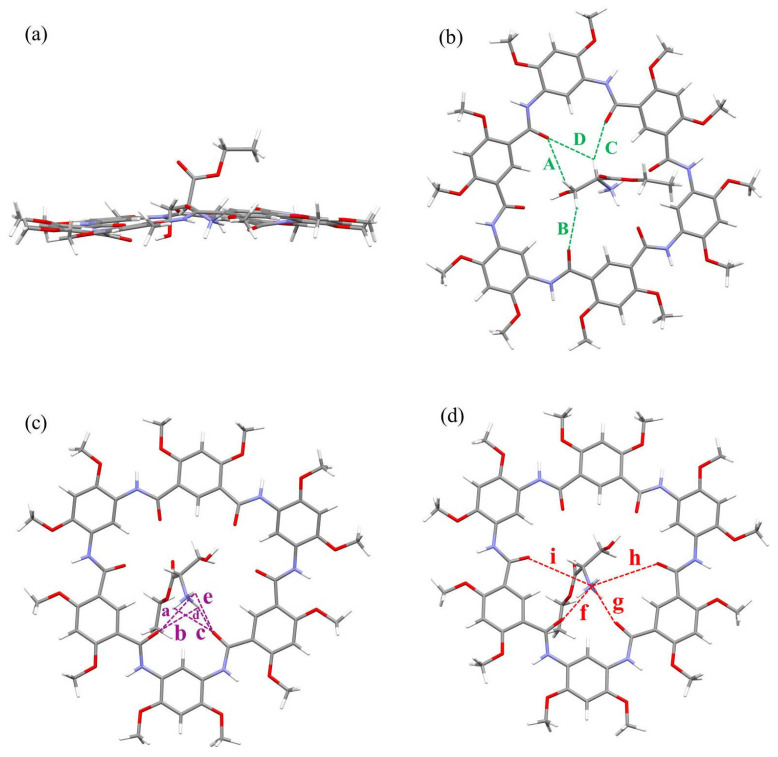
A hydrogen-bonded (H-bonded) amide macrocycle was found to serve as an effective component in the host-guest assembly for a supramolecular chirality transfer process. Circular dichroism (CD) spectroscopy studies showed that the near-planar macrocycle could produce a CD response when combined with three of the twelve L--amino acid esters (all cryptochiral molecules) tested as possible guests. The host-guest complexation between the macrocycle and cationic guests was explored using NMR, revealing the presence of a strong affinity involving the multi-point recognition of guests. This was further corroborated by density functional theory (DFT) calculations. The present work proposes a new strategy for amplifying the CD signals of cryptochiral molecules by means of H-bonded macrocycle-based host-guest association, and is expected to be useful in designing supramolecular chiroptical sensing materials.
氢键酰胺大环被发现是超分子手性传递过程中主体-客体组装的有效组成部分。圆二色(CD)光谱研究表明,当与测试的 12 种 L-氨基酸酯中的三种(所有隐手性分子)作为可能的客体结合时,近平面大环可以产生 CD 响应。使用 NMR 研究了大环与阳离子客体之间的主客体络合作用,揭示了存在涉及客体多点识别的强亲和力。这进一步得到了密度泛函理论(DFT)计算的证实。本工作提出了一种通过基于氢键大环的主体-客体缔合来放大隐手性分子的 CD 信号的新策略,有望用于设计超分子手性光学传感材料。