Faculty of Biomedical Sciences, Università della Svizzera italiana, Lugano, Switzerland.
Lab of Applied Psychology, Department of History, Society, and Human Studies, University of Salento, Lecce, Italy.
PLoS One. 2021 Jul 19;16(7):e0254716. doi: 10.1371/journal.pone.0254716. eCollection 2021.
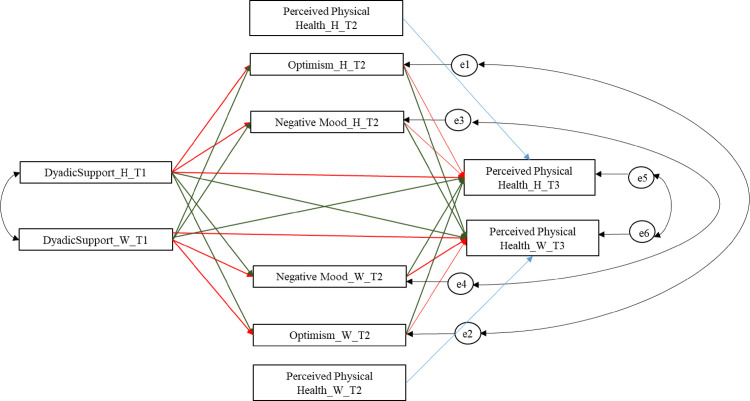
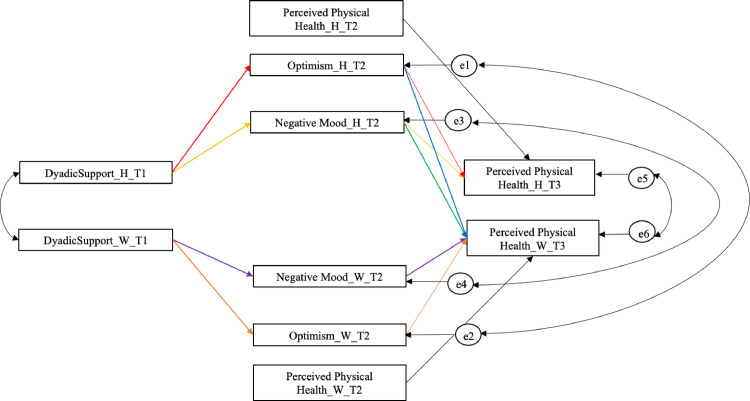
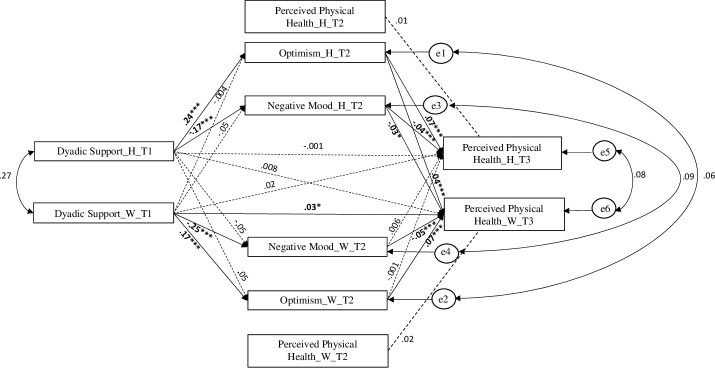
Supportive communicative experiences within close relationships, such as dyadic support, have a protective effect on individuals' health and emotional well-being. However, little is known about how partners interact in determining their own and others' health or the mechanisms through which dyadic support influences physical health. We addressed those gaps by studying 1088 romantic couples from three consecutive years (T1, T2, T3; Swiss Household Panel). The study applied a data analysis strategy called Actor Partner Interdependence Model extended Mediation, which allows for mediation processes while considering the interdependence, or non-independence, of data coming from partners. Results showed that dyadic support was positively associated with perceived health over two years through the mediation of optimistic attitudes and depressive mood, both for person and partner effects. The present study demonstrates the interplay between the dyadic process and personality dispositions in maintaining good health.
亲密关系中的支持性沟通体验,如对偶支持,对个体的健康和情感幸福感具有保护作用。然而,人们对伴侣之间如何相互作用来确定自己和他人的健康,以及对偶支持如何影响身体健康的机制知之甚少。我们通过研究来自三个连续年份(T1、T2、T3;瑞士家庭面板)的 1088 对浪漫夫妇来填补这些空白。该研究应用了一种名为“演员-伙伴相互依赖模型扩展中介”的数据分析策略,该策略允许在考虑来自伴侣的数据的相互依存性(或非独立性)的同时,进行中介过程。结果表明,对偶支持通过对乐观态度和抑郁情绪的中介作用,与两年内的感知健康呈正相关,这既对个人效应,也对伴侣效应都适用。本研究展示了在维持良好健康方面,对偶过程和个性特征之间的相互作用。