Center for Neurodevelopmental and Imaging Research, Kennedy Krieger Institute, 716 North Broadway, Baltimore, MD 21205, USA.
Department of Neurology, Johns Hopkins University, 733 North Broadway, Baltimore, MD 21205, USA.
Neuroimage Clin. 2021;31:102759. doi: 10.1016/j.nicl.2021.102759. Epub 2021 Jul 10.
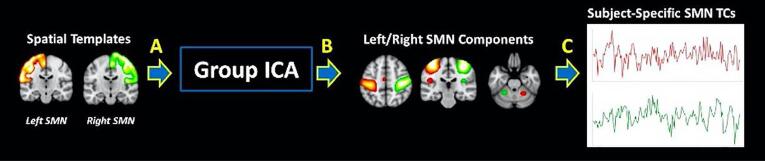
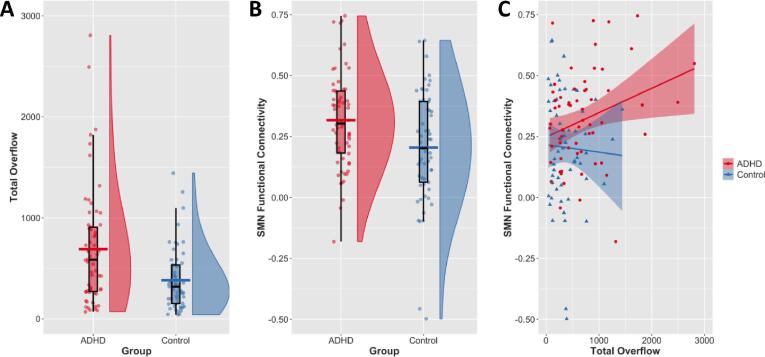
Mirror overflow is a developmental phenomenon defined as unintentional movements that mimic the execution of intentional movements in homologous muscles on the opposite side of the body. In children with attention-deficit/hyperactivity disorder (ADHD), mirror overflow is commonly excessive, abnormally persistent, and correlated with ADHD symptom severity. As such, it represents a promising clinical biomarker for disinhibited behavior associated with ADHD. Yet, the neural underpinnings of mirror overflow in ADHD remain unclear. Our objective was to test whether intrinsic interhemispheric functional connectivity between homologous regions of the somatomotor network (SMN) is associated with mirror overflow in school age children with and without ADHD using resting state functional magnetic resonance imaging. To this end, we quantified mirror overflow in 119 children (8-12 years old, 62 ADHD) during a finger sequencing task using finger twitch transducers affixed to the index and ring fingers. Group ICA was used to identify right- and left-lateralized SMNs and subject-specific back reconstructed timecourses were correlated to obtain a measure of SMN interhemispheric connectivity. We found that children with ADHD showed increased mirror overflow (p < 0.001; d = 0.671) and interhemispheric SMN functional connectivity (p = 0.023; d = 0.521) as compared to typically developing children. In children with ADHD, but not the typically developing children, there was a significant relationship between interhemispheric SMN functional connectivity and mirror overflow (t = 2.116; p = 0.039). Our findings of stronger interhemispheric functional connectivity between homologous somatomotor regions in children with ADHD is consistent with previous transcranial magnetic stimulation and diffusion-tractography imaging studies suggesting that interhemispheric cortical inhibitory mechanisms may be compromised in children with ADHD. The observed brain-behavior correlation further suggests that abnormally strong interhemispheric SMN connectivity in children with ADHD may diminish their ability to suppress overflow movements.
镜像溢出现象是一种发育现象,定义为无意识运动,这些运动模仿身体对侧同源肌肉执行的有意运动。在患有注意力缺陷/多动障碍(ADHD)的儿童中,镜像溢出现象通常过多、异常持久,并与 ADHD 症状严重程度相关。因此,它代表了与 ADHD 相关的去抑制行为的有前途的临床生物标志物。然而,ADHD 中镜像溢出现象的神经基础仍不清楚。我们的目的是使用静息态功能磁共振成像,测试 ADHD 儿童和非 ADHD 儿童的躯体运动网络(SMN)同源区域之间的内在大脑半球间功能连接是否与镜像溢出现象相关。为此,我们在 119 名儿童(8-12 岁,62 名 ADHD)中使用手指抽搐换能器测量了手指序列任务期间的镜像溢出现象,手指抽搐换能器贴在食指和无名指上。使用组独立成分分析(ICA)来识别右侧和左侧躯体运动网络,并对个体特异性反向重建时间序列进行相关,以获得躯体运动网络半球间连接的度量。我们发现,与正常发育的儿童相比,ADHD 儿童的镜像溢出现象增加(p<0.001;d=0.671),并且大脑半球间躯体运动网络功能连接增加(p=0.023;d=0.521)。在 ADHD 儿童中,但在正常发育的儿童中,大脑半球间躯体运动网络功能连接与镜像溢出现象之间存在显著关系(t=2.116;p=0.039)。我们发现 ADHD 儿童的同源躯体运动区域之间的大脑半球间功能连接更强,这与之前的经颅磁刺激和弥散张量成像研究一致,表明 ADHD 儿童的大脑半球间皮质抑制机制可能受损。观察到的大脑-行为相关性进一步表明,ADHD 儿童异常强大的大脑半球间躯体运动网络连接可能会降低他们抑制溢出现象的能力。