Laboratory of Neurophysiology, Graduate School of Human and Environmental Studies, Kyoto University, Yoshida-nihonmatsu-cho, Sakyo-ku, Kyoto, 606-8501, Japan.
Unit of Synergetic Studies for Space, Kyoto University, Kyoto, 606-8502, Japan.
Sci Rep. 2021 Jul 20;11(1):14749. doi: 10.1038/s41598-021-94201-9.
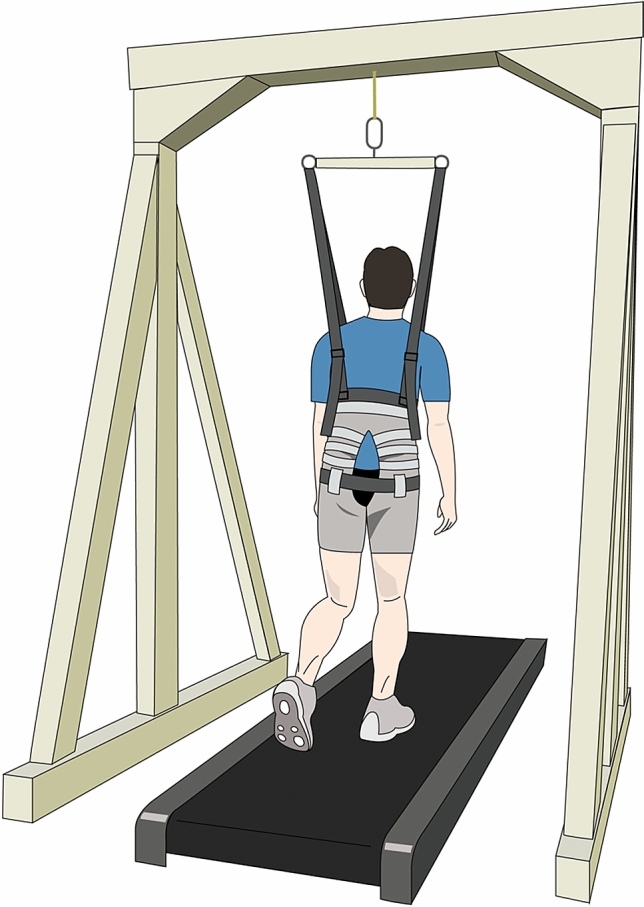
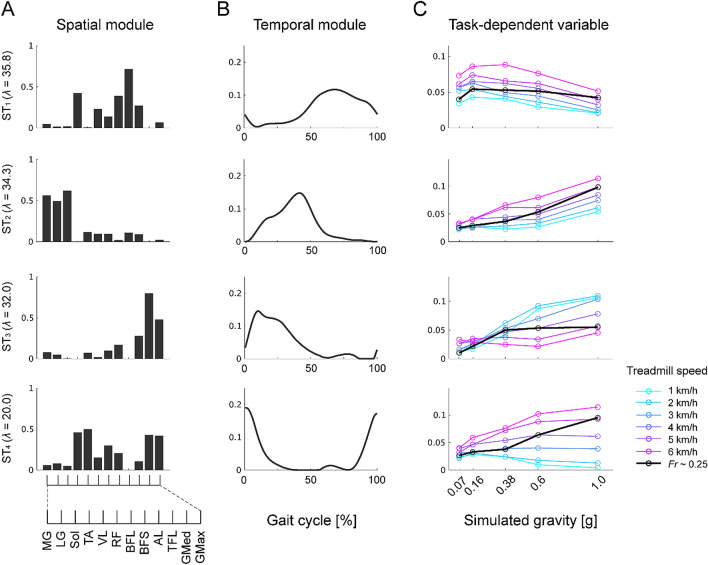
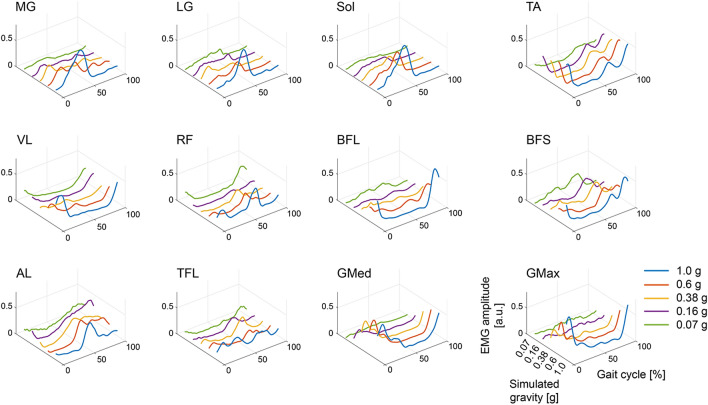
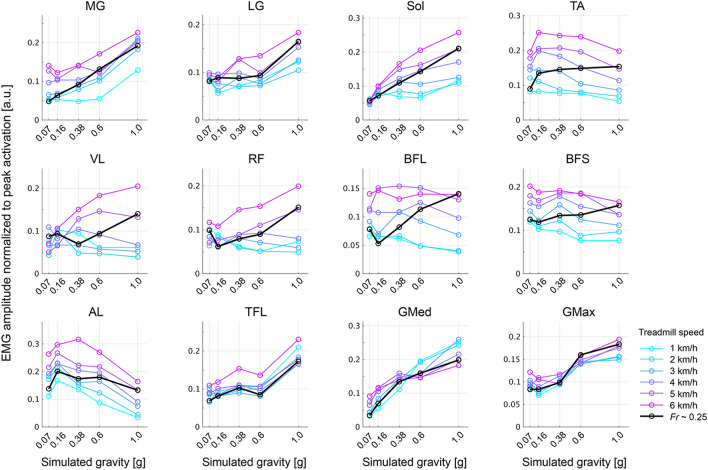
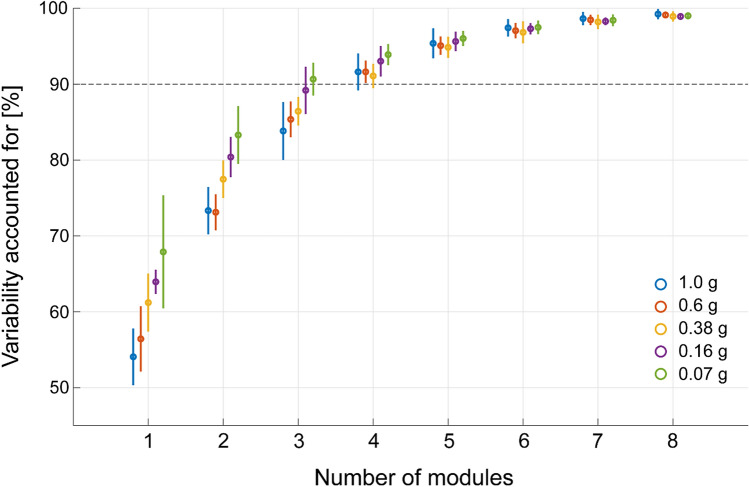
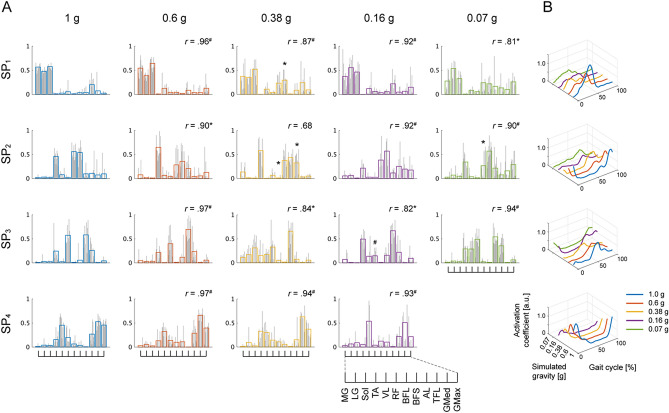
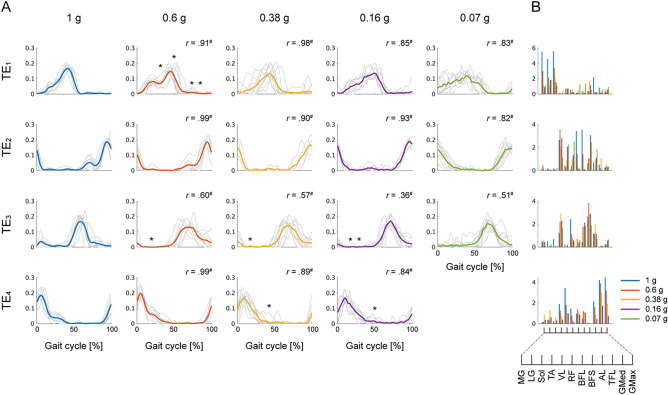
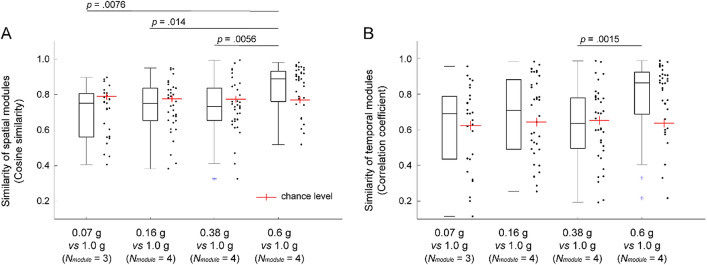
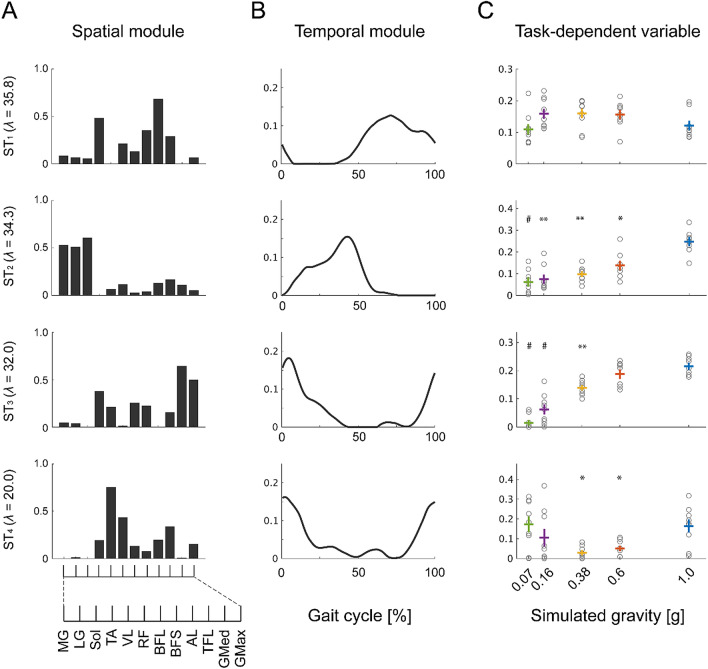
Gravity plays a crucial role in shaping patterned locomotor output to maintain dynamic stability during locomotion. The present study aimed to clarify the gravity-dependent regulation of modules that organize multiple muscle activities during walking in humans. Participants walked on a treadmill at seven speeds (1-6 km h and a subject- and gravity-specific speed determined by the Froude number (Fr) corresponding to 0.25) while their body weight was partially supported by a lift to simulate walking with five levels of gravity conditions from 0.07 to 1 g. Modules, i.e., muscle-weighting vectors (spatial modules) and phase-dependent activation coefficients (temporal modules), were extracted from 12 lower-limb electromyographic (EMG) activities in each gravity (Fr ~ 0.25) using nonnegative matrix factorization. Additionally, a tensor decomposition model was fit to the EMG data to quantify variables depending on the gravity conditions and walking speed with prescribed spatial and temporal modules. The results demonstrated that muscle activity could be explained by four modules from 1 to 0.16 g and three modules at 0.07 g, and the modules were shared for both spatial and temporal components among the gravity conditions. The task-dependent variables of the modules acting on the supporting phase linearly decreased with decreasing gravity, whereas that of the module contributing to activation prior to foot contact showed nonlinear U-shaped modulation. Moreover, the profiles of the gravity-dependent modulation changed as a function of walking speed. In conclusion, reduced gravity walking was achieved by regulating the contribution of prescribed spatial and temporal coordination in muscle activities.
重力在塑造模式化运动输出以维持运动中的动态稳定性方面起着至关重要的作用。本研究旨在阐明重力对组织人体行走过程中多个肌肉活动模块的调节作用。参与者在跑步机上以七种速度(1-6km/h 和由对应于 0.25 的弗劳德数 (Fr) 确定的、与重力相关的个体速度)行走,同时通过提升机部分支撑体重,以模拟从 0.07 到 1g 的五个重力条件下的行走。使用非负矩阵分解从每个重力(Fr~0.25)的 12 个下肢肌电图(EMG)活动中提取模块,即肌肉加权向量(空间模块)和与相位相关的激活系数(时间模块)。此外,使用张量分解模型拟合 EMG 数据,以量化依赖于重力条件和行走速度的变量,同时指定空间和时间模块。结果表明,肌肉活动可以用从 1 到 0.16g 的四个模块和 0.07g 的三个模块来解释,并且这些模块在重力条件下的空间和时间组件之间是共享的。作用于支撑阶段的模块的任务相关变量随重力的降低呈线性减小,而对足接触前激活有贡献的模块则表现出非线性 U 形调制。此外,重力依赖调制的模式随行走速度而变化。总之,通过调节肌肉活动中规定的空间和时间协调的贡献,可以实现减轻重力行走。