Sata Shizuka, Honda Kazuaki, Yamaguchi Satoshi, Komine Mizuki, Kim SungHyek, Kashino Makio, Hagio Shota, Fujii Shinya
Graduate School of Media and Governance, Keio University, Fujisawa, Japan.
NTT Communication Science Laboratories, NTT Corporation, Atsugi, Japan.
Front Neurol. 2024 Nov 18;15:1489143. doi: 10.3389/fneur.2024.1489143. eCollection 2024.
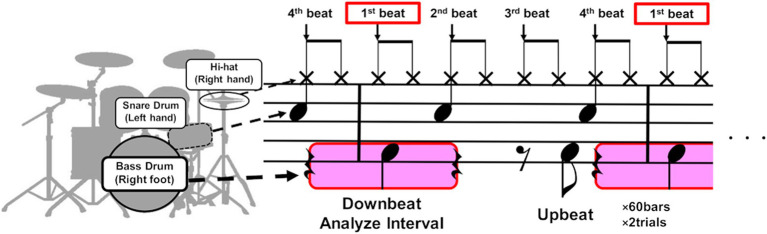
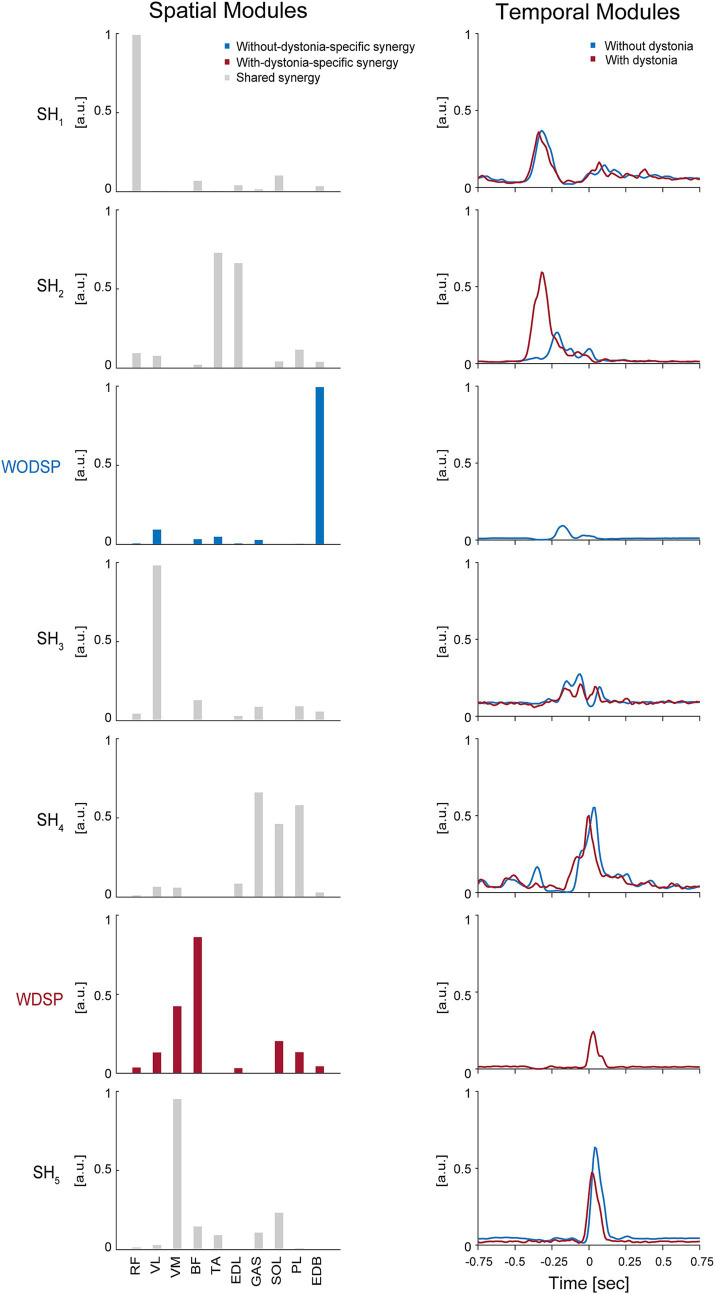
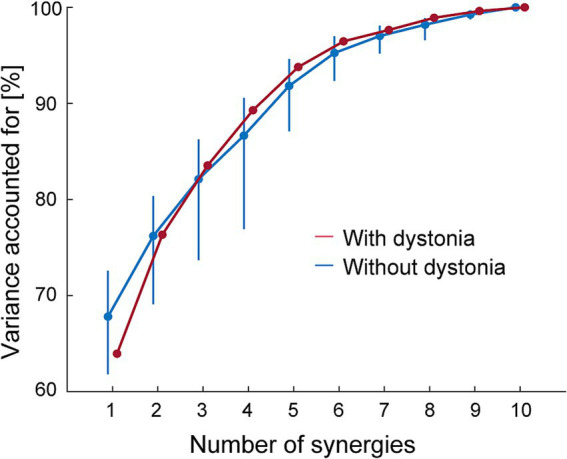
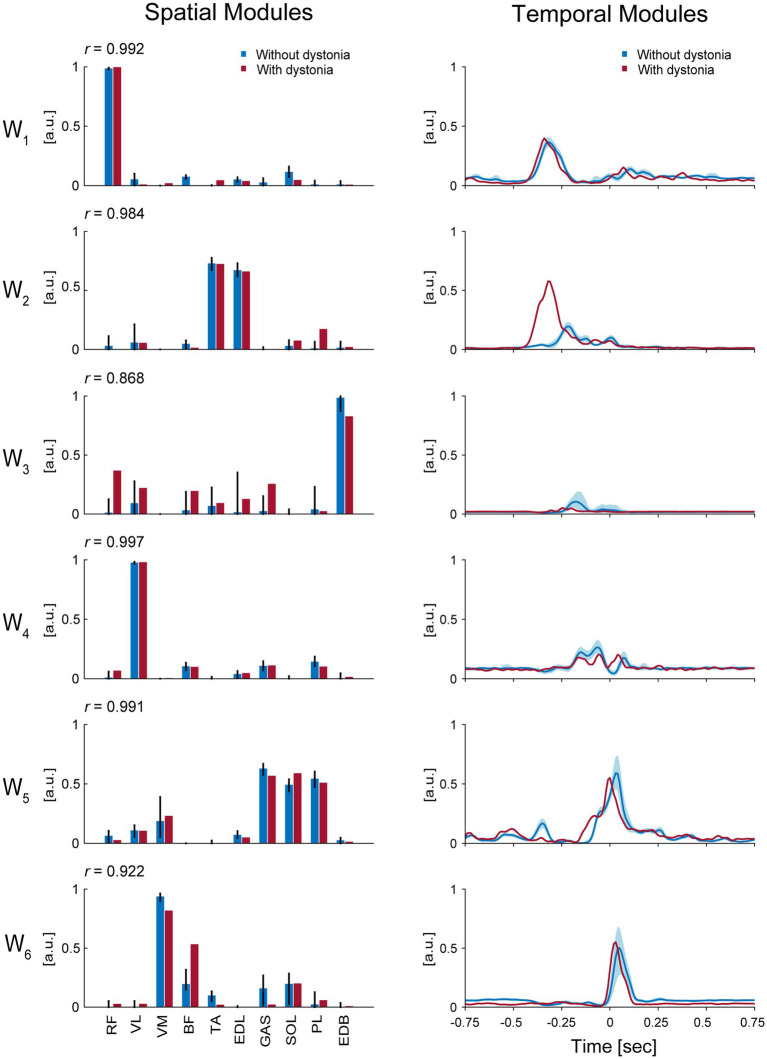
Musician's dystonia (MD) is a movement disorder characterized by involuntary muscle contractions specifically triggered by playing an instrument. This condition often leads to a loss of fine motor control, threatening the careers of affected musicians. While MD is commonly associated with the hands, it can also affect the lower limbs, particularly in drummers. Understanding the muscle coordination involved in MD is crucial for comprehending its neurological mechanisms, yet the muscle coordination of lower-limb dystonia has not been thoroughly explored. This study aimed to investigate the differences in lower-limb muscle synergies in a drummer with MD, utilizing non-negative matrix factorization (NMF) to analyze coordinated muscle activity patterns during drumming tasks. A 36-year-old male professional drummer with lower-limb MD was instructed to play a drum set in time with a metronome set at 80 beats per minute. The task involved striking the bass drum pedal in time with the downbeat. Electromyographic (EMG) data were collected from 10 muscles in the right lower limb. The data were analyzed using NMF to extract muscle synergies and compare the number of synergies, spatial modules, and temporal modules between the data with and without dystonia symptoms. The number of muscle synergies did not differ significantly between the data with and without symptoms. Notably, changes were observed in both the spatial and temporal modules of muscle synergies. Spatial modules revealed the appearance of dystonia-specific muscle synergy, which is considered related to compensatory movement. Temporal modules showed significant earlier overactivation in timing, which is considered the direct manifestation of dystonia symptoms. These findings indicate that lower-limb dystonia in drummers affects the spatial and temporal profiles of muscle synergies. This study underscores the importance of considering both spatial and temporal modules of muscle synergy in understanding and treating lower-limb dystonia in drummers. Further research is needed to validate these findings and apply muscle synergy analysis for the clinical assessment of lower-limb dystonia in drummers.
音乐家肌张力障碍(MD)是一种运动障碍,其特征是在演奏乐器时特别触发的不自主肌肉收缩。这种情况通常会导致精细运动控制能力丧失,威胁到受影响音乐家的职业生涯。虽然MD通常与手部有关,但它也可能影响下肢,尤其是鼓手。了解MD中涉及的肌肉协调对于理解其神经机制至关重要,然而下肢肌张力障碍的肌肉协调尚未得到充分探索。本研究旨在调查一名患有MD的鼓手下肢肌肉协同作用的差异,利用非负矩阵分解(NMF)分析击鼓任务期间的协调肌肉活动模式。一名患有下肢MD的36岁男性职业鼓手被要求按照每分钟80拍的节拍器及时演奏一套鼓。该任务包括在强拍时及时踩下低音鼓踏板。从右下肢的10块肌肉收集肌电图(EMG)数据。使用NMF对数据进行分析,以提取肌肉协同作用,并比较有和没有肌张力障碍症状的数据之间的协同作用数量、空间模块和时间模块。有症状和无症状的数据之间,肌肉协同作用的数量没有显著差异。值得注意的是,在肌肉协同作用的空间和时间模块中都观察到了变化。空间模块显示出肌张力障碍特异性肌肉协同作用的出现,这被认为与代偿性运动有关。时间模块显示在时间上有明显更早的过度激活,这被认为是肌张力障碍症状的直接表现。这些发现表明,鼓手的下肢肌张力障碍会影响肌肉协同作用的空间和时间特征。本研究强调了在理解和治疗鼓手下肢肌张力障碍时考虑肌肉协同作用的空间和时间模块的重要性。需要进一步的研究来验证这些发现,并将肌肉协同作用分析应用于鼓手下肢肌张力障碍的临床评估。