Holst Camilla Bjørnbak, Christensen Ib Jarle, Vitting-Seerup Kristoffer, Skjøth-Rasmussen Jane, Hamerlik Petra, Poulsen Hans Skovgaard, Johansen Julia Sidenius
Department of Radiation Biology, Department of Oncology, Rigshospitalet, Copenhagen University Hospital, Copenhagen, Denmark.
Brain Tumor Biology, Danish Cancer Society Research Center, Danish Cancer Society, Copenhagen, Denmark.
Neurooncol Adv. 2021 Jun 1;3(1):vdab072. doi: 10.1093/noajnl/vdab072. eCollection 2021 Jan-Dec.
CNS immune privilege has been challenged in recent years. Glioblastoma (GBM) immune dysfunction includes complex interactions with the immune system outside the CNS. The aim of this study was to determine diagnostic and prognostic potential of immune-related proteins in plasma in GBM and interrogate biomarker presence in the brain tumor microenvironment (TME).
One hundred and fifty-eight patients with glioma WHO grade II-IV were included. Plasma collected at surgery was screened for 92 proteins using proximity extension assay technology and related to clinical outcome. Secretion and expression of candidate prognostic biomarkers were subsequently analyzed in 8 GBM cell lines and public RNAseq data.
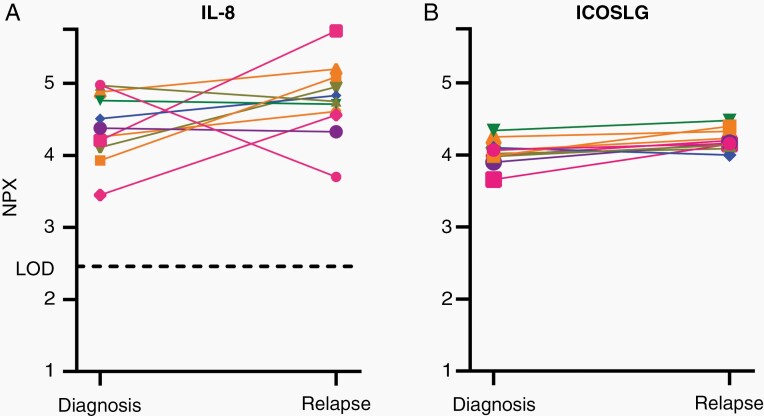
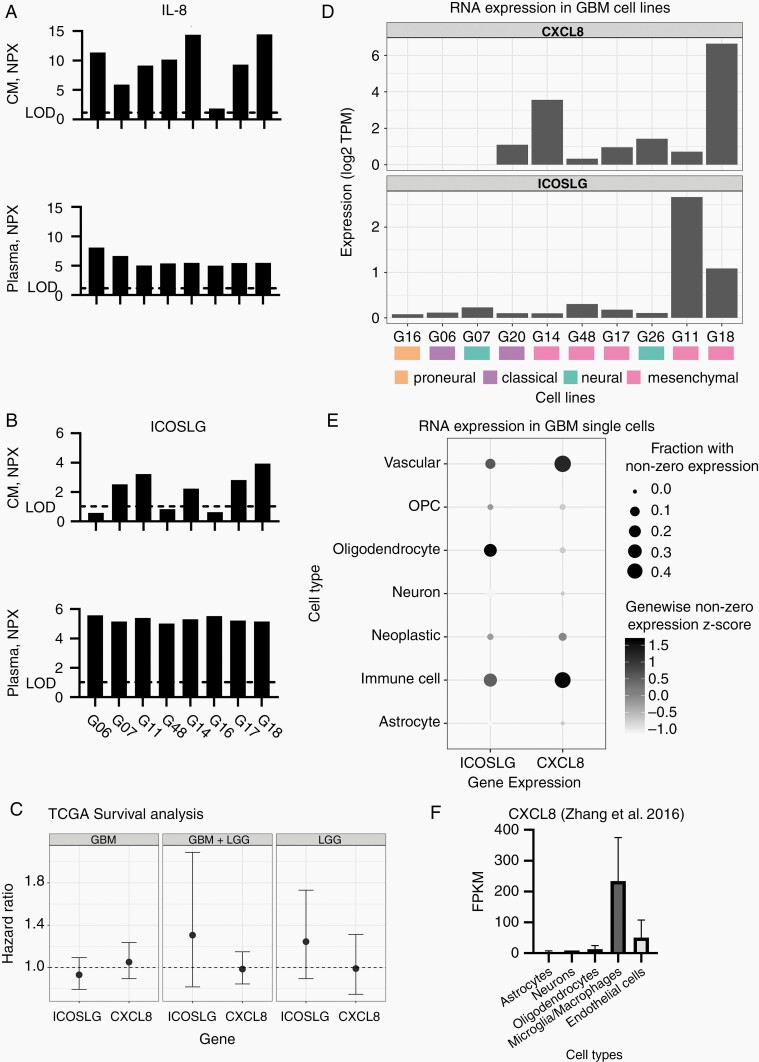
Plasma levels of 20 out of 92 screened proteins were significantly different in patients with GBM compared to patients with astrocytoma WHO grade II-III. High plasma interleukin-8 (IL-8) (hazard ratio [HR] = 1.52; = .0077) and low CD244 (HR = 0.36; = .0004) were associated with short progression-free survival and high plasma IL-8 (HR = 1.40; = .044) and low ICOS ligand (ICOSLG) (HR = 0.17; = .0003) were associated with short overall survival (OS) in newly diagnosed patients with GBM. A similar trend was found for ICOSLG (HR = 0.34; = .053) in recurrent GBM. IL-8 was mostly secreted and expressed by mesenchymal GBM cell lines and expressed by vascular cells and immune cells in the TME. This was also the case for ICOSLG, although less consistent, and with additional expression in tumor-associated oligodendrocytes.
High plasma IL-8 and low ICOSLG at surgery are associated with short OS in newly diagnosed GBM. Source of plasma ICOSLG may be found outside the TME.
近年来,中枢神经系统免疫豁免受到了挑战。胶质母细胞瘤(GBM)的免疫功能障碍包括与中枢神经系统外免疫系统的复杂相互作用。本研究的目的是确定血浆中免疫相关蛋白在GBM中的诊断和预后潜力,并探究脑肿瘤微环境(TME)中生物标志物的存在情况。
纳入158例世界卫生组织(WHO)II-IV级胶质瘤患者。采用邻位延伸分析技术对手术时采集的血浆进行92种蛋白质筛查,并与临床结局相关联。随后在8种GBM细胞系和公开的RNA测序数据中分析候选预后生物标志物的分泌和表达情况。
与WHO II-III级星形细胞瘤患者相比,GBM患者中92种筛查蛋白中的20种血浆水平存在显著差异。高血浆白细胞介素-8(IL-8)(风险比[HR]=1.52;P=.0077)和低CD244(HR=0.36;P=.0004)与新诊断GBM患者的无进展生存期缩短相关,高血浆IL-8(HR=1.40;P=.044)和低诱导共刺激分子配体(ICOSLG)(HR=0.17;P=.0003)与新诊断GBM患者的总生存期(OS)缩短相关。在复发性GBM中,ICOSLG也发现了类似趋势(HR=0.34;P=.053)。IL-8主要由间充质GBM细胞系分泌和表达,并由TME中的血管细胞和免疫细胞表达。ICOSLG也是如此,尽管不太一致,并且在肿瘤相关少突胶质细胞中还有额外表达。
手术时高血浆IL-8和低ICOSLG与新诊断GBM患者的短OS相关。血浆ICOSLG的来源可能在TME之外。