Nishimura Eri, Oka Shuntaro, Ozawa Junichi, Tanaka Kosuke, Momose Taichi, Kabe Kazuhiko, Namba Fumihiko
Department of Pediatrics, Saitama Medical Center, Saitama Medical University, Saitama, Japan.
Turk Arch Pediatr. 2021 Jan 12;56(2):115-120. doi: 10.5152/TurkArchPediatr.2020.20183. eCollection 2021 Mar.
Hypoglycemia increases the risk of adverse neurological outcomes in neonates. Adequate glucose monitoring requires repetitive and painful blood sampling. We aimed to evaluate the feasibility and accuracy of a continuous glucose monitoring system (CGMS) using factory-calibrated sensors to improve glucose monitoring and decrease the frequency of blood samples in neonates.
A methodological study was conducted to investigate a correlation of CGMS values with blood glucose measurements.
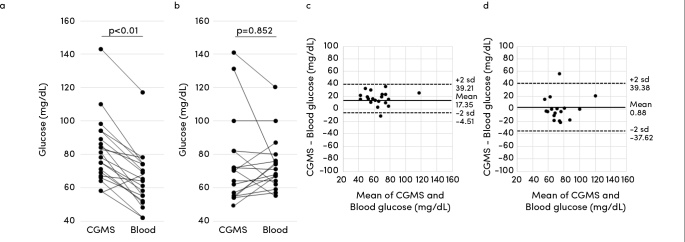
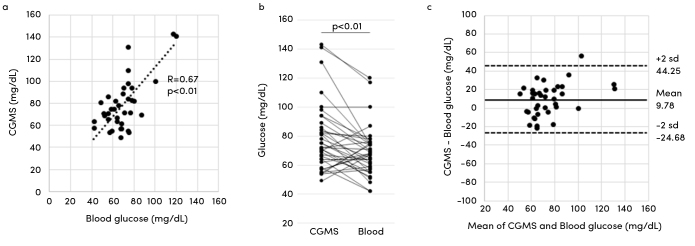
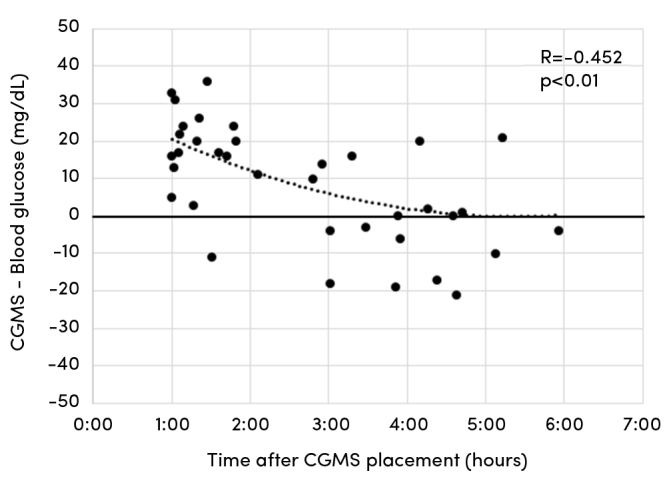
Factory-calibrated CGMS sensors were placed on 21 infants at risk of hypoglycemia after delivery. CGMS values were compared with blood glucose concentrations. Thirty-seven pairs of CGMS and blood glucose values were obtained. There was a good correlation between CGMS and blood glucose values (R=0.67, p<0.01) with a mean difference (2 standard deviations) of 9.78 (-24.68 to 44.25) mg/dL. The mean differences at <3 hours and ≥3 hours after sensor placement were 17.35 (-4.54 to 39.21) mg/dL and 0.88 (-37.62 to 39.38) mg/dL, respectively. CGMS values were significantly higher than blood glucose concentration at <3 hours after sensor placement (p<0.01), whereas no significant differences in glucose values were observed between the CGMS and blood glucose values at ≥3 hours after sensor placement (p=0.852).
The factory-calibrated CGMS was a safe and feasible modality for glucose monitoring. However, it has a tendency to overestimate the blood glucose concentrations. Therefore, this system should be used cautiously for neonates at risk of hypoglycemia, especially within 3 hours after sensor placement.
低血糖会增加新生儿出现不良神经学结局的风险。充分的血糖监测需要反复且痛苦的采血。我们旨在评估一种使用工厂校准传感器的连续血糖监测系统(CGMS)在改善新生儿血糖监测及减少采血频率方面的可行性和准确性。
开展一项方法学研究以调查CGMS值与血糖测量值之间的相关性。
产后将工厂校准的CGMS传感器置于21名有低血糖风险的婴儿身上。将CGMS值与血糖浓度进行比较。获得了37对CGMS值和血糖值。CGMS值与血糖值之间存在良好的相关性(R = 0.67,p < 0.01),平均差值(2个标准差)为9.78(-24.68至44.25)mg/dL。传感器放置后<3小时和≥3小时的平均差值分别为17.35(-4.54至39.21)mg/dL和0.88(-37.62至39.38)mg/dL。传感器放置后<3小时时CGMS值显著高于血糖浓度(p < 0.01),而传感器放置后≥3小时时CGMS值与血糖值之间未观察到显著差异(p = 0.852)。
工厂校准的CGMS是一种安全可行的血糖监测方式。然而,它有高估血糖浓度的倾向。因此,对于有低血糖风险的新生儿,尤其是在传感器放置后3小时内,应谨慎使用该系统。