Faculty of Veterinary Medicine, Department of Companion Animal Clinical Sciences, Norwegian University of Life Sciences, Ås, Norway.
Department of Biosciences, Centre for Ecological and Evolutionary Synthesis, University of Oslo, Oslo, Norway.
J Vet Intern Med. 2021 Sep;35(5):2177-2186. doi: 10.1111/jvim.16201. Epub 2021 Jul 21.
A severe form of acute hemorrhagic diarrhea syndrome (AHDS) occurred in dogs in the Oslo region of Norway during autumn 2019.
To characterize the fecal microbiota of dogs with AHDS during the outbreak and compare it to that of healthy dogs from the same period and before the outbreak.
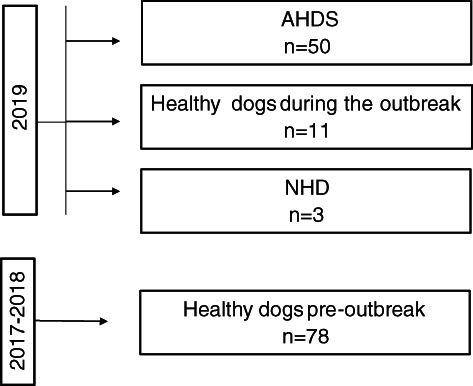
Dogs with AHDS (n = 50), dogs with nonhemorrhagic diarrhea (n = 3), and healthy dogs (n = 11) were sampled during the outbreak. In addition, 78 healthy dogs from the same region were sampled before the outbreak between 2017 and 2018.
Retrospective case-control study. The fecal microbiotas were characterized using 16S rRNA gene amplicon sequencing.
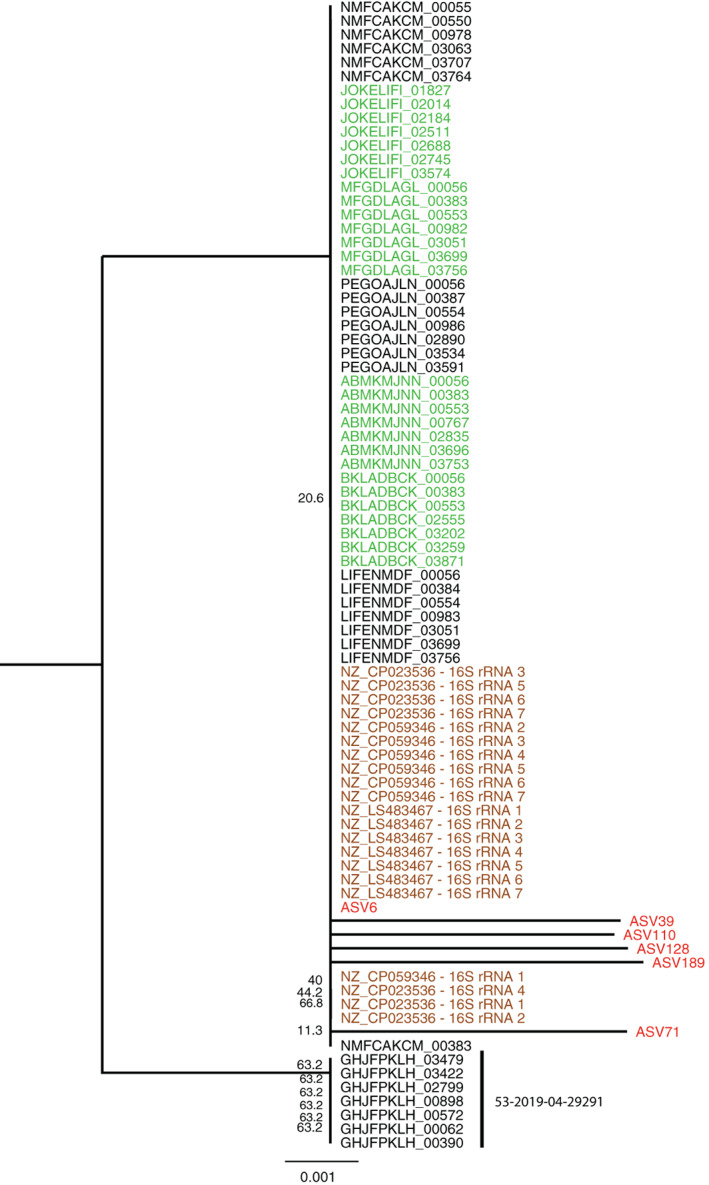
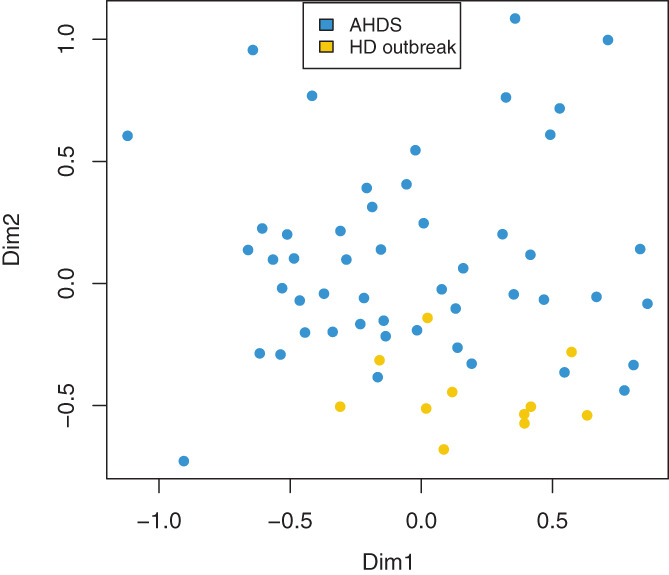
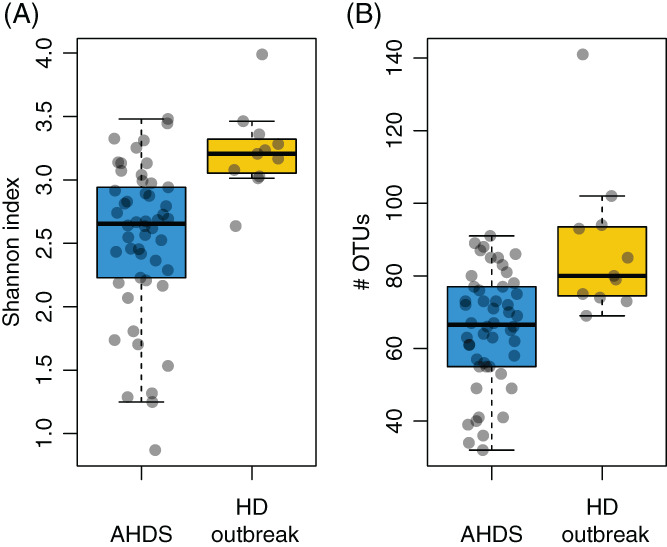
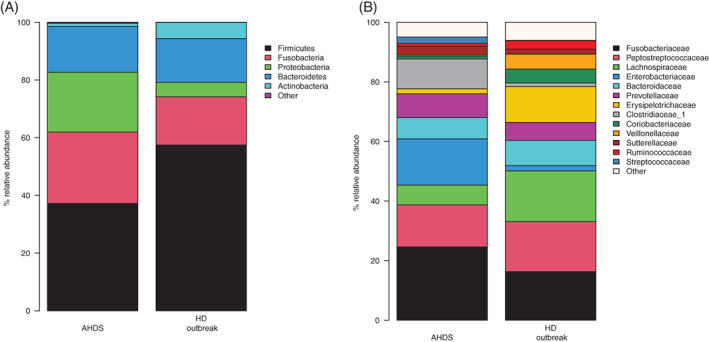
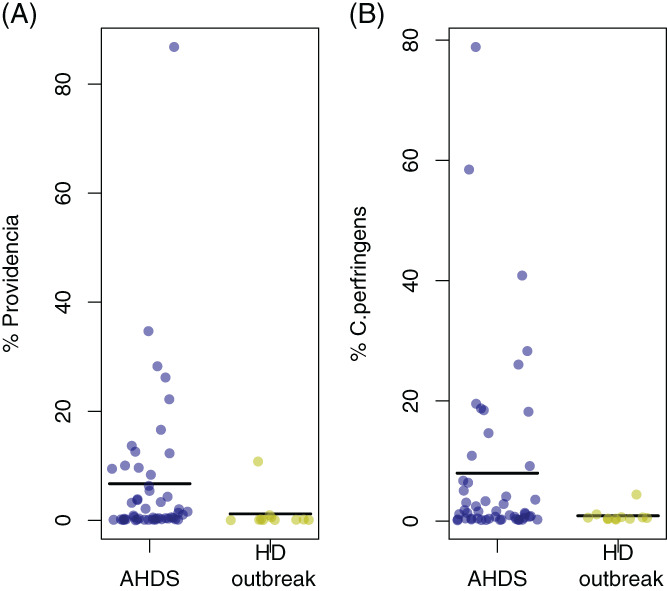
Dogs with AHDS had significantly different microbiota composition (R = .07, P < .001) and decreased intestinal diversity relative to healthy dogs from the outbreak period (median, 2.7; range, 0.9-3.5 vs median, 3.2; range, 2.6-4.0; P < .001). The microbiota in dogs with AHDS was characterized by a decrease of Firmicutes and an outgrowth of Proteobacteria, with increased numbers of Clostridium perfringens and Providencia spp. Among the Providencia spp., 1 showed 100% sequence identity with a Providencia alcalifaciens strain that was cultivated and isolated from the same outbreak. No Providencia spp. was found in healthy dogs sampled before the outbreak.
Dogs with AHDS had marked changes in fecal microbiota including increased numbers of Providencia spp. and C. perfringens, which may have contributed to the severity of this illness.
2019 年秋季,挪威奥斯陆地区的犬只发生了严重的急性出血性腹泻综合征(AHDS)。
描述暴发期间患有 AHDS 的犬的粪便微生物群,并将其与同期和暴发前的健康犬进行比较。
在暴发期间,对患有 AHDS 的犬(n=50)、患有非出血性腹泻的犬(n=3)和健康犬(n=11)进行了采样。此外,在暴发前的 2017 年至 2018 年期间,从同一地区采集了 78 只健康犬。
回顾性病例对照研究。使用 16S rRNA 基因扩增子测序对粪便微生物群进行了描述。
与暴发期间的健康犬相比,患有 AHDS 的犬的微生物群落组成存在显著差异(R=0.07,P<.001),且肠道多样性降低(中位数,2.7;范围,0.9-3.5 与中位数,3.2;范围,2.6-4.0;P<.001)。AHDS 犬的微生物群以厚壁菌门减少和变形菌门过度生长为特征,产芽孢梭菌和普罗威登斯菌属的数量增加。在普罗威登斯菌属中,有 1 株与从同一暴发中培养和分离的产碱普罗威登斯菌菌株具有 100%的序列同一性。在暴发前采集的健康犬中未发现普罗威登斯菌属。
患有 AHDS 的犬粪便微生物群发生了显著变化,包括普罗威登斯菌属和产芽孢梭菌的数量增加,这可能导致了该病的严重程度。