Wu XiaoQin, Zhang XinYue, Xun RenDe, Liu MengSi, Sun Zhen, Huang JianChao
Department of Neurosurgery, The First Affiliated Hospital, University of South China, Hengyang, China.
College of Integrated Chinese and Western Medicine, Affiliated Hospital of Traditional Chinese Medicine, Southwest Medical University, Luzhou, China.
Front Immunol. 2021 Jul 5;12:693200. doi: 10.3389/fimmu.2021.693200. eCollection 2021.
The efficacy and safety of chimeric antigen receptor T (CAR-T) cell therapy in the treatment of non-Hodgkin's lymphoma has already been demonstrated. However, patients with a history of/active secondary central nervous system (CNS) lymphoma were excluded from the licensing trials conducted on two widely used CAR-T cell products, Axicabtagene ciloleucel (Axi-cel) and Tisagenlecleucel (Tisa-cel). Hence, the objective of the present review was to assess whether secondary CNS lymphoma patients would derive a benefit from Axi-cel or Tisa-cel therapy, while maintaining controllable safety.
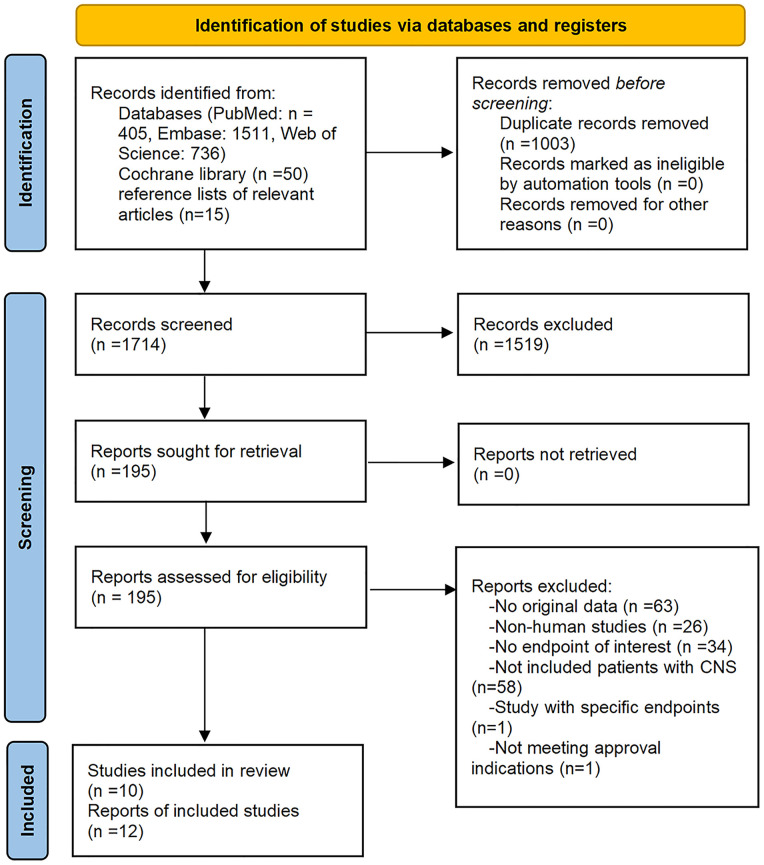
Two reviewers searched PubMed, Embase, Web of Science, and Cochrane library independently in order to identify all records associated with Axi-cel and Tisa-cel published prior to February 15, 2021. Studies that included secondary CNS lymphoma patients treated with Axi-cel and Tisa-cel and reported or could be inferred efficacy and safety endpoints of secondary CNS lymphoma patients were included. A tool designed specifically to evaluate the risk of bias in case series and reports and the ROBINS-I tool applied for cohort studies were used.
Ten studies involving forty-four patients were included. Of these, seven were case reports or series. The other three reports were cohort studies involving twenty-five patients. Current evidence indicates that secondary CNS lymphoma patients could achieve long-term remission following Axi-cel and Tisa-cel treatment. Compared with the non-CNS cohort, however, progression-free survival and overall survival tended to be shorter. This was possibly due to the relatively small size of the CNS cohort. The incidence and grades of adverse effects in secondary CNS lymphoma patients resembled those in the non-CNS cohort. No incidences of CAR-T cell-related deaths were reported. Nevertheless, the small sample size introduced a high risk of bias and prevented the identification of specific patients who could benefit more from CAR-T cell therapy.
Secondary CNS lymphoma patients could seem to benefit from both Axi-cel and Tisa-cel treatment, with controllable risks. Thus, CAR-T cell therapy has potential as a candidate treatment for lymphoma patients with CNS involvement. Further prospective studies with larger samples and longer follow-up periods are warranted and recommended.
嵌合抗原受体T(CAR-T)细胞疗法在治疗非霍奇金淋巴瘤方面的疗效和安全性已得到证实。然而,在对两种广泛使用的CAR-T细胞产品——阿基仑赛(Axicabtagene ciloleucel,Axi-cel)和替雷利珠单抗(Tisagenlecleucel,Tisa-cel)进行的上市许可试验中,有中枢神经系统(CNS)淋巴瘤病史/活动性继发性中枢神经系统淋巴瘤的患者被排除在外。因此,本综述的目的是评估继发性中枢神经系统淋巴瘤患者是否能从Axi-cel或Tisa-cel治疗中获益,同时保持安全性可控。
两名研究者独立检索了PubMed、Embase、Web of Science和Cochrane图书馆,以识别2021年2月15日前发表的所有与Axi-cel和Tisa-cel相关的记录。纳入的研究包括接受Axi-cel和Tisa-cel治疗的继发性中枢神经系统淋巴瘤患者,并报告或可推断继发性中枢神经系统淋巴瘤患者的疗效和安全性终点。使用专门设计用于评估病例系列和报告中偏倚风险的工具以及用于队列研究的ROBINS-I工具。
纳入了10项涉及44例患者的研究。其中,7项为病例报告或病例系列。其他3项报告为涉及25例患者的队列研究。目前的证据表明,继发性中枢神经系统淋巴瘤患者在接受Axi-cel和Tisa-cel治疗后可实现长期缓解。然而,与非中枢神经系统队列相比,无进展生存期和总生存期往往较短。这可能是由于中枢神经系统队列规模相对较小。继发性中枢神经系统淋巴瘤患者不良反应的发生率和分级与非中枢神经系统队列相似。未报告CAR-T细胞相关死亡病例。然而,样本量小带来了高偏倚风险,且无法识别出可能从CAR-T细胞疗法中获益更多的特定患者。
继发性中枢神经系统淋巴瘤患者似乎能从Axi-cel和Tisa-cel治疗中获益,且风险可控。因此,CAR-T细胞疗法有潜力作为中枢神经系统受累淋巴瘤患者的候选治疗方法。有必要且建议开展进一步的大样本、长期随访的前瞻性研究。