Biological and Health Sciences Division, State University of Ponta Grossa-UEPG, Ponta Grossa-PR, Brazil.
Braincare Desenvolvimento e Inovação Tecnológica S.A., São Carlos-SP, Brazil.
PLoS One. 2021 Jul 22;16(7):e0240570. doi: 10.1371/journal.pone.0240570. eCollection 2021.
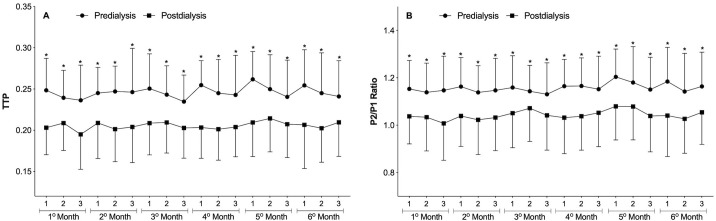
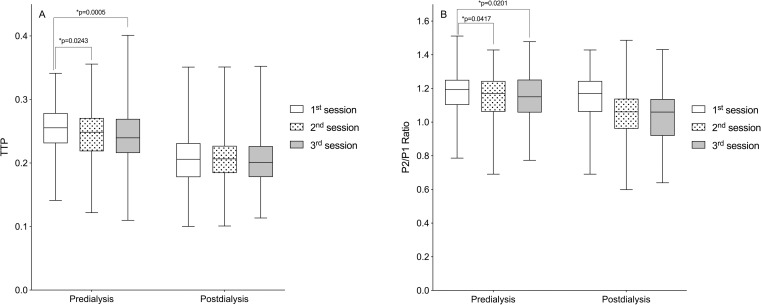
End-stage renal disease (ESRD) is treated mainly by hemodialysis, however, hemodialysis is associated with frequent complications, some of them involve the increased intracranial pressure. In this context, monitoring the intracranial pressure of these patients may lead to a better understanding of how intracranial pressure morphology varies with hemodialysis. This study aimed to follow-up patients with ESRD by monitoring intracranial pressure before and after hemodialysis sessions using a noninvasive method. We followed-up 42 patients with ESRD in hemodialysis, for six months. Noninvasive intracranial pressure monitoring data were obtained through analysis of intracranial pressure waveform morphology, this information was uploaded to Brain4care® cloud algorithm for analysis. The cloud automatically sends a report containing intracranial pressure parameters. In total, 4881 data points were collected during the six months of follow-up. The intracranial pressure parameters (time to peak and P2/P1 ratio) were significantly higher in predialysis when compared to postdialysis for the three weekly sessions and throughout the follow-up period (p<0.01) data showed general improvement in brain compliance after the hemodialysis session. Furthermore, intracranial pressure parameters were significantly higher in the first weekly hemodialysis session (p<0.05). In conclusion, there were significant differences between pre and postdialysis intracranial pressure in patients with ESRD on hemodialysis. Additionally, the pattern of the intracranial pressure alterations was consistent over time suggesting that hemodialysis can improve time to peak and P2/P1 ratio which may reflect in brain compliance.
终末期肾病(ESRD)主要通过血液透析治疗,然而,血液透析常伴有频繁的并发症,其中一些涉及颅内压升高。在这种情况下,监测这些患者的颅内压可能有助于更好地了解颅内压形态如何随血液透析而变化。本研究旨在通过非侵入性方法在血液透析前后监测 ESRD 患者的颅内压来随访这些患者。我们对 42 名接受血液透析的 ESRD 患者进行了为期六个月的随访。通过分析颅内压波形形态获得非侵入性颅内压监测数据,这些信息被上传到 Brain4care®云算法进行分析。云自动发送包含颅内压参数的报告。在六个月的随访期间共收集了 4881 个数据点。与透析后相比,在三次每周透析和整个随访期间,颅内压参数(波峰时间和 P2/P1 比值)在透析前明显更高(p<0.01),数据显示脑顺应性在血液透析后普遍改善。此外,在第一周的血液透析中,颅内压参数明显更高(p<0.05)。总之,血液透析的 ESRD 患者透析前后的颅内压存在显著差异。此外,颅内压变化模式随时间推移保持一致,表明血液透析可以改善波峰时间和 P2/P1 比值,这可能反映了脑顺应性的改善。